Comprehensive Guide to Solving First-Order Differential Equations
Understanding the Basics of Differential Equations
Introduction to Differential Equations and Their Solutions
A differential equation is a mathematical expression that relates a function with its derivatives. Typically, it involves an independent variable, often denoted as \( x \), and a dependent variable \( y = f(x) \), along with derivatives of \( y \) with respect to \( x \). The general form can be written as:
\[ \frac{dy}{dx} = g(x) \]
Here, the equation connects the rate of change of \( y \) to the variable \( x \). The goal of solving such an equation is to find the original function \( y \) that satisfies this relationship, eliminating the derivative.
For example, consider the differential equation:
\[ \frac{dy}{dx} = \cos x \]
Integrating both sides with respect to \( x \) gives the solution:
\[ y = \sin x + C \]
where \( C \) is an arbitrary constant. This solution is also called the primitive of the differential equation.
Example: Find the general solution of the differential equation \(\frac{dy}{dx} = 2x\).
Solution: Integrate both sides with respect to \( x \):
\[ y = \int 2x \, dx = x^2 + C \]
This represents the family of functions whose derivative is \( 2x \).
Separating Variables to Solve Differential Equations
Method of Variable Separation and Its Application
Some differential equations can be rearranged so that all terms involving the independent variable \( x \) and its differential \( dx \) are on one side, and all terms involving the dependent variable \( y \) and its differential \( dy \) are on the other. Such equations are called separable differential equations and can be expressed as:
\[ f(x) \, dx + g(y) \, dy = 0 \]
where \( f(x) \) and \( g(y) \) are functions of \( x \) and \( y \) respectively. By integrating both sides separately, the solution can be found.
Example: Solve the differential equation \(\frac{dy}{dx} = \frac{x^2 + 2}{y + 1}\).
Solution: Rearrange terms to separate variables:
\[ (y + 1) \, dy = (x^2 + 2) \, dx \]
Integrate both sides:
\[ \int (y + 1) \, dy = \int (x^2 + 2) \, dx \]
Calculating the integrals:
\[ \frac{y^2}{2} + y = \frac{x^3}{3} + 2x + C \]
This implicit equation represents the general solution.
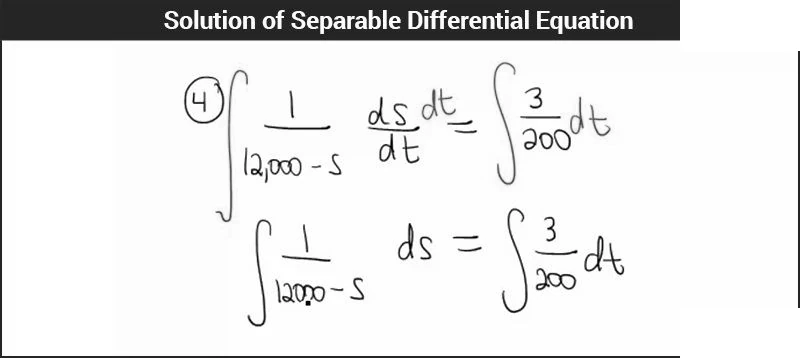
Solution of Separable Differential Equation
Practical Application: Exponential Growth in Velocity
Modeling Velocity Increase Using Differential Equations
Consider a scenario where an object’s velocity increases proportionally over time. This can be modeled by a differential equation where the rate of change of velocity \( v \) with respect to time \( t \) is proportional to the velocity itself:
\[ \frac{dv}{dt} = k v \]
where \( k \) is the proportionality constant. This is a separable differential equation and can be solved by separating variables.
Example: A cyclist starts at a velocity of 8 m/s and accelerates at a rate of 12% per second. How long will it take for the velocity to triple?
Solution: Let \( v \) be the velocity at time \( t \). The differential equation is:
\[ \frac{dv}{dt} = 0.12 v \]
Separate variables:
\[ \frac{1}{v} dv = 0.12 dt \]
Integrate both sides:
\[ \int \frac{1}{v} dv = \int 0.12 dt \implies \ln v = 0.12 t + C \]
Exponentiate to solve for \( v \):
\[ v = e^{0.12 t + C} = C_1 e^{0.12 t} \]
Using initial condition \( v = 8 \) at \( t = 0 \):
\[ 8 = C_1 e^{0} \implies C_1 = 8 \]
So,
\[ v = 8 e^{0.12 t} \]
To find \( t \) when \( v = 3 \times 8 = 24 \):
\[ 24 = 8 e^{0.12 t} \implies e^{0.12 t} = 3 \]
Taking natural logarithm:
\[ 0.12 t = \ln 3 \implies t = \frac{\ln 3}{0.12} \approx \frac{1.0986}{0.12} = 9.155 \text{ seconds} \]
Therefore, it takes approximately 9.16 seconds for the velocity to triple.
Exact Differential Equations and Their Resolution
Identifying and Solving Exact Equations
An exact differential equation is one where the expression can be written as the total differential of some function \( F(x,y) \). Consider the equation:
\[ M(x,y) \, dx + N(x,y) \, dy = 0 \]
If the condition
\[ \frac{\partial M}{\partial y} = \frac{\partial N}{\partial x} \]
is satisfied, the equation is exact. The solution is then given by \( F(x,y) = C \), where \( F \) is found by integrating \( M \) with respect to \( x \) and \( N \) with respect to \( y \).
Example: Solve the differential equation:
\[ (2xy + 3) \, dx + (x^2 + 4y^3) \, dy = 0 \]
Solution: First, check exactness:
\[ \frac{\partial M}{\partial y} = \frac{\partial}{\partial y} (2xy + 3) = 2x \]
\[ \frac{\partial N}{\partial x} = \frac{\partial}{\partial x} (x^2 + 4y^3) = 2x \]
Since both partial derivatives are equal, the equation is exact.
Integrate \( M \) with respect to \( x \):
\[ \int (2xy + 3) \, dx = x^2 y + 3x + h(y) \]
Differentiate this with respect to \( y \):
\[ \frac{\partial}{\partial y} (x^2 y + 3x + h(y)) = x^2 + h'(y) \]
Set equal to \( N \):
\[ x^2 + h'(y) = x^2 + 4y^3 \implies h'(y) = 4y^3 \]
Integrate \( h'(y) \):
\[ h(y) = y^4 + C \]
Therefore, the implicit solution is:
\[ x^2 y + 3x + y^4 = C \]
Quick Reference: Key Concepts and Formulas
Concept | Description | General Form |
|---|---|---|
Differential Equation | Equation involving derivatives of dependent variable | \( \frac{dy}{dx} = g(x,y) \) |
Separable Equation | Variables can be separated on opposite sides | \( f(x) dx + g(y) dy = 0 \) |
Exact Equation | Equation is total differential of some function | \( M dx + N dy = 0, \quad \frac{\partial M}{\partial y} = \frac{\partial N}{\partial x} \) |
General Solution | Function satisfying the differential equation | \( y = \int g(x) dx + C \) |
Exponential Growth Model | Rate proportional to current value | \( \frac{dv}{dt} = k v \implies v = C e^{kt} \) |
Glossary of Important Terms
Term | Definition |
|---|---|
Differential Equation | An equation involving derivatives of a function with respect to variables. |
Dependent Variable | The variable whose value depends on another variable, often \( y \). |
Independent Variable | The variable with respect to which differentiation is performed, often \( x \). |
Separable Equation | A differential equation where variables can be separated on different sides. |
Exact Equation | A differential equation that is the total differential of some function. |
Primitive | The original function obtained after integrating a derivative. |
Integration Constant | An arbitrary constant \( C \) added after integration. |
Partial Derivative | Derivative of a multivariable function with respect to one variable. |
Exponential Growth | Growth rate proportional to the current amount. |
Implicit Solution | A solution expressed as a relation between variables, not explicitly solved for one variable. |
Frequently Asked Questions
What defines a separable differential equation?
A separable differential equation is one where the variables and their differentials can be rearranged so that all terms involving one variable are on one side and the others on the opposite side, allowing separate integration.
How do you verify if a differential equation is exact?
Check if the partial derivative of \( M \) with respect to \( y \) equals the partial derivative of \( N \) with respect to \( x \) in the equation \( M dx + N dy = 0 \). If equal, the equation is exact.
What is the significance of the integration constant in solutions?
The integration constant represents the family of solutions differing by a constant, accounting for initial conditions or boundary values.
Can all first-order differential equations be solved by separation of variables?
No, only those equations where variables can be separated into distinct sides are solvable by this method. Others require different techniques.
How is exponential growth modeled using differential equations?
Exponential growth is modeled by the equation \( \frac{dv}{dt} = k v \), where the rate of change is proportional to the current value, leading to solutions of the form \( v = C e^{kt} \).