Comprehensive Guide to Matrix Inverses and Their Applications
Understanding the Concept of Matrix and Its Inverse
Fundamentals of Matrices and Their Inverses
A matrix is an organized array of elements arranged systematically in rows and columns. The size or order of a matrix is expressed as the number of rows followed by the number of columns, such as \(2 \times 2\), \(3 \times 3\), and so forth. Only square matrices, where the number of rows equals the number of columns, can have an inverse matrix.
The inverse of a matrix \(A\), denoted as \(A^{-1}\), is a matrix that when multiplied with \(A\) results in the identity matrix \(I\). This relationship is expressed as:
\[ AA^{-1} = A^{-1}A = I \]
The identity matrix acts like the number 1 in matrix multiplication, having 1s on the diagonal and 0s elsewhere.
For a matrix to have an inverse, it must be non-singular, meaning its determinant is not zero. The determinant for a \(2 \times 2\) matrix \(A = \begin{bmatrix} a & b \\ c & d \end{bmatrix}\) is calculated as \(ad - bc\). If this value equals zero, the inverse does not exist.
Techniques to Calculate the Inverse of a Matrix
Method 1: Using the Determinant and Adjugate for 2×2 Matrices
This straightforward approach applies to \(2 \times 2\) matrices. The inverse is found by swapping the elements on the main diagonal, changing the signs of the off-diagonal elements, and dividing by the determinant.
For matrix \(A = \begin{bmatrix} a & b \\ c & d \end{bmatrix}\), the inverse is:
\[ A^{-1} = \frac{1}{ad - bc} \begin{bmatrix} d & -b \\ -c & a \end{bmatrix} \]
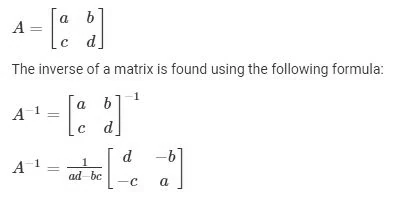
Formula for the inverse of a 2 × 2 matrix
For larger matrices like \(3 \times 3\), the process involves calculating the determinant and cofactors, which is more complex but follows the same principle.
Method 2: Utilizing Minors, Cofactors, and the Adjoint Matrix
This method is applicable to square matrices of any order. It involves the following steps:
Calculate the determinant of the matrix to ensure it is non-zero.
Find the minor matrices by removing the row and column of each element.
Determine the cofactor matrix by applying signs to the minors.
Transpose the cofactor matrix to obtain the adjoint matrix.
Divide the adjoint matrix by the determinant to get the inverse.
The formula is:
\[ A^{-1} = \frac{\text{adj}(A)}{\det(A)} \]
Where \(\text{adj}(A)\) is the adjoint of matrix \(A\), and \(\det(A)\) is its determinant.
Method 3: Finding the Inverse via Elementary Row Operations
This approach transforms the original matrix into the identity matrix by applying a series of elementary row operations. Simultaneously, these operations are applied to an identity matrix to obtain the inverse.
To find \(A^{-1}\) using this method:
Write the augmented matrix \([A | I]\), where \(I\) is the identity matrix of the same order as \(A\).
Perform row operations to convert \(A\) into \(I\).
The transformed identity matrix on the right side becomes \(A^{-1}\).
This method is especially useful for larger matrices or when computational tools are used.
Applying Formulas and Examples for Matrix Inversion
Formula for Inverse of 2×2 and 3×3 Matrices
The inverse of a \(2 \times 2\) matrix \(A = \begin{bmatrix} a & b \\ c & d \end{bmatrix}\) is given by:
\[ A^{-1} = \frac{1}{ad - bc} \begin{bmatrix} d & -b \\ -c & a \end{bmatrix} \]
For a \(3 \times 3\) matrix \(A = \begin{bmatrix} a_{11} & a_{12} & a_{13} \\ a_{21} & a_{22} & a_{23} \\ a_{31} & a_{32} & a_{33} \end{bmatrix}\), the inverse is calculated by:
\[ A^{-1} = \frac{1}{\det(A)} \text{adj}(A) \]
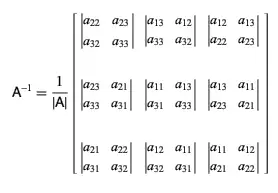
This inverse is useful for solving systems of equations and other applications in math and science.
Inverse matrix formula for 3 × 3 matrices
Example: Calculating the Inverse of a 2×2 Matrix
Find the inverse of matrix \(B = \begin{bmatrix} 4 & 7 \\ 2 & 5 \end{bmatrix}\).
Step 1: Calculate the determinant:
\[ \det(B) = (4)(5) - (7)(2) = 20 - 14 = 6 \]
Step 2: Apply the inverse formula:
\[ B^{-1} = \frac{1}{6} \begin{bmatrix} 5 & -7 \\ -2 & 4 \end{bmatrix} = \begin{bmatrix} \frac{5}{6} & -\frac{7}{6} \\ -\frac{1}{3} & \frac{2}{3} \end{bmatrix} \]
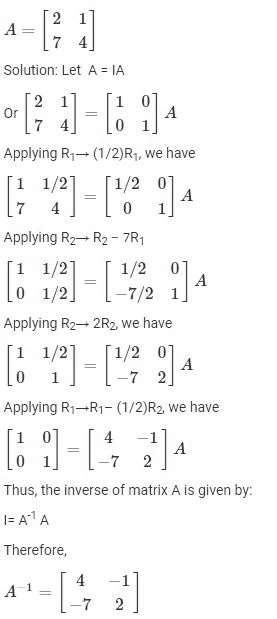
Stepwise inverse calculation of a 2 × 2 matrix
Example: Finding the Inverse of a 3×3 Matrix
Determine the inverse of matrix \(C = \begin{bmatrix} 2 & 0 & 1 \\ 3 & 0 & 0 \\ 5 & 1 & 1 \end{bmatrix}\).
Step 1: Compute the determinant of \(C\).
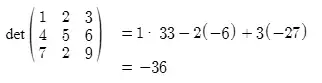
Determinant calculation for matrix \(C\)
Step 2: Calculate minors for each element.
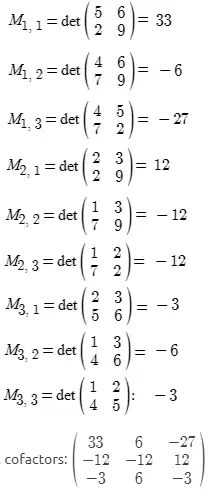
Minors of matrix \(C\)
Step 3: Find the cofactor matrix and then transpose it to get the adjoint.
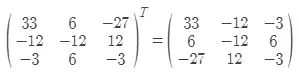
Adjoint matrix of \(C\)
Step 4: Calculate the inverse by dividing the adjoint by the determinant.
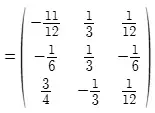
Inverse matrix \(C^{-1}\)
Key Characteristics and Properties of Inverse Matrices
Essential Properties to Remember
If \(A\) is invertible, then the inverse of its inverse is the original matrix: \((A^{-1})^{-1} = A\).
The product of two invertible matrices \(A\) and \(B\) is invertible, and \((AB)^{-1} = B^{-1} A^{-1}\).
The inverse of the transpose of \(A\) equals the transpose of the inverse: \((A^T)^{-1} = (A^{-1})^T\).
Multiplying a matrix by its inverse yields the identity matrix: \(AA^{-1} = A^{-1}A = I_n\), where \(I_n\) is the identity matrix of order \(n\).
Practice Exercises to Reinforce Matrix Inversion Skills
Exercise 1: Inverse of a 3×3 Matrix
Calculate the inverse of the matrix:
\[ A = \begin{bmatrix} 2 & 3 & 1 \\ 4 & -1 & 2 \\ 1 & 0 & 1 \end{bmatrix} \]
Exercise 2: Using Elementary Row Operations
Find the inverse of the matrix by applying elementary row transformations:
\[ B = \begin{bmatrix} 1 & 0 & 2 \\ 0 & 1 & 3 \\ 4 & 0 & 1 \end{bmatrix} \]
Exercise 3: Inverse of a 2×2 Matrix
Determine the inverse of the matrix:
\[ C = \begin{bmatrix} 5 & 8 \\ 3 & 7 \end{bmatrix} \]
Exam Tip: Always verify that the determinant is non-zero before attempting to find the inverse. If the determinant equals zero, the matrix is singular and does not have an inverse.
Quick Reference: Summary of Matrix Inverse Concepts
Concept | Details |
|---|---|
Matrix Order | Number of rows × number of columns (e.g., \(3 \times 3\)) |
Invertible Matrix | Square matrix with non-zero determinant |
Determinant of 2×2 Matrix | \(ad - bc\) for \( \begin{bmatrix} a & b \\ c & d \end{bmatrix} \) |
Inverse Formula (2×2) | \(A^{-1} = \frac{1}{ad - bc} \begin{bmatrix} d & -b \\ -c & a \end{bmatrix}\) |
Inverse Formula (3×3) | \(A^{-1} = \frac{1}{\det(A)} \text{adj}(A)\) |
Adjoint Matrix | Transpose of the cofactor matrix |
Elementary Row Operations | Used to transform matrix into identity to find inverse |
Identity Matrix | Matrix with 1s on diagonal and 0s elsewhere |
Property of Inverse | \((AB)^{-1} = B^{-1} A^{-1}\) |
Non-Invertible Matrix | Matrix with determinant zero (singular matrix) |
Glossary of Key Terms
Term | Definition |
|---|---|
Matrix | A rectangular array of numbers arranged in rows and columns. |
Square Matrix | A matrix with the same number of rows and columns. |
Determinant | A scalar value that can be computed from the elements of a square matrix. |
Inverse Matrix | A matrix which, when multiplied with the original matrix, yields the identity matrix. |
Identity Matrix | A square matrix with 1s on the diagonal and 0s elsewhere. |
Adjoint Matrix | The transpose of the cofactor matrix of a given matrix. |
Cofactor | Signed minor of an element in a matrix. |
Minor | The determinant of the submatrix formed by deleting one row and one column. |
Singular Matrix | A matrix with zero determinant, which does not have an inverse. |
Elementary Row Operations | Operations used to manipulate matrices, such as row swapping, scaling, and addition. |
Frequently Asked Questions (FAQs)
What does the inverse of a matrix represent?
The inverse of a matrix is a matrix that, when multiplied with the original matrix, results in the identity matrix, effectively acting as the reciprocal in matrix multiplication.
How can I find the inverse of a 3×3 matrix?
First, calculate the determinant to ensure it is non-zero. Then find the matrix of cofactors, transpose it to get the adjoint, and finally divide by the determinant.
Is the adjoint matrix the same as the inverse matrix?
No, the adjoint matrix is the transpose of the cofactor matrix. The inverse is obtained by dividing the adjoint by the determinant of the original matrix.
How do I know if a matrix has an inverse?
If the determinant of the matrix is not zero, the matrix is invertible; otherwise, it is singular and does not have an inverse.
What are some important properties of inverse matrices?
Key properties include: the inverse of an inverse is the original matrix, the inverse of a product is the product of inverses in reverse order, and the inverse of a transpose is the transpose of the inverse.