Comprehensive Guide to Determinants and Their Properties
Fundamentals of Determinants and Their Calculation
Understanding the Concept and Basic Computation
Determinants are scalar values derived from square matrices, representing a unique number associated with the matrix elements arranged in rows and columns. For a matrix of order \( n \), the determinant is a single value calculated from its \( n \times n \) elements. The determinant of a 1x1 matrix is simply the element itself.
For a 2x2 matrix, given by
\[ A = \begin{bmatrix} a & b \\ c & d \end{bmatrix}, \]
the determinant is computed as \( ad - bc \).
Extending to a 3x3 matrix,
\[ A = \begin{bmatrix} a & b & c \\ d & e & f \\ g & h & i \end{bmatrix}, \]
the determinant is evaluated using the formula:
\[ \det(A) = a(ei - fh) - b(di - fg) + c(dh - eg). \]
Each determinant is a square arrangement, with rows running horizontally and columns vertically. The total number of elements in a determinant of order \( n \) is \( n^2 \).
Example: Calculate the determinant of a 3x3 matrix
Find the determinant of
\[ \begin{vmatrix} 4 & 1 & 3 \\ 2 & 0 & 5 \\ 7 & 6 & 1 \end{vmatrix}. \]
Solution:
Using the formula,
\[ \det = 4(0 \times 1 - 5 \times 6) - 1(2 \times 1 - 5 \times 7) + 3(2 \times 6 - 0 \times 7) \]
\[ = 4(0 - 30) - 1(2 - 35) + 3(12 - 0) = 4(-30) - 1(-33) + 3(12) = -120 + 33 + 36 = -51. \]
Techniques for Expanding Determinants and Their Special Types
Applying the Sarrus Rule and Exploring Symmetry in Determinants
The Sarrus method offers a straightforward approach to calculate the determinant of a 3x3 matrix by summing the products of diagonals from left to right and subtracting the products of diagonals from right to left.
For matrix
\[ \begin{vmatrix} a_{11} & a_{12} & a_{13} \\ a_{21} & a_{22} & a_{23} \\ a_{31} & a_{32} & a_{33} \end{vmatrix}, \]
the determinant is
\[ \Delta = (a_{11}a_{22}a_{33} + a_{12}a_{23}a_{31} + a_{13}a_{21}a_{32}) - (a_{13}a_{22}a_{31} + a_{11}a_{23}a_{32} + a_{12}a_{21}a_{33}). \]
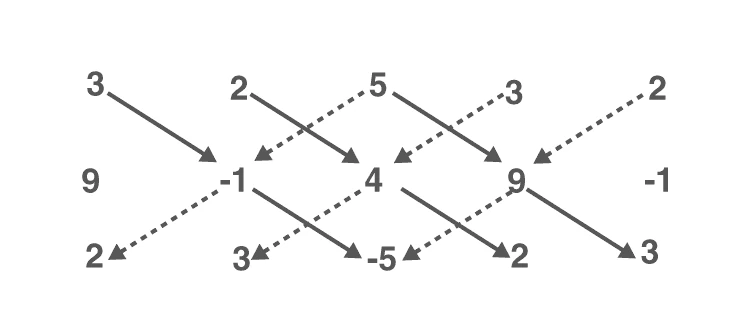
Visual representation of a 3x3 matrix for Sarrus expansion
Example: Use Sarrus rule to find the determinant
Calculate the determinant of
\[ \begin{vmatrix} 3 & 2 & 5 \\ 7 & -1 & 4 \\ 1 & 3 & -2 \end{vmatrix}. \]
Solution:
Applying the Sarrus formula,
\[ \Delta = (3 \times -1 \times -2) + (2 \times 4 \times 1) + (5 \times 7 \times 3) - (5 \times -1 \times 1) - (3 \times 4 \times 3) - (2 \times 7 \times -2) \]
\[ = (6) + (8) + (105) - (-5) - (36) - (-28) = 6 + 8 + 105 + 5 - 36 + 28 = 116. \]
Characteristics of Symmetric and Skew-Symmetric Determinants
A determinant is termed symmetrical if the matrix elements satisfy \( a_{ij} = a_{ji} \) for all \( i, j \). This means the matrix is equal to its transpose.
Example of a symmetric determinant:
\[ \begin{vmatrix} a & h & g \\ h & b & f \\ g & f & c \end{vmatrix}. \]
Conversely, a determinant is skew-symmetric if \( a_{ij} = -a_{ji} \) for every element, implying the matrix is the negative of its transpose.
Example of a skew-symmetric determinant:
\[ \begin{vmatrix} 0 & 3 & -1 \\ -3 & 0 & 5 \\ 1 & -5 & 0 \end{vmatrix}. \]
Note:
If the determinant of matrix \( A \) is zero, \( \det(A) = 0 \), then \( A \) is called a singular matrix.
If \( \det(A) \neq 0 \), then \( A \) is non-singular.
Multiplying Determinants and Advanced Applications
Rules for Multiplying Determinants of Same Order
Multiplying two determinants of the same order involves a row-to-column multiplication approach. For two 2x2 determinants,
\[ \begin{vmatrix} a_1 & b_1 \\ a_2 & b_2 \end{vmatrix} \times \begin{vmatrix} l_1 & m_1 \\ l_2 & m_2 \end{vmatrix} = \begin{vmatrix} a_1 l_1 + b_1 l_2 & a_1 m_1 + b_1 m_2 \\ a_2 l_1 + b_2 l_2 & a_2 m_1 + b_2 m_2 \end{vmatrix}. \]
For two 3x3 determinants, the product is given by:
\[ \begin{vmatrix} a_1 & b_1 & c_1 \\ a_2 & b_2 & c_2 \\ a_3 & b_3 & c_3 \end{vmatrix} \times \begin{vmatrix} l_1 & m_1 & n_1 \\ l_2 & m_2 & n_2 \\ l_3 & m_3 & n_3 \end{vmatrix} = \begin{vmatrix} a_1 l_1 + b_1 l_2 + c_1 l_3 & a_1 m_1 + b_1 m_2 + c_1 m_3 & a_1 n_1 + b_1 n_2 + c_1 n_3 \\ a_2 l_1 + b_2 l_2 + c_2 l_3 & a_2 m_1 + b_2 m_2 + c_2 m_3 & a_2 n_1 + b_2 n_2 + c_2 n_3 \\ a_3 l_1 + b_3 l_2 + c_3 l_3 & a_3 m_1 + b_3 m_2 + c_3 m_3 & a_3 n_1 + b_3 n_2 + c_3 n_3 \end{vmatrix}. \]
Important points:
The determinants must be of identical order.
To find the element in the \( m \)-th row and \( n \)-th column of the product, multiply the \( m \)-th row of the first determinant by the \( n \)-th column of the second determinant and sum the products.
This method aligns with the standard row-by-column multiplication of matrices.
If \( \Delta' \) is the determinant formed by replacing each element of \( \Delta \) with its cofactor, then \( \Delta' = \Delta^{n-1} \). This \( \Delta' \) is called the reciprocal determinant.
Example: Simplify the square of a determinant
Reduce the power of the determinant
\[ \left| \begin{matrix} 0 & p & q \\ p & 0 & r \\ q & r & 0 \end{matrix} \right|^2 \]
to a single determinant.
Solution:
Multiplying the determinant by itself,
\[ \left| \begin{matrix} 0 & p & q \\ p & 0 & r \\ q & r & 0 \end{matrix} \right|^2 = \left| \begin{matrix} 0 & p & q \\ p & 0 & r \\ q & r & 0 \end{matrix} \right| \times \left| \begin{matrix} 0 & p & q \\ p & 0 & r \\ q & r & 0 \end{matrix} \right|. \]
Using the multiplication rule, the product equals
\[ \left| \begin{matrix} p^2 + q^2 & pr & pq \\ rp & q^2 + r^2 & qr \\ qp & rq & p^2 + r^2 \end{matrix} \right|. \]
Summary of Key Determinant Properties and Formulas
Property | Description |
|---|---|
Transpose Invariance | The determinant remains unchanged when rows and columns are interchanged: \( |A^T| = |A| \). |
Row/Column Swap | Swapping two rows or columns changes the sign of the determinant. |
Duplicate Rows/Columns | If any two rows or columns are identical, the determinant is zero. |
Scalar Multiplication | Multiplying a row or column by scalar \( k \) multiplies the determinant by \( k \). |
Linearity | If elements of a row or column are sums, the determinant is the sum of determinants with those elements separated. |
Order and Elements | A determinant of order \( n \) has \( n^2 \) elements arranged in a square matrix. |
Singular Matrix | Matrix with determinant zero is singular and non-invertible. |
Non-singular Matrix | Matrix with non-zero determinant is invertible. |
Reciprocal Determinant | Determinant formed by cofactors equals \( \Delta^{n-1} \). |
Multiplication Rule | Product of two determinants equals determinant of product matrix using row-column multiplication. |
Glossary of Essential Terms
Term | Definition |
|---|---|
Determinant | A scalar value computed from a square matrix representing certain properties of the matrix. |
Matrix | A rectangular array of numbers arranged in rows and columns. |
Order | The number of rows or columns in a square matrix. |
Singular Matrix | A matrix with determinant zero, not invertible. |
Non-singular Matrix | A matrix with non-zero determinant, invertible. |
Transpose | A matrix obtained by interchanging rows and columns. |
Symmetric Matrix | A matrix equal to its transpose, \( a_{ij} = a_{ji} \). |
Skew-Symmetric Matrix | A matrix where \( a_{ij} = -a_{ji} \) and diagonal elements are zero. |
Cofactor | The signed minor of an element used in determinant expansion. |
Sarrus Rule | A method to calculate 3x3 determinants using diagonals. |
Frequently Asked Questions on Determinants
What is the determinant of an identity matrix?
The determinant of an identity matrix of any order is always 1.
Can determinants be negative?
Yes, determinants can be positive, negative, or zero depending on the matrix elements.
How are determinants used in solving linear equations?
Determinants help solve systems of linear equations using Cramer's rule for two or three variables.
What happens if two rows or columns of a matrix are identical?
The determinant becomes zero if any two rows or columns are the same.
Does the determinant change when the matrix is transposed?
No, the determinant remains the same after transposing the matrix.