Understanding Continuity in Functions
Fundamentals of Continuity in Mathematical Functions
Conceptualizing Continuity and Its Criteria
A function is said to be continuous at a particular point if its value changes smoothly without any abrupt jumps or breaks. In simpler terms, if you can sketch the function around that point without lifting your pen, the function is continuous there. This means small changes in the input produce small changes in the output.
Formally, for a function \( f \) defined on a subset of real numbers, continuity at a point \( c \) requires that the left-hand limit, right-hand limit, and the function's value at \( c \) all exist and are equal:
\[ \lim_{x \to c^-} f(x) = \lim_{x \to c^+} f(x) = f(c) \]
If these conditions fail, the function is discontinuous at \( c \), and \( c \) is called a point of discontinuity.
Extending this idea, a function is continuous on an interval if it is continuous at every point within that interval, including the endpoints if the interval is closed.
To summarize, the three essential conditions for continuity at \( x = a \) are:
- The function \( f \) must be defined at \( a \), i.e., \( f(a) \) exists.
- The limit \( \lim_{x \to a} f(x) \) must exist.
- The value of the function at \( a \) must equal the limit, i.e., \( f(a) = \lim_{x \to a} f(x) \).
Example 1: Verifying Continuity of a Linear Function
Check if the function \( f(x) = 4x - 1 \) is continuous at \( x = 2 \).
Solution:
First, evaluate the function at \( x = 2 \):
\[ f(2) = 4(2) - 1 = 8 - 1 = 7 \]
Next, find the limit as \( x \) approaches 2:
\[ \lim_{x \to 2} f(x) = \lim_{x \to 2} (4x - 1) = 4(2) - 1 = 7 \]
Since \( f(2) \) exists and equals the limit, the function is continuous at \( x = 2 \).
Analyzing Discontinuities Through Piecewise Functions
Examining Continuity in Different Intervals
Functions defined by different expressions over various intervals may exhibit discontinuities at the points where the definition changes. To determine continuity at such points, we compare the left-hand and right-hand limits with the function's value.
Consider a function defined as:
\[ f(x) = \begin{cases} x + 3, & x < 2 \\ 5, & x = 2 \\ x - 1, & x > 2 \end{cases} \]
To check continuity at \( x = 2 \), we evaluate the left-hand limit (LHL), right-hand limit (RHL), and the function value:
\[ \text{LHL} = \lim_{x \to 2^-} f(x) = 2 + 3 = 5 \]
\[ \text{RHL} = \lim_{x \to 2^+} f(x) = 2 - 1 = 1 \]
\[ f(2) = 5 \]
Since LHL \( \neq \) RHL, the function is discontinuous at \( x = 2 \).
Example 2: Identifying Discontinuity in a Piecewise Function
Determine if the function below is continuous at \( x = 3 \):
\[ g(x) = \begin{cases} 2x + 1, & x < 3 \\ 7, & x = 3 \\ x - 2, & x > 3 \end{cases} \]
Solution:
Calculate the left-hand limit:
\[ \lim_{x \to 3^-} g(x) = 2(3) + 1 = 7 \]
Calculate the right-hand limit:
\[ \lim_{x \to 3^+} g(x) = 3 - 2 = 1 \]
Function value at \( x = 3 \):
\[ g(3) = 7 \]
Since the left and right limits differ, \( g \) is not continuous at \( x = 3 \).
Visualizing Continuity with Graphical Representations
Interpreting Graphs to Detect Continuity
Graphs provide an intuitive way to understand whether a function is continuous. A continuous function's graph can be drawn without lifting the pen, while discontinuities appear as breaks, jumps, or holes.
For instance, the graph of the piecewise function from the previous example shows a jump at \( x = 2 \), indicating discontinuity.
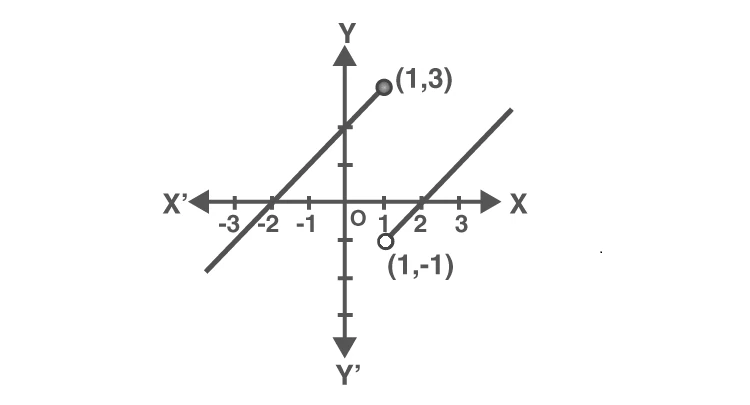
Example 3: Graphical Identification of Continuity
Examine the graph of a function that is continuous everywhere except at \( x = 1 \), where a jump occurs.
Explanation:
- The graph is unbroken for all \( x \neq 1 \).
- At \( x = 1 \), the graph shows a sudden jump, indicating the left and right limits differ.
- This confirms the function is discontinuous at \( x = 1 \).
Summary of Key Points on Continuity
| Aspect | Description |
|---|---|
| Continuity at a Point | Function value and both one-sided limits exist and are equal at that point. |
| Discontinuity | Occurs when the above condition fails; types include jump, removable, and infinite discontinuities. |
| Continuity on Interval | Function is continuous at every point within the interval, including endpoints if closed. |
| Left-Hand Limit (LHL) | Limit of function as input approaches from the left side. |
| Right-Hand Limit (RHL) | Limit of function as input approaches from the right side. |
| Function Value | Actual value of the function at the point of interest. |
| Continuous Function Graph | Graph can be drawn without lifting the pen. |
| Discontinuous Function Graph | Graph shows breaks, jumps, or holes. |
| Piecewise Functions | May have discontinuities at points where the definition changes. |
| Singleton Domain | A function defined at only one point is trivially continuous there. |
Glossary of Important Terms
| Term | Definition |
|---|---|
| Continuity | Property of a function having no breaks or jumps at a point. |
| Discontinuity | A point where a function is not continuous. |
| Limit | The value a function approaches as the input approaches a point. |
| Left-Hand Limit (LHL) | Limit of a function as the input approaches from the left side. |
| Right-Hand Limit (RHL) | Limit of a function as the input approaches from the right side. |
| Point of Discontinuity | A specific input value where the function is discontinuous. |
| Piecewise Function | A function defined by different expressions over different intervals. |
| Singleton Domain | A domain consisting of a single point. |
| Continuous Interval | An interval where the function is continuous at every point. |
| Function Value | The output of a function at a specific input. |
Frequently Asked Questions
What does it mean for a function to be continuous at a point?
A function is continuous at a point if the function's value and the limits from both sides exist and are equal at that point.
How can I check if a piecewise function is continuous at the boundary?
Evaluate the left-hand limit, right-hand limit, and the function's value at the boundary point. If all three are equal, the function is continuous there.
Can a function be continuous if it is only defined at one point?
Yes, a function defined at a single point is considered continuous at that point.
What types of discontinuities can occur in functions?
Common types include jump discontinuities, removable discontinuities, and infinite discontinuities.
Why is the graph useful in understanding continuity?
Graphs visually reveal breaks or jumps in a function, making it easier to identify points of discontinuity.