Comprehensive Guide to Polymerization Processes and Types
Fundamentals of Polymer Formation
Understanding the Polymerization Process
Polymerization is a chemical reaction where numerous small molecules called monomers chemically bond to create large macromolecules known as polymers. These macromolecules can exhibit various architectures such as linear chains, branched structures, or intricate three-dimensional networks. The nature of the polymer depends on the type of polymerization reaction and the monomers involved.
There are several polymerization mechanisms, with the primary categories being step-growth polymerization, chain-growth polymerization (both classified under addition polymerization), and condensation polymerization. Each mechanism differs in how monomers link and how the polymer chains grow.
For example, the polymerization of styrene monomers results in polystyrene, a widely used plastic. This transformation involves the repeated addition of styrene units to form a long polymer chain.
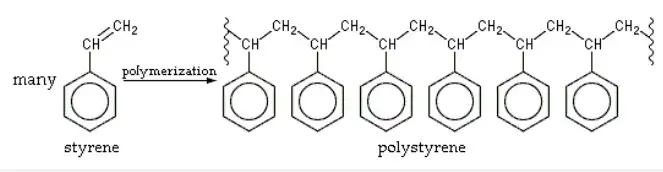
Illustration of Styrene Monomers Polymerizing into Polystyrene
Example Problem
Calculate the number of monomer units in a polymer chain if the molecular weight of the polymer is 50,000 g/mol and the molecular weight of the monomer unit is 100 g/mol.
Solution:
The degree of polymerization \( n \) is given by:
\[ n = \frac{\text{Molecular weight of polymer}}{\text{Molecular weight of monomer}} = \frac{50000}{100} = 500 \]
Therefore, the polymer chain consists of 500 repeating monomer units.
Mechanisms Behind Polymer Chain Growth
Step-Growth Polymerization Explained
In step-growth polymerization, polymer chains form through reactions between functional groups of monomers or oligomers. Unlike chain-growth, any two molecular species can react, leading to gradual growth of molecular weight. This process is typically slower, with molecular weight increasing steadily over time.
Condensation polymerization is a common example where each step releases a small molecule such as water or hydrogen chloride as a byproduct. This mechanism is prevalent in forming polyamides and polyesters.
Example Problem
During the condensation polymerization of a diacid and a diamine, water is released as a byproduct. If 0.5 moles of water are produced, how many moles of amide linkages are formed?
Solution:
Each amide linkage formation releases one molecule of water. Therefore, the moles of amide linkages formed equals the moles of water released:
\[ \text{Moles of amide linkages} = 0.5 \text{ moles} \]
Condensation Polymerization and Its Variants
Condensation polymerization involves joining monomers with the simultaneous elimination of small molecules like water or HCl. This reaction type is essential for synthesizing polymers such as polyamides (nylons), polyesters, and phenol-formaldehyde resins.
For instance, Nylon 66 is produced by condensing hexamethylenediamine with adipic acid under high temperature and pressure, forming amide bonds and releasing water molecules.
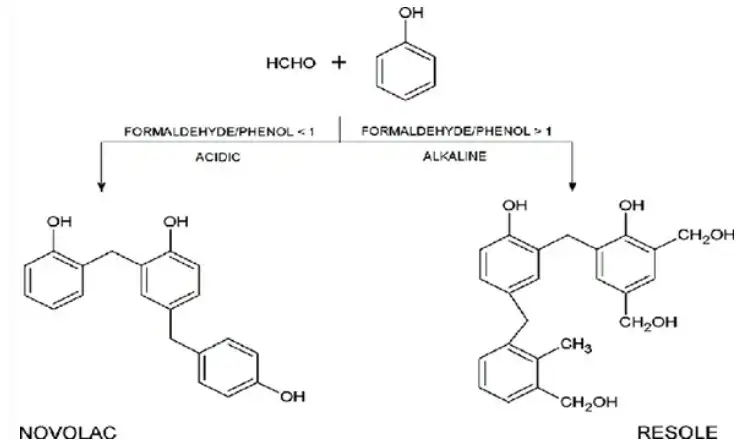
Condensation Polymerization Process Illustration
Example Problem
Calculate the mass of water released when 1 mole of Nylon 6 is formed by polymerizing caprolactam.
Solution:
Each polymerization step releases one mole of water. The molar mass of water is 18 g/mol.
\[ \text{Mass of water} = 1 \times 18 = 18 \text{ g} \]
Chain-Growth Polymerization and Free Radical Mechanism
Chain-growth polymerization involves the rapid addition of monomer units to an active site on a growing polymer chain. This process typically proceeds via free radicals, cations, or anions. The free radical mechanism is common for polymerizing alkenes like ethylene.
The polymerization of ethylene to polyethylene involves three stages: initiation (formation of free radicals), propagation (growth of polymer chain by successive monomer addition), and termination (ending the chain growth).
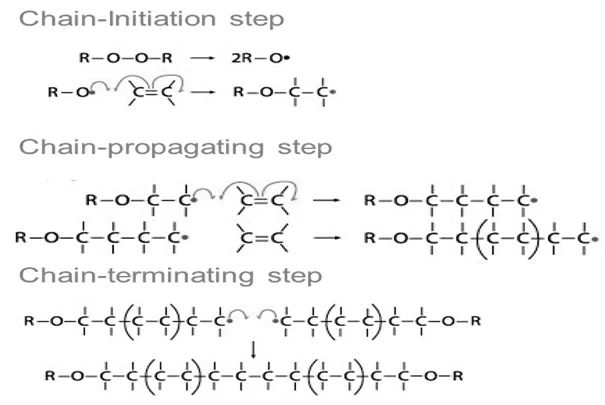
Stages of Free Radical Polymerization
Example Problem
In a free radical polymerization, if the initiation step produces 0.01 moles of radicals and each radical adds 1000 monomer units before termination, calculate the total moles of polymer formed.
Solution:
Total moles of polymer chains formed equals the moles of radicals initiated:
\[ \text{Moles of polymer chains} = 0.01 \]
Total moles of monomer units polymerized:
\[ 0.01 \times 1000 = 10 \text{ moles} \]
Industrial Preparation and Varieties of Polymers
Manufacturing Different Types of Polyethylene
Polyethylene is produced in two main forms: low-density polyethylene (LDPE) and high-density polyethylene (HDPE). LDPE is synthesized under high pressure (1000–2000 atm) and elevated temperatures (350–520 K) using peroxide initiators, resulting in a branched polymer with flexible properties.
HDPE is prepared at lower pressures (3–4 atm) and moderate temperatures (~343 K) using catalysts like titanium tetrachloride and triethylaluminium, producing a linear, tougher polymer used in rigid containers.
Example Problem
Compare the density difference between LDPE and HDPE if LDPE has a density of 0.92 g/cm³ and HDPE has 0.96 g/cm³. Calculate the percentage increase in density from LDPE to HDPE.
Solution:
\[ \text{Percentage increase} = \frac{0.96 - 0.92}{0.92} \times 100 = \frac{0.04}{0.92} \times 100 \approx 4.35\% \]
Specialty Polymers: Teflon and Polyacrylonitrile
Polytetrafluoroethylene (PTFE), commonly known as Teflon, is produced by polymerizing tetrafluoroethylene under high pressure with free radical initiators. Its chemical inertness and resistance to corrosion make it ideal for non-stick cookware and gaskets.
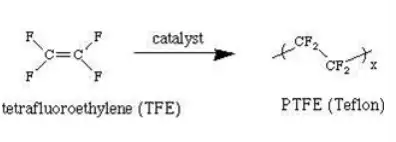
Structure of Polytetrafluoroethylene (Teflon)
Polyacrylonitrile is synthesized via addition polymerization of acrylonitrile monomers using peroxide catalysts. It serves as a wool substitute in commercial fibers like Acrilan.
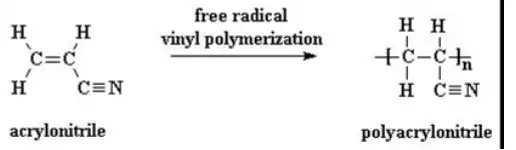
Polyacrylonitrile Fiber Example
Anionic Polymerization Overview
Anionic polymerization is a chain-growth process initiated by negatively charged species (anions). It is particularly effective for polymerizing vinyl monomers and is sensitive to the solvent environment. This method is used to produce synthetic rubbers and thermoplastic elastomers.
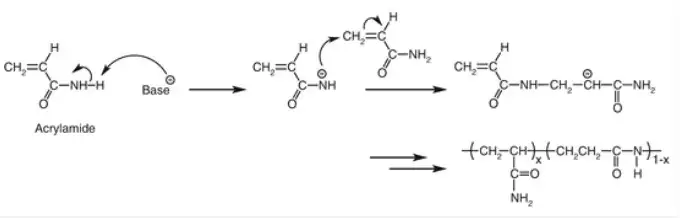
Schematic of Anionic Polymerization
Example Problem
Explain why anionic polymerization is preferred for synthesizing polydiene rubbers compared to free radical polymerization.
Answer:
Anionic polymerization allows better control over molecular weight and polymer architecture.
It proceeds at lower temperatures, reducing side reactions.
It produces polymers with more uniform properties, essential for high-performance rubbers.
Classification and Properties of Polymers
Categories Based on Origin
Polymers are classified by their source into natural, semi-synthetic, and synthetic types. Natural polymers occur in plants and animals, such as starch and rubber. Semi-synthetic polymers are chemically modified natural polymers, like cellulose acetate. Synthetic polymers are entirely man-made, including polythene and Nylon 66.
Structural Classification of Polymers
Polymers can be categorized by their molecular architecture:
Linear polymers: Consist of straight chains, e.g., PVC.
Branched polymers: Linear chains with side branches, e.g., low-density polyethylene.
Network or cross-linked polymers: Three-dimensional networks formed by multifunctional monomers, e.g., Bakelite and melamine resins.
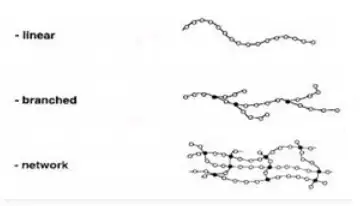
Different Polymer Structures: Linear, Branched, and Network
Polymerization Mode and Molecular Forces
Based on polymerization mode, polymers are divided into addition and condensation polymers. Addition polymers form by repeated addition of monomers with double or triple bonds, while condensation polymers form with elimination of small molecules.
Intermolecular forces further classify polymers into elastomers, fibers, thermoplastics, and thermosets:
Elastomers: Rubber-like, flexible polymers with weak intermolecular forces, e.g., Buna-S.
Fibers: Polymers with strong hydrogen bonding, crystalline and strong, e.g., polyamides.
Thermoplastics: Polymers that soften on heating and harden on cooling, e.g., polystyrene.
Thermosetting polymers: Cross-linked polymers that do not soften on reheating, e.g., Bakelite.
Quick Reference Summary
Polymerization Type | Key Characteristics | Examples | Byproducts |
|---|---|---|---|
Step-Growth | Slow molecular weight increase; reaction between functional groups | Polyamides, Polyesters | Water, HCl |
Chain-Growth (Addition) | Rapid chain elongation via active centers (radicals, ions) | Polyethylene, Polystyrene | None |
Condensation | Monomers join with elimination of small molecules | Nylon 66, Bakelite | Water, HCl |
Anionic Polymerization | Initiated by anions; sensitive to solvents | Synthetic rubbers, SBR | None |
Glossary of Key Terms
Term | Definition |
|---|---|
Monomer | A small molecule that can chemically bind to others to form a polymer. |
Polymer | A large molecule composed of repeating monomer units. |
Step-Growth Polymerization | Polymer formation by reaction between functional groups of monomers or oligomers. |
Chain-Growth Polymerization | Polymerization where monomers add to an active site on a growing chain. |
Condensation Polymerization | Polymerization involving elimination of small molecules like water. |
Free Radical | A reactive species with an unpaired electron initiating chain polymerization. |
Initiation | The first step in chain-growth polymerization forming active centers. |
Propagation | Growth phase where monomers add to the active chain end. |
Termination | Step where active chain ends are deactivated, ending polymer growth. |
Elastomer | Polymer with elastic properties, capable of stretching and returning to shape. |
Frequently Asked Questions
What distinguishes addition polymerization from condensation polymerization?
Addition polymerization involves monomers adding without byproduct formation, while condensation polymerization releases small molecules like water during polymer formation.
Why is free radical polymerization widely used industrially?
Because it allows polymerization of many monomers under relatively mild conditions and produces polymers with diverse properties.
How does the structure of a polymer affect its properties?
Linear polymers tend to be flexible, branched polymers have lower density, and cross-linked polymers are rigid and heat resistant.
What role do catalysts play in polymerization?
Catalysts speed up polymerization reactions and can influence polymer structure and molecular weight.
Can polymers be recycled based on their type?
Thermoplastics can be remelted and reshaped, whereas thermosetting polymers cannot be remolded once set.