Comprehensive Overview of Polymers and Their Applications
Fundamentals and Classification of Polymers
Understanding Polymers and Their Origins
Polymers are extensive molecules formed by linking numerous smaller units called monomers. The word "polymer" originates from Greek, meaning "many parts." These macromolecules are ubiquitous, ranging from natural biopolymers like DNA strands to synthetic plastics such as polypropylene widely used in daily life.
Polymers are broadly categorized based on their source: natural polymers derived from plants and animals, synthetic polymers manufactured by humans, and semi-synthetic polymers which are chemically modified natural polymers. Each type exhibits distinct physical and chemical characteristics that determine their practical applications.
Example: Identify the category of the following polymers:
(a) Cellulose
(b) Nylon-6,6
(c) Cellulose acetate
Solution:
(a) Cellulose is a natural polymer found in plants.
(b) Nylon-6,6 is a synthetic polymer produced industrially.
(c) Cellulose acetate is a semi-synthetic polymer obtained by chemically modifying cellulose.
Structural Variations in Polymer Chains
Polymers can be classified by the architecture of their monomer chains. Linear polymers consist of long, unbranched chains, such as polyvinyl chloride (PVC), commonly used in pipes and cables. Branched polymers have side chains attached to the main chain, exemplified by low-density polyethylene. Cross-linked polymers feature covalent bonds connecting different chains, resulting in rigid structures like Bakelite and melamine.
Example: Classify the following polymers based on their chain structure:
(a) Polyethylene used in plastic bags
(b) Bakelite used in electrical insulators
Solution:
(a) Polyethylene is a branched polymer.
(b) Bakelite is a cross-linked polymer.
Additional Polymer Classifications
Polymers are also categorized by polymerization type, monomer composition, and intermolecular forces. Addition polymerization involves monomers joining without by-products, while condensation polymerization releases small molecules like water. Homopolymers contain one monomer type, whereas copolymers consist of two or more. Based on molecular forces, polymers are classified as elastomers, fibers, thermoplastics, or thermosetting polymers, each with unique mechanical and thermal properties.
Example: Differentiate between addition and condensation polymerization with examples.
Solution:
Addition polymerization involves monomers like ethene forming polyethylene without by-products.
Condensation polymerization involves monomers like diamines and dicarboxylic acids forming nylon-6,6 with elimination of water molecules.
Polymer Structures, Types, and Their Properties
Backbone Composition and Polymer Categories
Most polymers possess a hydrocarbon backbone, a chain of carbon and hydrogen atoms linked covalently, due to carbon's tetravalency. Examples include polypropylene and polystyrene. Some polymers incorporate other elements in their backbone, such as nitrogen in nylon. Based on backbone composition, polymers are divided into organic (carbon-based) and inorganic (non-carbon-based) polymers.
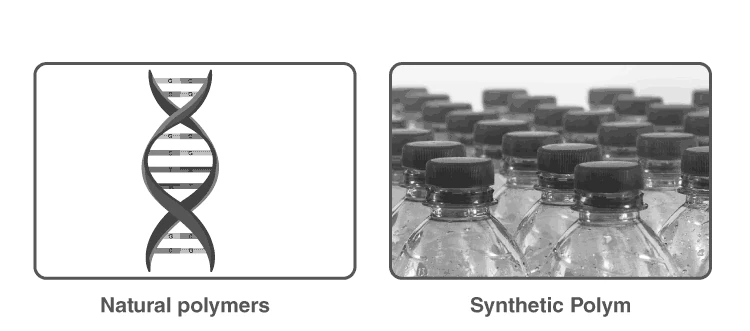
Illustration of polymer chain structures with different backbones
Example: Classify the following polymers:
(a) Polypropylene
(b) Nylon
Solution:
(a) Polypropylene has a hydrocarbon (carbon) backbone, so it is an organic polymer.
(b) Nylon contains nitrogen atoms in its backbone, classifying it as an organic polymer with heteroatoms.
Specialized Polymer Types and Their Applications
Polymers can also be categorized by their synthesis and thermal stability. Natural polymers occur in living organisms, synthetic polymers are man-made, and biodegradable polymers decompose via microbial action, useful in medical applications like surgical bandages. High-temperature polymers resist degradation at elevated temperatures, making them suitable for sterilization equipment and heat-resistant products.
Example: Describe two polymers used in high-temperature applications and their uses.
Solution:
(a) Polypropylene softens upon heating and solidifies on cooling, used in automotive parts and reusable containers.
(b) Polyethylene is widely used in packaging materials like plastic bags and bottles.
Physical, Chemical, and Optical Characteristics of Polymers
Polymer properties depend on chain length, cross-linking, and intermolecular forces. Increasing chain length and cross-linking enhances tensile strength. Polymers transition from crystalline to semi-crystalline states rather than melting sharply. Chemical properties include hydrogen and ionic bonding that improve cross-linking and flexibility. Polymers with Van der Waals forces have lower melting points. Optical properties, such as temperature-dependent refractive index changes, enable applications in lasers and spectroscopy.
Example: Explain why some polymers have high flexibility while others are rigid.
Solution:
Polymers with dipole-dipole bonding side chains exhibit high flexibility due to weaker intermolecular forces.
Polymers with strong covalent cross-links or ionic bonds are more rigid and have higher tensile strength.
Polymerization Processes, Molecular Mass, and Practical Uses
Mechanisms of Polymer Formation
Polymerization is the chemical process where monomers link to form polymers. Addition polymerization, or chain growth polymerization, involves monomers joining sequentially without by-products, such as ethene polymerizing to polyethylene. Condensation polymerization, or step growth polymerization, involves elimination of small molecules like water during bond formation, typical in nylon synthesis. Copolymerization combines different monomers to create polymers with tailored properties, such as synthetic rubbers like BUNA-S.
Example: Differentiate addition and condensation polymerization with a reaction example.
Solution:
Addition polymerization: Ethene monomers form polyethylene without by-products.
Condensation polymerization: Hexamethylenediamine and adipic acid react to form nylon-6,6 with water elimination.
Calculating Polymer Molecular Masses
Polymers have two average molecular masses: number average molecular mass (\( \bar{M}_n \)) and weight average molecular mass (\( \bar{M}_w \)). The number average is calculated by:
\[ \bar{M}_n = \frac{\sum N_i M_i}{\sum N_i} \]
where \( N_i \) is the number of molecules with molecular mass \( M_i \). This average is determined by colligative properties like osmotic pressure.
The weight average molecular mass is:
\[ \bar{M}_w = \frac{\sum m_i M_i}{\sum m_i} = \frac{\sum N_i M_i^2}{\sum N_i M_i} \]
where \( m_i \) is the mass of molecules with molecular mass \( M_i \). The polydispersity index (PDI) is the ratio:
\[ \text{PDI} = \frac{\bar{M}_w}{\bar{M}_n} \]
For natural polymers, PDI is typically 1, indicating uniform molecular weight distribution.
Example: Calculate the number average molecular mass for a polymer sample with:
- 10 molecules of mass 20,000 g/mol
- 5 molecules of mass 50,000 g/mol
Solution:
\[ \bar{M}_n = \frac{(10 \times 20000) + (5 \times 50000)}{10 + 5} = \frac{200000 + 250000}{15} = \frac{450000}{15} = 30000 \text{ g/mol} \]
Everyday Applications of Polymers
Polymers are integral to numerous industries. Polypropylene is used in textiles, packaging, automotive parts, and stationery due to its moldability and durability. Polystyrene serves in packaging, insulation, and household items like trays and containers. Polyvinyl chloride (PVC) is essential for sewage pipes, electrical insulation, clothing, and vinyl flooring. Urea-formaldehyde resins are employed in adhesives and molded products. Glyptal is used in paints and coatings, while Bakelite finds applications in electrical switches, kitchenware, and insulators.
Example: Match the polymer to its common use:
(a) Polystyrene
(b) PVC
(c) Bakelite
Solution:
(a) Packaging and insulation
(b) Sewage pipes and electrical insulation
(c) Electrical switches and kitchen products
Summary Table: Key Polymer Concepts
Aspect | Description | Example |
|---|---|---|
Polymer Source | Natural, Synthetic, Semi-synthetic | Cellulose, Nylon-6,6, Cellulose acetate |
Chain Structure | Linear, Branched, Cross-linked | PVC, Low-density polyethylene, Bakelite |
Polymerization Type | Addition, Condensation, Copolymerization | Polyethylene, Nylon-6,6, BUNA-S |
Backbone Composition | Organic (carbon), Inorganic (non-carbon) | Polypropylene, Silicone |
Physical Property | Tensile strength increases with chain length and cross-linking | Rubber (elastomer), Nylon (fiber) |
Molecular Mass Averages | Number average (\( \bar{M}_n \)), Weight average (\( \bar{M}_w \)) | Used in polymer characterization |
Applications | Packaging, textiles, construction, medical | Polypropylene, Polystyrene, PVC |
Glossary of Polymer Terminology
Term | Definition |
|---|---|
Polymer | A large molecule composed of repeating monomer units. |
Monomer | A small molecule that can join with others to form a polymer. |
Polymerization | Chemical process of linking monomers to form polymers. |
Addition Polymerization | Polymerization without by-products, monomers add sequentially. |
Condensation Polymerization | Polymerization with elimination of small molecules like water. |
Copolymer | Polymer made from two or more different monomers. |
Cross-linked Polymer | Polymer chains connected by covalent bonds forming a network. |
Elastomer | Rubber-like polymer with elastic properties. |
Thermoplastic | Polymer that softens on heating and hardens on cooling repeatedly. |
Polydispersity Index (PDI) | Ratio of weight average to number average molecular mass. |
Frequently Asked Questions on Polymers
How do polymers exhibit different physical properties?
Variations in molecular interactions among monomers, such as hydrogen bonding, ionic bonding, and Van der Waals forces, result in polymers with diverse elasticity, strength, and thermal behavior. For example, elastomers have weak intermolecular forces, making them flexible, while fibers have strong interactions, providing high tensile strength.
What is vulcanization and why is it important?
Vulcanization is the process of adding sulfur to natural rubber to create cross-links between polymer chains. This enhances the rubber's mechanical stability and stiffness, making it suitable for applications like vehicle tires.
What are biodegradable polymers and their significance?
Biodegradable polymers can be broken down by microorganisms, reducing environmental impact. An example is poly β-hydroxybutyrate-co-β-hydroxy valerate (PHBV), used in medical applications such as surgical bandages.
What defines engineering plastics and synthetic metals?
Engineering plastics possess high strength and resistance to chemicals and heat, suitable for demanding applications. Synthetic metals, or intrinsically conducting polymers, exhibit electrical and magnetic properties similar to metals, useful in electronic devices.
How is the molecular mass of polymers determined?
Molecular mass is calculated using number average and weight average methods, based on the distribution of molecular weights in a polymer sample. These averages help characterize polymer properties and performance.