Techniques for Ore Concentration and Beneficiation
Fundamentals of Ore Concentration
Understanding the Process of Gangue Removal
Ore concentration, also known as dressing or benefaction, refers to the process of separating valuable minerals from the unwanted impurities called gangue. The choice of concentration technique depends on the physical and chemical characteristics of the ore. Efficient concentration enhances the purity of the ore before further extraction steps.
Solution:
Initial gangue percentage = 40%
Final gangue percentage = 100% - 85% = 15%
Gangue removed = 40% - 15% = 25%
Percentage of gangue removed = \(\frac{25}{40} \times 100 = 62.5\%\)
Gravity-Based Separation Techniques
Hydraulic Washing Method
This technique exploits the difference in density between ore particles and gangue. The crushed ore is washed with a strong upward flow of water. The lighter gangue particles are carried away by the water current, while the denser ore settles down. This method is particularly effective for ores with significant density differences.
Solution:
The large density difference allows water to easily separate lighter gangue from heavier ore.
Since ore is almost twice as dense as gangue, the upward water current can carry away gangue while ore settles.
Hence, hydraulic washing efficiently concentrates the ore.
Magnetic Separation Process
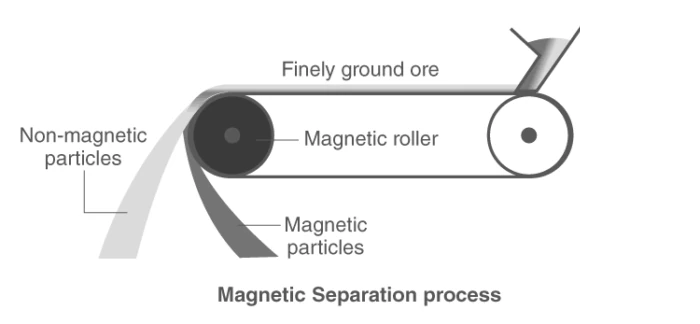
Magnetic separation utilizes the magnetic properties of minerals to isolate ore from gangue. The ore is finely ground and passed over a conveyor belt equipped with a magnetic roller. Magnetic particles adhere to the belt, while non-magnetic gangue falls off. This method is ideal for ores containing magnetic minerals.
Solution:
Magnetic ore fraction = 70%
Gangue fraction = 30%
Magnetic separation collects the magnetic 70%, leaving gangue behind.
Therefore, 70% of the ore is recovered by this method.
Chemical and Froth-Based Concentration Methods
Froth Flotation Technique
This method is primarily applied to sulphide ores. The powdered ore is mixed with water to form a slurry, to which collectors and froth stabilizers are added. Collectors increase the hydrophobicity of metal particles, enabling them to attach to air bubbles and form froth. Froth stabilizers maintain the froth's stability. The froth containing metal particles is skimmed off, separating it from the gangue.
Solution:
Initial metal = \(500 \times 0.60 = 300 \text{ g}\)
Metal in froth = \(300 \times 0.90 = 270 \text{ g}\)
Recovery percentage = \(\frac{270}{300} \times 100 = 90\%\)
Leaching Process for Soluble Ores
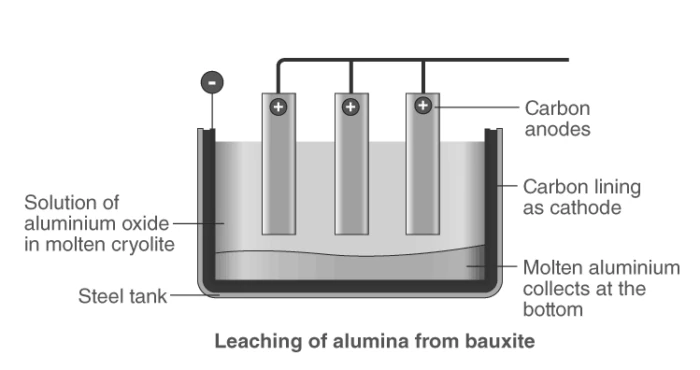
Leaching is a chemical concentration method used when the ore dissolves in a suitable solvent. The powdered ore is treated with a chemical solution, often a strong base like sodium hydroxide (NaOH). The metal dissolves into the solution, separating from the insoluble gangue. This method is commonly used for extracting aluminium from bauxite.
Solution:
Aluminium extracted = 150 g
Total ore = 200 g
Extraction percentage = \(\frac{150}{200} \times 100 = 75\%\)
Summary of Ore Concentration Methods
| Method | Principle | Suitable For | Key Advantage |
|---|---|---|---|
| Hydraulic Washing | Density difference and gravity | Ores with large density difference | Simple and cost-effective |
| Magnetic Separation | Magnetic properties of minerals | Magnetic ores like magnetite | Efficient separation of magnetic minerals |
| Froth Flotation | Surface chemistry and hydrophobicity | Sulphide ores | Selective separation of sulphide minerals |
| Leaching | Chemical solubility in solvents | Ores soluble in chemicals (e.g., bauxite) | Effective for chemical extraction |
Key Terms and Definitions
| Term | Meaning |
|---|---|
| Ore | Natural rock containing valuable minerals |
| Gangue | Unwanted impurities mixed with ore |
| Beneficiation | Process of improving ore quality by removing gangue |
| Hydraulic Washing | Separation using water flow based on density |
| Magnetic Separation | Using magnetic properties to separate minerals |
| Froth Flotation | Separation by selective attachment to air bubbles |
| Leaching | Extraction by dissolving ore in chemical solvents |
| Collectors | Chemicals that increase hydrophobicity of ore particles |
| Froth Stabilizers | Substances that maintain froth stability during flotation |
| Density | Mass per unit volume of a substance |
Frequently Asked Questions
What determines the choice of concentration method for an ore?
The selection depends on the physical and chemical properties of the ore, such as density, magnetic susceptibility, and solubility.
Can froth flotation be used for all types of ores?
Froth flotation is mainly effective for sulphide ores and is not suitable for oxides or native metals.
Why is leaching preferred for bauxite ore?
Bauxite dissolves in alkaline solutions like NaOH, allowing aluminium to be separated chemically from the gangue.
Is magnetic separation applicable to non-magnetic ores?
No, magnetic separation only works if either the ore or gangue has magnetic properties.
What is the main advantage of hydraulic washing?
It is a simple, low-cost method effective for ores with a significant difference in density between ore and gangue.