Understanding the Mechanism of Transcription in Gene Expression
Fundamentals of Transcription in Molecular Biology
Overview of Transcription and Its Role in Gene Expression
Transcription represents the initial phase of gene expression where the genetic code embedded in DNA is transcribed into RNA. This process is essential for transferring genetic instructions from DNA to the cellular machinery responsible for protein synthesis. During transcription, only one strand of the DNA double helix, called the template strand, is used to generate a complementary RNA molecule known as messenger RNA (mRNA). This mRNA carries the blueprint for protein assembly.
The central dogma of molecular biology describes the flow of genetic information as DNA → RNA → Protein, with transcription serving as the critical step converting DNA sequences into RNA transcripts.
Example: Consider a DNA segment with the sequence 5′-ATGCGTAC-3′ on the coding strand. During transcription, the RNA polymerase reads the template strand (complementary to the coding strand) and synthesizes an mRNA strand. If the template strand is 3′-TACGCATG-5′, the resulting mRNA sequence will be 5′-AUGCGUAC-3′, which is complementary and antiparallel to the template strand.
Central Dogma: Flow of Genetic Information from DNA to RNA to Protein
Enzymatic Machinery and DNA Template in Transcription
Role and Function of RNA Polymerase in RNA Synthesis
RNA polymerase is the pivotal enzyme that orchestrates the transcription process. It binds to specific DNA sequences called promoters, initiating the synthesis of RNA by reading the DNA template strand in the 3′ to 5′ direction and assembling the RNA strand in the 5′ to 3′ direction. This enzyme catalyzes the polymerization of ribonucleotides complementary to the DNA template, ensuring accurate transcription of genetic information.
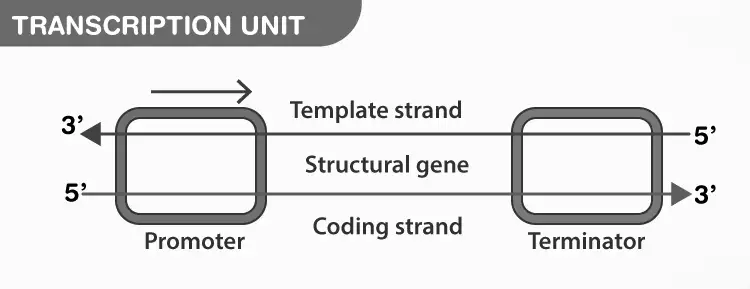
The transcription unit refers to the DNA segment transcribed into an RNA molecule, typically encoding a single gene. Unlike DNA replication, transcription exhibits a relatively lower fidelity, allowing for some variability in RNA sequences.
Example: Suppose an RNA polymerase binds to a promoter region at position 1000 on a DNA strand and transcribes a gene of length 1500 base pairs. The enzyme moves along the template strand, synthesizing RNA until it reaches the terminator sequence at position 2500, where transcription ceases and the RNA transcript is released.
Stepwise Progression of Transcription
Initiation: Beginning of RNA Synthesis
During initiation, RNA polymerase locates and binds to the promoter region on the DNA, which marks the transcription start site. The DNA double helix unwinds locally, exposing the nucleotide bases of the template strand. This unwound region serves as the template for the assembly of the RNA strand.
Example: In a bacterial gene, the RNA polymerase recognizes the -35 and -10 promoter elements upstream of the transcription start site. Upon binding, the DNA unwinds between positions -10 and +1, allowing the polymerase to begin RNA synthesis at the +1 site.
Elongation: Extension of the RNA Chain
During elongation, RNA polymerase moves along the DNA template strand, adding ribonucleotides complementary to the DNA sequence. The RNA strand grows in the 5′ to 3′ direction as nucleotides are linked by phosphodiester bonds.
Example: If the DNA template sequence is 3′-TACGGA-5′, the RNA polymerase adds nucleotides in the order 5′-AUGCCU-3′ to the growing RNA chain, matching each base pair accurately.
Termination: Completion of Transcription
Termination occurs when RNA polymerase encounters a specific terminator sequence on the DNA. This signal causes the enzyme to detach from the DNA template and release the newly synthesized RNA transcript.
Example: In prokaryotes, a rho-independent terminator sequence forms a hairpin loop in the RNA transcript, destabilizing the RNA-DNA hybrid and causing RNA polymerase to dissociate, ending transcription.
Post-Transcriptional Modifications of RNA
Processing Steps to Generate Mature mRNA
The initial RNA transcript, called pre-mRNA, undergoes several modifications before becoming a functional mRNA molecule capable of directing protein synthesis. These modifications include capping, polyadenylation, and splicing.
Capping
A methylated guanine nucleotide is added to the 5′ end of the pre-mRNA, forming a protective cap. This cap prevents degradation by exonucleases and assists in ribosome binding during translation.
Polyadenylation
The 3′ end of the pre-mRNA is cleaved at a specific site, and a poly-A tail consisting of multiple adenine nucleotides is added. This tail enhances mRNA stability and facilitates export from the nucleus.
Splicing
Non-coding sequences called introns are excised from the pre-mRNA by the spliceosome complex. The remaining coding sequences, exons, are joined together to form a continuous coding sequence. This process allows a single gene to produce multiple protein variants through alternative splicing.
Summary Table: Key Aspects of Transcription
Aspect | Description |
|---|---|
Definition | Conversion of DNA sequence into complementary RNA strand |
Enzyme | RNA polymerase |
Template | Single DNA strand (template strand) |
Direction of Synthesis | RNA synthesized 5′ to 3′ |
Stages | Initiation, Elongation, Termination |
RNA Processing | Capping, Polyadenylation, Splicing |
End Product | Mature mRNA ready for translation |
Glossary of Essential Terms
Term | Meaning |
|---|---|
Transcription | Process of synthesizing RNA from DNA template |
RNA Polymerase | Enzyme that catalyzes RNA synthesis |
Template Strand | DNA strand used as a guide for RNA synthesis |
Promoter | DNA sequence where RNA polymerase binds to start transcription |
Terminator | DNA sequence signaling the end of transcription |
Pre-mRNA | Initial RNA transcript before processing |
Capping | Addition of a methylated guanine to 5′ end of RNA |
Polyadenylation | Addition of poly-A tail to 3′ end of RNA |
Splicing | Removal of introns and joining of exons in RNA |
Exons | Coding sequences retained in mature mRNA |
Frequently Asked Questions on Transcription
What is the main purpose of transcription?
Transcription's primary role is to produce an RNA copy of a gene's DNA sequence, which serves as a template for protein synthesis.
Where does transcription initiate and terminate on the DNA?
Transcription begins at the promoter region near the 5′ end of the gene and ends at the terminator sequence downstream.
Are enhancer sequences essential for transcription?
Enhancers are regulatory DNA elements that increase transcription efficiency but are not always located near the genes they regulate.
What types of RNA are produced by transcription?
Transcription can yield various RNA types including mRNA, rRNA, tRNA, and non-coding RNAs depending on the gene transcribed.
What defines a promoter sequence?
A promoter is a specific DNA region upstream of a gene where RNA polymerase binds to initiate transcription.