Comprehensive Guide to Solid Waste Management
Understanding the Fundamentals of Solid Waste Management
Overview of Waste Collection and Processing
Solid waste management encompasses the entire sequence of activities involved in gathering, treating, and disposing of solid refuse. This systematic approach includes collecting waste from various origins, transporting it safely, analyzing its composition, and ultimately disposing of it in an environmentally responsible manner. Effective management requires continuous supervision to ensure adherence to established regulations and standards.
By maintaining strict control over these processes, communities can minimize environmental harm and safeguard public health.
Practical Example: Calculating Waste Collection Efficiency
Problem: A city generates 1200 tonnes of solid waste daily. The waste management department collects 1080 tonnes each day. Calculate the collection efficiency percentage.
Solution:
Collection efficiency is calculated as the ratio of waste collected to waste generated, expressed as a percentage.
\[ \text{Efficiency} = \left( \frac{\text{Waste Collected}}{\text{Waste Generated}} \right) \times 100 = \left( \frac{1080}{1200} \right) \times 100 = 90\% \]
Thus, the waste collection efficiency of the city is 90%, indicating effective waste gathering operations.
Classification and Sources of Solid Waste
Varieties and Origins of Solid Waste
Solid waste arises from multiple sources including households, industries, agriculture, and construction activities. Common categories include domestic garbage, industrial residues, agricultural by-products, and materials such as plastics, metals, glass, and electronic waste. Additionally, medical facilities generate specialized hazardous waste requiring careful handling.
Understanding the diverse origins helps in designing tailored management strategies for each waste type.
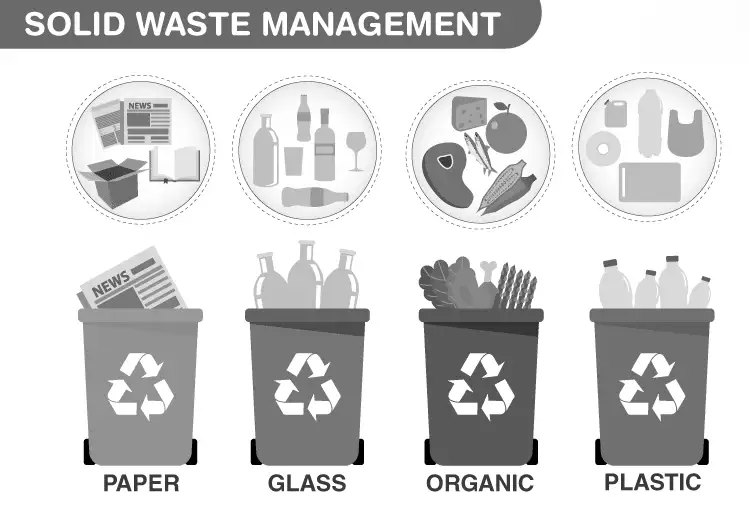
Illustration of the Solid Waste Management Process
Example: Identifying Waste Types in a Community
Question: A neighborhood produces the following wastes daily: vegetable peels, plastic bottles, used batteries, and construction debris. Classify each waste into biodegradable, recyclable, or hazardous categories.
Answer:
Vegetable peels – Biodegradable waste
Plastic bottles – Recyclable waste
Used batteries – Hazardous waste
Construction debris – Non-biodegradable, requires special disposal
This classification aids in proper segregation and disposal.
Methods and Implications of Waste Disposal
Approaches to Waste Disposal and Their Environmental Impact
Disposal techniques vary globally and depend on the waste source. Municipal solid waste is often categorized into biodegradable, recyclable, and hazardous fractions. Biodegradable waste includes food scraps and garden waste, recyclable waste covers plastics and metals, while hazardous waste involves items like batteries and medical refuse.
Landfilling remains the predominant disposal method, with modern landfills engineered to minimize pollution and health risks. However, improper disposal can lead to environmental contamination, groundwater pollution, and health hazards due to toxic substances and disease vectors.
Example: Estimating Landfill Volume Requirement
Problem: A town produces 500 tonnes of solid waste daily. If the average density of compacted waste in a landfill is \( 600 \text{ kg/m}^3 \), calculate the volume of landfill space needed per day.
Solution:
First, convert tonnes to kilograms:
\[ 500 \text{ tonnes} = 500 \times 1000 = 500,000 \text{ kg} \]
Volume required is mass divided by density:
\[ V = \frac{500,000 \text{ kg}}{600 \text{ kg/m}^3} = 833.33 \text{ m}^3 \]
Therefore, the landfill must accommodate approximately 833.33 cubic meters of waste daily.
Consequences of Ineffective Waste Management
Neglecting proper waste disposal leads to accumulation of garbage, creating breeding grounds for disease vectors and emitting foul odors. Toxic industrial wastes can contaminate soil and groundwater, disrupting ecosystems and posing serious health risks. Burning mixed waste releases harmful gases causing respiratory and chronic illnesses.
Hence, stringent waste management practices are essential to protect environmental and public health.
Quick Reference: Key Points on Solid Waste Management
Aspect | Details |
|---|---|
Definition | Process of collecting, treating, and disposing of solid wastes |
Sources | Domestic, industrial, agricultural, medical, construction |
Waste Types | Biodegradable, recyclable, hazardous |
Common Disposal | Landfills designed to minimize pollution |
Environmental Risks | Soil and water contamination, air pollution, health hazards |
Management Importance | Reduces pollution, prevents disease, conserves resources |
Glossary of Essential Terms
Term | Meaning |
|---|---|
Biodegradable Waste | Organic material that decomposes naturally |
Hazardous Waste | Waste posing substantial or potential threats to health or environment |
Landfill | Designated site for waste disposal by burial |
Recyclable Waste | Materials that can be processed and reused |
Solid Waste | Non-liquid waste materials from various sources |
Waste Segregation | Separating waste into categories for efficient processing |
Composting | Biological decomposition of organic waste into nutrient-rich soil |
Incineration | Burning waste to reduce volume and sometimes generate energy |
Groundwater Pollution | Contamination of underground water by harmful substances |
Waste Treatment | Processes to reduce or eliminate hazardous properties of waste |
Frequently Asked Questions
What does solid waste management involve?
It includes the collection, transportation, treatment, and disposal of solid wastes from various sources to protect health and environment.
How are wastes categorized?
Wastes are broadly classified as biodegradable, recyclable, hazardous, and non-biodegradable based on their properties and disposal needs.
What are the main sources of industrial waste?
Industries such as chemical plants, textile factories, power stations, and food processing units generate diverse waste types requiring specialized handling.
Why is proper waste disposal critical?
It prevents environmental pollution, controls disease spread, conserves resources, and maintains community aesthetics.
What are the risks of mixing hazardous waste with regular garbage?
It complicates disposal, increases health hazards, and can release toxic substances into the environment.