Understanding the Origin and Evolution of Life on Earth
The Beginning of the Universe and Its Impact on Life
Formation of the Cosmos and Early Conditions
The story of life on Earth is deeply connected to the birth of the universe itself. Approximately 20 billion years ago, the cosmos was a vast expanse of darkness filled with clouds of gas and dust. The widely accepted Big Bang Theory proposes that a colossal explosion initiated the creation of the universe, setting into motion the formation of galaxies and matter as we know it.
Following this event, the environment gradually stabilized as temperatures dropped, allowing gases such as hydrogen and helium to form. These gases eventually coalesced into the galaxies that populate the universe today.

Illustration showing the early universe and origin of life
Example Problem
Estimate the approximate age of the universe if the Big Bang occurred 18 billion years ago and the Earth formed 9 billion years after that. How old is the Earth?
Solution:
The age of the Earth can be calculated by subtracting the time between the Big Bang and Earth's formation from the universe's age:
\[ \text{Age of Earth} = 18 \text{ billion years} - 9 \text{ billion years} = 9 \text{ billion years} \]
Therefore, the Earth is approximately 9 billion years old based on this estimation.
Emergence of Life on Earth
Early Earth Atmosphere and the Birth of Life
About 10 billion years after the universe's inception, Earth formed enveloped by a thick atmosphere composed mainly of water vapor, methane, carbon dioxide, and ammonia. Initially, there was no stable atmosphere, only a mixture of gases and moisture. The intense solar radiation played a crucial role in accelerating chemical reactions by breaking and forming bonds among these gases, gradually transforming Earth's surface.
After millions of years, when the atmosphere stabilized, the first living organisms appeared roughly 4 billion years ago, marking the beginning of life on our planet.
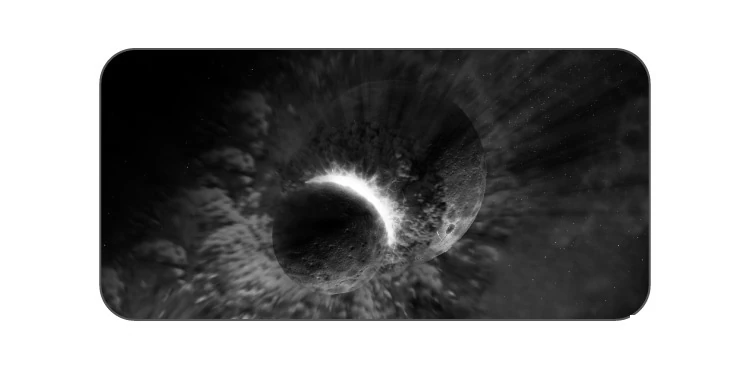
Representation of primitive life emerging on Earth
Example Problem
If the Earth formed 10 billion years after the Big Bang and the first life appeared 4 billion years ago, calculate how many billion years passed between Earth's formation and the emergence of life.
Solution:
\[ \text{Time between Earth formation and life emergence} = 10 \text{ billion years} - 4 \text{ billion years} = 6 \text{ billion years} \]
This means life began approximately 6 billion years after Earth was formed.
Theories Explaining the Origin of Life
Scientific Perspectives on How Life Began
Various hypotheses have been proposed to explain how life originated on Earth. Some scientists believed that life arrived from outer space in the form of spores, while others supported the idea that life spontaneously arose from non-living matter such as decaying organic material. The latter, known as spontaneous generation, was later disproved.
In 1953, researchers Oparin and Haldane introduced the chemical evolution theory, suggesting that life began from simple organic molecules like proteins and RNA formed under Earth's early atmospheric conditions. Experiments have since supported this idea, showing how inorganic molecules could give rise to organic compounds, setting the stage for the evolution of diverse life forms.
Example Problem
Explain why the theory of spontaneous generation was rejected and how chemical evolution provides a better explanation for the origin of life.
Answer:
Spontaneous generation suggested life arose from non-living matter without scientific evidence.
Experiments failed to reproduce life from decaying matter, disproving spontaneous generation.
Chemical evolution theory is supported by experiments showing organic molecules can form from inorganic substances under early Earth conditions.
This theory explains the gradual formation of complex molecules necessary for life.
It provides a scientific framework for understanding the transition from non-living to living matter.
Quick Reference Summary
Concept | Key Points |
|---|---|
Big Bang Theory | Universe originated from a massive explosion ~20 billion years ago; formation of galaxies and gases. |
Earth's Formation | Formed ~10 billion years after Big Bang; early atmosphere rich in gases like methane and ammonia. |
First Life | Appeared ~4 billion years ago after atmosphere stabilized; life evolved from simple to complex forms. |
Spontaneous Generation | Disproved theory that life arises from non-living matter like mud or decaying material. |
Chemical Evolution | Life originated from organic molecules formed from inorganic substances under early Earth conditions. |
Glossary of Key Terms
Term | Definition |
|---|---|
Big Bang Theory | The scientific explanation for the origin of the universe from a massive explosion. |
Galaxy | A massive system of stars, gas, and dust bound together by gravity. |
Atmosphere | The layer of gases surrounding a planet. |
Organic Molecules | Compounds containing carbon, essential for life. |
Inorganic Molecules | Compounds not based on carbon-hydrogen bonds. |
Spontaneous Generation | Disproven idea that life arises from non-living matter spontaneously. |
Chemical Evolution | The process by which simple molecules formed complex organic compounds leading to life. |
RNA | A nucleic acid involved in coding, decoding, and expression of genes. |
Proteins | Large biomolecules essential for structure and function in living organisms. |
Solar Radiation | Energy emitted by the sun that influences chemical reactions on Earth. |
Frequently Asked Questions
What is the Big Bang Theory?
The Big Bang Theory explains that the universe began from a massive explosion approximately 20 billion years ago, leading to the formation of galaxies and matter.
How did Earth's early atmosphere differ from today?
Initially, Earth's atmosphere lacked oxygen and was composed mainly of water vapor, methane, carbon dioxide, and ammonia, unlike the oxygen-rich atmosphere we have now.
Why was the spontaneous generation theory rejected?
Because experiments failed to show life arising from non-living matter, disproving the idea that life can spontaneously emerge from decaying materials.
What does chemical evolution mean?
Chemical evolution refers to the process where inorganic molecules transformed into organic molecules under early Earth conditions, leading to the origin of life.
When did the first life forms appear on Earth?
Life is believed to have originated around 4 billion years ago after Earth's atmosphere became stable enough to support living organisms.