Fundamentals and Proofs of Biological Evolution
Understanding the Mechanism of Evolution
Conceptualizing Evolution and Natural Selection
Evolution refers to the gradual transformation in the inherited traits of populations across successive generations. This process is primarily driven by natural selection, where organisms with advantageous characteristics have a higher likelihood of survival and reproduction. Over extended periods, these beneficial traits become more common, leading to the emergence of new species and diversity in life forms.
Genetic diversity within a population is crucial for evolution, as it provides the raw material for natural selection to act upon. Variations in physical features can offer survival benefits in specific environments, and these traits are passed down to offspring, shaping the evolutionary trajectory.
Example Problem
A population of beetles has two color variants: green and brown. The green beetles are more visible to predators, while brown beetles blend into the environment better. If the initial population has 60% green and 40% brown beetles, and after several generations, the brown beetles constitute 75% of the population, explain the evolutionary process responsible for this change.
Solution:
The difference in coloration affects survival; brown beetles have a camouflage advantage.
Predators are more likely to prey on green beetles, reducing their numbers.
Brown beetles survive longer and reproduce more, increasing their frequency.
This is an example of natural selection favoring the brown coloration trait.
Over generations, the population shifts towards a higher proportion of brown beetles.
Key Evidences Supporting Evolutionary Theory
Fossil Records as Historical Evidence
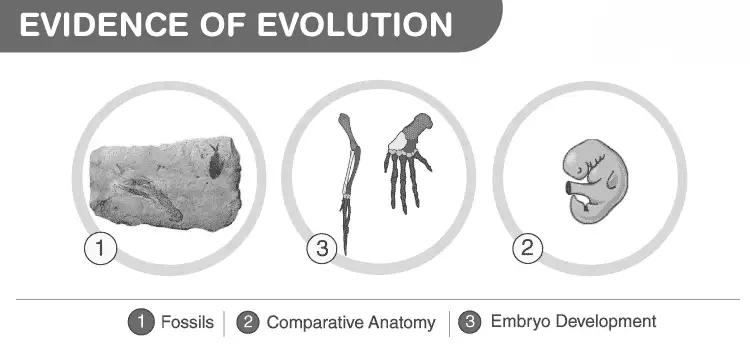
Fossils are preserved remains or impressions of ancient organisms embedded in rock layers. The depth at which a fossil is found correlates with its age; deeper fossils are typically older. These records provide insights into the Earth's past environments and the organisms that inhabited them. The scientific study of fossils, known as paleontology, helps reconstruct evolutionary history by revealing transitional forms and extinct species.
Example Problem
A fossil is discovered 30 meters below the surface in sedimentary rock. Another fossil is found 10 meters below the surface. Which fossil is older and why? Explain the principle used to determine this.
Solution:
The fossil found 30 meters deep is older than the one at 10 meters.
This is based on the principle of superposition, which states that in undisturbed rock layers, older layers lie beneath younger layers.
Therefore, fossils in deeper strata represent earlier life forms.
Comparative Anatomy Revealing Common Origins
Comparative anatomy studies the similarities and differences in the body structures of different species. It provides evidence for shared ancestry and evolutionary relationships. Two important categories are homologous and analogous structures.
Homologous structures have similar anatomical features but may serve different functions, indicating a common ancestor. For instance, the forelimbs of humans, dolphins, and bats have similar bone arrangements but are adapted for different uses such as grasping, swimming, and flying.
Analogous structures perform similar functions but differ in their anatomical origin, reflecting convergent evolution where unrelated species adapt similarly to environmental pressures. An example is the wings of insects and birds, both used for flight but structurally distinct.
Comparison of homologous and analogous organs
Example Problem
Explain why the wings of a bat and a butterfly are considered analogous structures, while the forelimbs of a human and a whale are homologous structures.
Solution:
Bat and butterfly wings serve the same function (flight) but have different structural origins; bat wings have bones, butterfly wings are membranous.
This indicates convergent evolution, so they are analogous.
Human and whale forelimbs share similar bone structures despite different functions (manipulation vs swimming).
This similarity points to a common ancestor, making them homologous structures.
Embryonic Development Patterns Indicating Ancestry
During early development, embryos of diverse species exhibit strikingly similar features, suggesting a shared evolutionary origin. For example, embryos of mammals, birds, reptiles, and fish display comparable stages such as pharyngeal arches and tail structures. As development proceeds, species-specific traits emerge, reflecting their evolutionary divergence.
Example Problem
Why do embryos of different vertebrates show similar structures during early development, and what does this imply about their evolutionary relationships?
Solution:
Similar embryonic features indicate that these species share a common ancestor.
These conserved developmental stages reflect inherited genetic programs.
Differences arise later, leading to species-specific characteristics.
This evidence supports the concept of descent with modification in evolution.
Summary of Evolutionary Evidence
Type of Evidence | Description | Significance |
|---|---|---|
Fossils | Preserved remains of ancient organisms found in rock layers | Provide chronological record of life and extinct species |
Comparative Anatomy | Study of structural similarities and differences among species | Indicates common ancestry and evolutionary adaptations |
Embryology | Comparison of early developmental stages across species | Reveals shared genetic heritage and evolutionary links |
Glossary of Key Terms
Term | Definition |
|---|---|
Evolution | Gradual change in species characteristics over generations |
Natural Selection | Process where organisms with favorable traits survive and reproduce |
Genetic Variation | Differences in DNA among individuals within a population |
Fossil | Preserved remains or impressions of ancient organisms |
Paleontology | Scientific study of fossils and ancient life forms |
Homologous Structures | Body parts with similar structure but different functions |
Analogous Structures | Body parts with different structures but similar functions |
Embryo | Early developmental stage of an organism |
Divergent Evolution | Process where related species evolve different traits |
Convergent Evolution | Process where unrelated species develop similar traits |
Frequently Asked Questions
What is the role of genetic variation in evolution?
Genetic variation provides the diversity of traits on which natural selection acts, enabling populations to adapt and evolve over time.
How do fossils help in understanding evolution?
Fossils offer a historical record of past life forms, showing changes in species and the emergence of new organisms through geological time.
What distinguishes homologous from analogous structures?
Homologous structures share a common ancestry but may have different functions, while analogous structures have similar functions but evolved independently.
Why do embryos of different species look similar initially?
Similar embryonic stages reflect shared genetic heritage and common ancestry among species.
Can evolution occur without natural selection?
Yes, other mechanisms like genetic drift and gene flow can also cause evolutionary changes, but natural selection is a primary driver.