Understanding the Menstrual Cycle and Its Hormonal Regulation
Overview of Menstruation and Female Reproductive Anatomy
Introduction to Menstrual Function and Cycle
The female body undergoes a recurring sequence of physiological changes each month, collectively known as the menstrual cycle, which prepares it for potential pregnancy. When fertilization of the ovum does not occur, the thickened lining of the uterus is shed, resulting in menstrual bleeding.
Menstruation typically begins between ages 10 and 15, marking the onset of puberty, a milestone called menarche. This cyclical process continues until menopause, which usually occurs around the age of 50, signaling the end of reproductive capability.
The menstrual cycle is counted from the first day of bleeding and generally spans 28 to 30 days, though individual variations exist.
Key Female Reproductive Structures Involved
Understanding the menstrual cycle requires familiarity with the main reproductive organs:
Ovaries: Two glands that store and nurture ova (eggs) and release one mature ovum monthly.
Uterus (Womb): The site where a fertilized egg implants and the fetus develops.
Fallopian Tubes: Tubes connecting the ovaries to the uterus, through which the ovum travels.
The number of ova in the ovaries is fixed before birth. Hormonal signals during puberty trigger the maturation and release of one ovum each month until menopause.
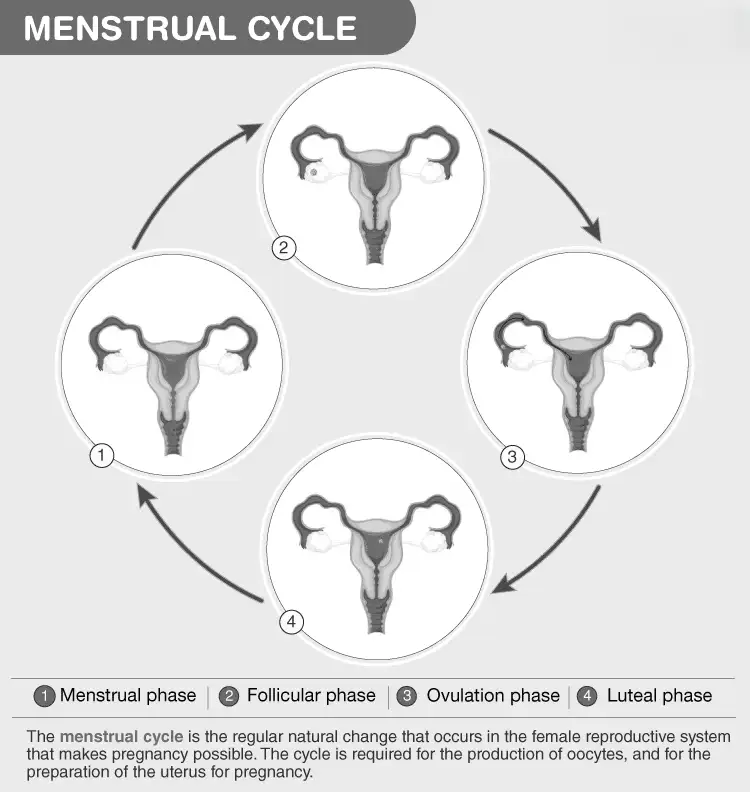
Illustration of the Menstrual Cycle Phases
Detailed Phases of the Menstrual Cycle
Menstrual Phase: Shedding of the Uterine Lining
This initial phase begins on day one of the cycle, characterized by the breakdown and discharge of the endometrial lining through menstrual bleeding. This process typically lasts between 3 to 5 days and marks the start of a new cycle.
Example: If a woman’s menstrual bleeding starts on March 1st and lasts 4 days, the menstrual phase covers March 1st to March 4th. The next cycle will begin on the first day of bleeding following this phase.
Follicular Phase: Follicle Development and Uterine Preparation
During this phase, the primary ovarian follicles mature into Graafian follicles under hormonal influence. Simultaneously, the endometrium thickens to prepare for possible implantation. This phase spans from the end of menstruation until ovulation.
Example: Suppose the follicular phase lasts from day 5 to day 13 in a 28-day cycle. During this time, estrogen levels rise, stimulating the growth of the uterine lining and follicle maturation.
Ovulatory Phase: Release of the Mature Ovum
Midway through the cycle, typically between days 13 and 17, ovulation occurs. The mature Graafian follicle ruptures, releasing the ovum into the fallopian tube. This phase is critical for fertilization and is triggered by a surge in luteinizing hormone (LH).
Example: In a 30-day cycle, ovulation might occur on day 16. The ovum released during this phase remains viable for fertilization for about 24 hours.
Luteal Phase: Post-Ovulation and Uterine Maintenance
Following ovulation, the ruptured follicle transforms into the corpus luteum, which secretes progesterone. This hormone maintains the endometrial lining, making it receptive for implantation. If fertilization does not occur, the corpus luteum degenerates, progesterone levels fall, and menstruation begins anew.
Example: If fertilization fails, the corpus luteum breaks down around day 26 in a 28-day cycle, leading to decreased progesterone and the onset of menstruation.
Hormonal Control Throughout the Menstrual Cycle
Role of Key Hormones in Regulating the Cycle
The menstrual cycle is orchestrated by hormones secreted by the endocrine system, primarily estrogen, progesterone, follicle-stimulating hormone (FSH), and luteinizing hormone (LH). These hormones regulate the development of ovarian follicles, ovulation, and preparation of the uterus.
FSH and LH are released by the anterior pituitary gland. FSH promotes follicle growth, which in turn produces estrogen. Estrogen stimulates the thickening of the uterine lining. Mid-cycle, a surge in LH triggers ovulation. After ovulation, the corpus luteum secretes progesterone to sustain the endometrium.
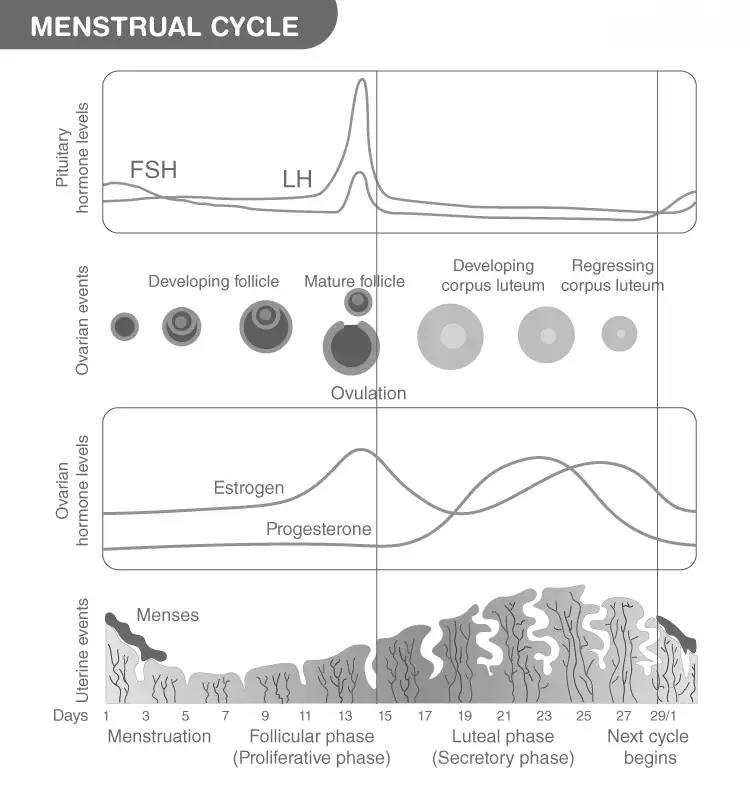
Hormonal Changes Across Menstrual Cycle Phases
Example: Consider a woman whose LH level peaks sharply on day 14, inducing ovulation. Progesterone levels rise after day 14, maintaining the uterine lining until day 28, when they drop if fertilization does not occur.
Quick Reference: Summary of Menstrual Cycle Phases and Hormonal Roles
Phase | Duration (Days) | Main Events | Dominant Hormones |
|---|---|---|---|
Menstrual | 1–5 | Shedding of uterine lining | Low estrogen and progesterone |
Follicular | 6–13 | Follicle maturation, endometrium thickening | Rising FSH and estrogen |
Ovulation | 14 (approx.) | Release of ovum | LH surge |
Luteal | 15–28 | Corpus luteum formation, uterine lining maintenance | High progesterone |
Glossary of Key Terms Related to Menstrual Cycle
Term | Definition |
|---|---|
Menarche | The first menstrual bleeding marking the onset of puberty. |
Menopause | The permanent cessation of menstruation, usually around age 50. |
Ovum | The female reproductive cell or egg released during ovulation. |
Follicle | A sac in the ovary containing an immature ovum. |
Graafian Follicle | A mature ovarian follicle ready to release an ovum. |
Corpus Luteum | A temporary gland formed from the ruptured follicle that secretes progesterone. |
FSH (Follicle-Stimulating Hormone) | Hormone that stimulates follicle growth in the ovary. |
LH (Luteinizing Hormone) | Hormone that triggers ovulation and corpus luteum formation. |
Estrogen | Hormone that promotes the thickening of the uterine lining. |
Progesterone | Hormone that maintains the uterine lining for implantation. |
Frequently Asked Questions on Menstrual Cycle
What is the typical length of a menstrual cycle?
The menstrual cycle usually lasts about 28 days but can range from 20 to 40 days depending on individual physiological factors.
Can you explain what ovulation entails?
Ovulation is the process where a mature follicle ruptures, releasing an ovum into the fallopian tube, typically around day 14 in a 28-day cycle, triggered by a surge in luteinizing hormone.
What is the corpus luteum and its function?
The corpus luteum is a temporary endocrine structure formed from the ruptured follicle after ovulation; it secretes progesterone to sustain the uterine lining for potential pregnancy.
How do hormones fluctuate during the menstrual cycle?
FSH and estrogen rise during the follicular phase to mature follicles and thicken the uterus lining. LH surges to induce ovulation. Progesterone increases in the luteal phase to maintain the lining, dropping if fertilization does not occur.
What triggers menstruation to begin?
Menstruation starts when progesterone levels fall due to the degeneration of the corpus luteum, causing the uterine lining to break down and shed.