Understanding Immunity: Body's Defense Mechanisms Explained
Fundamentals of Body Defense: Innate Immunity
Overview of Natural Defense Mechanisms
Innate immunity represents the body's inherent ability to resist infections from birth. It acts immediately upon encountering harmful microorganisms, utilizing physical, chemical, and cellular barriers to prevent pathogen invasion. This non-specific defense system includes components such as intact skin, mucous membranes, and various immune cells that provide the first line of protection without prior exposure to the pathogen.
These natural defenses are crucial in maintaining health by blocking or neutralizing pathogens before they can cause disease.
Illustrative Example: Physical Barriers in Action
Problem: A person has a minor cut on their skin. Explain how innate immunity prevents infection at this site.
Solution:
The skin usually acts as a physical barrier preventing pathogen entry. However, a cut breaches this barrier.
Immediately, innate immune cells such as neutrophils and macrophages migrate to the site to engulf invading microbes.
Physiological barriers like antimicrobial enzymes in saliva and tears also help reduce microbial load.
Cytokines and interferons are released to alert neighboring cells and enhance immune response.
Thus, the innate immune system rapidly contains and eliminates pathogens, preventing infection.
Key Components of Innate Immunity
Innate immunity relies on several types of barriers:
Physical barriers: Skin, body hair, cilia, and mucous membranes trap and block pathogens.
Physiological barriers: Acidic stomach environment, saliva, and tears contain antimicrobial substances.
Cellular barriers: White blood cells like neutrophils, macrophages, and natural killer cells identify and destroy invaders.
Cytokine barriers: Infected cells release interferons to protect neighboring cells from infection.
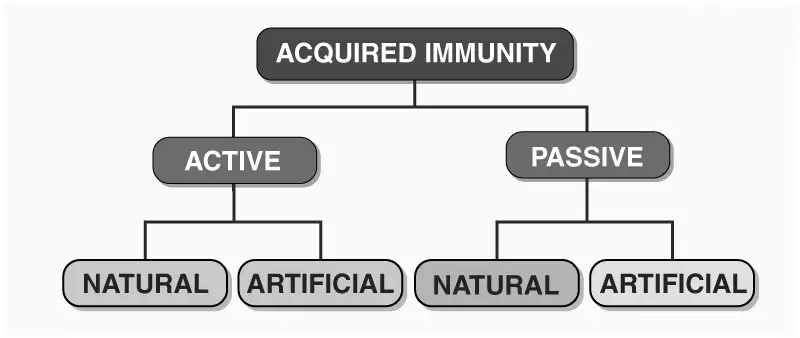
Illustration of innate immune components and their functions
Adaptive Immunity: Tailored Defense Against Pathogens
Understanding Acquired Immunity and Its Specificity
Acquired immunity develops after birth as the immune system encounters various pathogens. Unlike innate immunity, it is highly specific and involves the production of antibodies and activation of lymphocytes that target particular antigens. This system not only combats current infections but also retains memory to provide faster and stronger responses upon future exposures.
This adaptive response is essential for long-term protection and is the basis for vaccination.
Example: Immune Memory Formation
Problem: A person is infected with a virus for the first time and recovers. Explain how the immune system responds if the same virus infects again.
Solution:
During the first infection, B-cells produce antibodies specific to the virus antigen, constituting the primary immune response.
Memory B-cells and T-cells are generated and remain in the body after recovery.
Upon re-exposure, these memory cells recognize the virus quickly and initiate a rapid and robust secondary immune response.
This accelerated response neutralizes the virus before symptoms develop, often preventing illness.
Cells Driving Adaptive Immunity
The adaptive immune system primarily involves two lymphocyte types:
B-cells: Mature in bone marrow and produce antibodies that neutralize pathogens in body fluids (humoral immunity).
T-cells: Mature in the thymus and include helper T-cells that coordinate immune responses, cytotoxic T-cells that kill infected cells, and regulatory T-cells that modulate immunity.
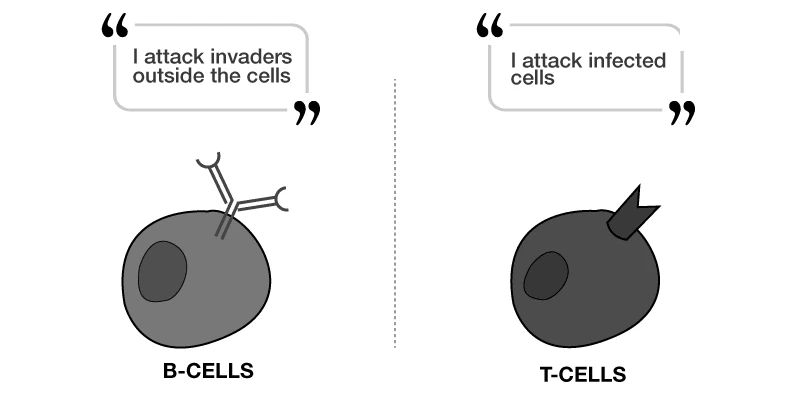
B-cells and T-cells: Key players in acquired immunity
Immune System Architecture and Immunization Strategies
Structure and Function of the Immune Network
The immune system is a complex network of cells, tissues, and organs working together to protect the body from infections. It includes lymphoid organs such as bone marrow, thymus, spleen, lymph nodes, and lymphatic vessels. These organs facilitate the production, maturation, and activation of immune cells.
White blood cells, especially lymphocytes, play a central role in identifying and eliminating pathogens. The immune system also remembers previous encounters to mount faster responses in the future.
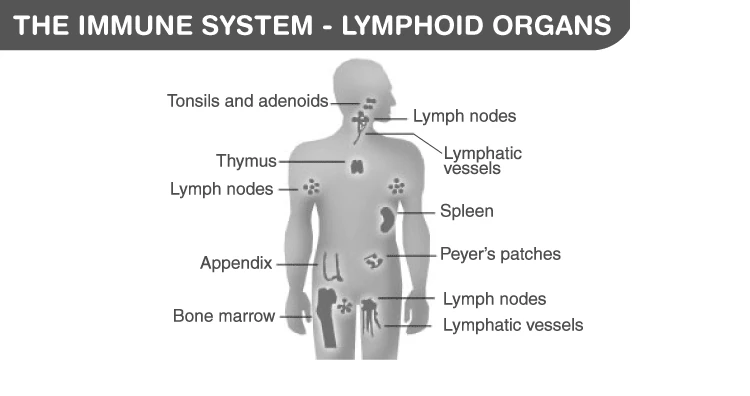
Lymphoid organs involved in immune defense
Vaccination: Artificially Induced Immunity
Vaccines contain weakened or inactive parts of pathogens (antigens) that stimulate the immune system without causing disease. This exposure trains the body to produce antibodies and memory cells, providing protection against future infections.
For example, the smallpox vaccine introduces smallpox antigens, prompting the immune system to prepare defenses that prevent the disease upon real exposure.
Example: Calculating Antibody Concentration Post Vaccination
Problem: After vaccination, a person's blood contains antibodies at a concentration of \( 150 \text{ units/mL} \). If the antibody concentration doubles every 3 days, what will be the concentration after 9 days?
Solution:
The antibody concentration doubles every 3 days, so after 9 days (which is 3 intervals of 3 days), the concentration will be:
\[ 150 \times 2^3 = 150 \times 8 = 1200 \text{ units/mL} \]
Therefore, the antibody concentration after 9 days will be \( 1200 \text{ units/mL} \).
Summary Table: Key Aspects of Immunity
Aspect | Innate Immunity | Acquired Immunity |
|---|---|---|
Presence at Birth | Yes | No |
Specificity | Non-specific | Highly specific |
Response Time | Immediate | Delayed (days) |
Memory | Absent | Present |
Main Cells Involved | Phagocytes, Natural Killer Cells | B-cells, T-cells |
Type of Immunity | Natural, Non-specific | Adaptive, Specific |
Glossary of Important Terms
Term | Definition |
|---|---|
Antigen | A molecule capable of inducing an immune response, often found on pathogens. |
Antibody | A protein produced by B-cells that binds specifically to an antigen. |
Phagocyte | A cell that engulfs and digests foreign particles and pathogens. |
Macrophage | A large phagocytic cell that also signals other immune cells. |
Helper T-cell | A T-lymphocyte that activates other immune cells by releasing cytokines. |
Cytotoxic T-cell | A T-cell that kills infected or cancerous cells. |
Memory Cell | A lymphocyte that remembers a specific antigen for faster response upon re-exposure. |
Innate Immunity | Non-specific defense mechanisms present from birth. |
Acquired Immunity | Specific immunity developed after exposure to pathogens. |
Vaccine | A preparation containing antigens to stimulate protective immunity. |
Frequently Asked Questions
What distinguishes innate immunity from acquired immunity?
Innate immunity is the body's immediate, non-specific defense present from birth, while acquired immunity develops over time and targets specific pathogens with memory for future protection.
How do vaccines help in disease prevention?
Vaccines introduce harmless antigens to stimulate the immune system to produce antibodies and memory cells, preparing the body to fight real infections effectively.
What role do B-cells and T-cells play in immunity?
B-cells produce antibodies that neutralize pathogens, whereas T-cells help coordinate immune responses and kill infected cells.
Can the immune system attack the body's own cells?
Yes, in autoimmune diseases, the immune system mistakenly targets the body's own tissues, leading to conditions like Type I diabetes.
Why is the immune response slower during the first infection?
The first encounter with a pathogen triggers a primary response that takes time to produce specific antibodies; subsequent exposures elicit faster secondary responses due to immune memory.