Understanding the Genetic Code and Its Role in Protein Synthesis
Fundamentals of Genetic Coding in Protein Formation
Decoding the Language of Life: What Constitutes the Genetic Code?
The process of protein synthesis can be likened to translating one language into another. Here, the four-letter nucleotide alphabet of RNA is converted into a sequence of 20 amino acids that form proteins. This translation requires a precise correspondence between the nucleotide bases and amino acids.
The genetic code is a set of instructions that cells use to interpret the information encoded in DNA or mRNA sequences. Ribosomes perform this translation by linking amino acids in the order specified by mRNA. Transfer RNA (tRNA) molecules play a crucial role by carrying specific amino acids and reading the mRNA in triplets, known as codons.
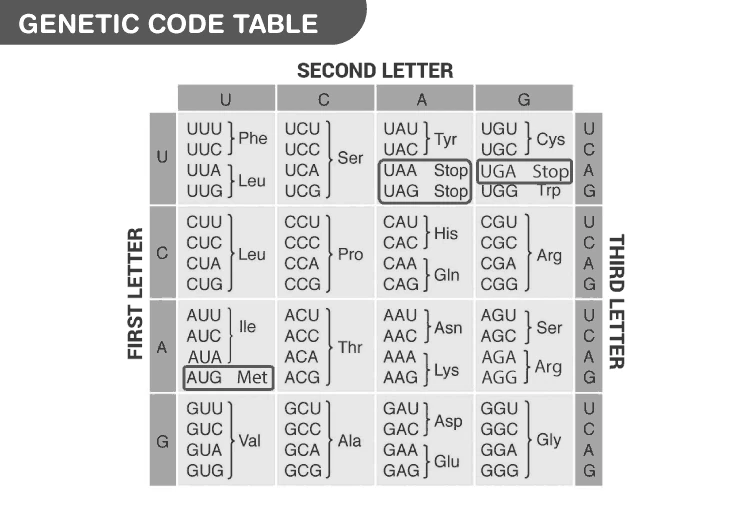
Genetic Code Table illustrating codon assignments to amino acids
Each codon consists of three nucleotides and corresponds to a specific amino acid or a stop signal during protein synthesis. For example, leucine is represented by six different codons, demonstrating the redundancy in the code.
Importantly, the genetic code is nearly universal, meaning that almost all organisms use the same codon assignments for protein synthesis, with only minor exceptions.
Example: Interpreting a Codon Sequence
Given the mRNA sequence 5’-AUG-GCU-CAA-3’, identify the amino acids encoded by each codon.
Solution:
The first codon,
AUG, is the start codon and codes for Methionine.The second codon,
GCU, codes for Alanine.The third codon,
CAA, codes for Glutamine.
Thus, the polypeptide chain begins with Methionine, followed by Alanine and Glutamine.
Key Characteristics of the Genetic Code
Triplet Nature and Sequential Reading of Codons
The genetic code is composed of codons, each made up of three nucleotides. This triplet structure ensures that 64 possible codons (4 bases raised to the power of 3) can encode 20 amino acids, allowing some amino acids to be represented by multiple codons.
Codons are read one after another without overlapping, meaning each nucleotide belongs to only one codon. For instance, the codon 5’-UCU-3’ codes for Serine, and the next codon 5’-AUG-3’ codes for Methionine.
Additionally, the code is commaless; there are no gaps or punctuation marks between codons in the mRNA sequence.
Example: Calculating Possible Codon Combinations
How many unique codons can be formed using the four RNA bases (A, U, G, C) arranged in triplets?
Solution:
Since each position in the codon can be any of the four bases, the total number of codons is:
\[ 4 \times 4 \times 4 = 4^3 = 64 \]
Therefore, 64 distinct codons are possible.
Directionality and Polarity in Codon Reading
Codons are always read in the 5’ to 3’ direction, which is critical for correct protein synthesis. Reading the sequence in reverse would change the codon and potentially code for a different amino acid, altering the protein's structure and function.
Example: Understanding Codon Polarity
Consider the codon 5’-AUG-3’. What would be the sequence if read in the reverse direction, and how would it affect the amino acid coded?
Solution:
The reverse sequence is 3’-GUA-5’, which corresponds to 5’-AUG-3’ reversed. This reversed codon codes for Valine instead of Methionine, demonstrating the importance of polarity in genetic coding.
Special Features and Exceptions in the Genetic Code
Degeneracy, Start and Stop Signals
The genetic code is degenerate, meaning most amino acids are encoded by more than one codon. For example, except for Methionine (AUG) and Tryptophan (UGG), multiple codons can specify the same amino acid, providing a buffer against mutations.
The codon AUG serves as the universal start signal, initiating protein synthesis by coding for Methionine in eukaryotes or N-formylmethionine in prokaryotes. Conversely, UAA, UAG, and UGA function as stop codons, signaling the end of translation and not coding for any amino acid.
Example: Identifying Start and Stop Codons
In the mRNA sequence 5’-AUG-CCG-UAA-3’, identify the start and stop codons and the amino acids coded.
Solution:
AUGis the start codon coding for Methionine.CCGcodes for Proline.UAAis a stop codon, signaling termination of translation.
The polypeptide chain will consist of Methionine followed by Proline before translation stops.
Universality and Notable Exceptions
While the genetic code is largely universal across organisms, some exceptions exist. Certain organisms reassign stop codons to code for amino acids, and alternative start codons like GUG can sometimes initiate translation, coding for Methionine instead of Valine.
These exceptions highlight the flexibility and evolutionary adaptations of the genetic code.
Exam Tip: Remember that AUG is the primary start codon, but GUG can also serve as a start codon in some prokaryotes. Stop codons never code for amino acids and signal the end of protein synthesis.
Quick Reference: Summary of Genetic Code Properties
Property | Description |
|---|---|
Triplet Code | Each amino acid is encoded by a sequence of three nucleotides (codon). |
Non-overlapping | Codons are read sequentially without sharing nucleotides. |
Commaless | No punctuation or gaps between codons in mRNA. |
Degenerate | Multiple codons can code for the same amino acid. |
Universal | Genetic code is nearly the same across all organisms. |
Start Codon | AUG (Methionine) initiates translation. |
Stop Codons | UAA, UAG, UGA signal termination of protein synthesis. |
Polarity | Codons are read in the 5’ to 3’ direction. |
Non-ambiguous | Each codon specifies only one amino acid. |
Exceptions | Some organisms have variations in codon assignments. |
Glossary of Key Terms
Term | Definition |
|---|---|
Codon | A sequence of three nucleotides in mRNA that codes for an amino acid or stop signal. |
Genetic Code | The set of rules by which information encoded in DNA or RNA sequences is translated into proteins. |
mRNA (Messenger RNA) | RNA molecule that carries genetic information from DNA to ribosomes for protein synthesis. |
tRNA (Transfer RNA) | RNA molecule that transports specific amino acids to the ribosome during translation. |
Ribosome | Cellular machinery that facilitates the assembly of amino acids into proteins. |
Start Codon | The codon (usually AUG) that signals the beginning of protein synthesis. |
Stop Codon | Codons (UAA, UAG, UGA) that signal the end of translation. |
Degeneracy | The phenomenon where multiple codons code for the same amino acid. |
Polarity | The directionality (5’ to 3’) in which codons are read during translation. |
Non-overlapping | Each nucleotide is part of only one codon in the sequence. |
Frequently Asked Questions
What is the significance of the triplet nature of the genetic code?
The triplet code allows 64 possible codons, which is sufficient to encode all 20 amino acids, providing redundancy and reducing errors during protein synthesis.
Why is the genetic code described as universal?
Because nearly all living organisms use the same codon assignments for amino acids, indicating a common evolutionary origin.
What roles do start and stop codons play in protein synthesis?
Start codons signal the beginning of translation, while stop codons indicate its termination, ensuring proteins are synthesized correctly.
How does degeneracy in the genetic code benefit organisms?
Degeneracy provides a buffer against mutations, as multiple codons can code for the same amino acid, minimizing the impact of nucleotide changes.
Are there exceptions to the universal genetic code?
Yes, some organisms have variations where certain codons code differently, especially in mitochondrial genomes or some microorganisms.