Mechanisms of Gene Expression Control in Prokaryotes and Eukaryotes
Fundamentals of Gene Expression and Its Regulation
Understanding Gene Expression and Its Modulation
Gene expression refers to the process by which the information encoded in a gene is used to synthesize a functional product, typically a protein. This process can be influenced at multiple stages, resulting in variations in the amount or type of protein produced. Such modifications in gene activity are collectively termed gene regulation.
Gene regulation can occur at several levels including DNA replication, transcription, RNA processing, and translation. Each stage offers a potential control point to alter the final protein output, thereby enabling cells to adapt to changing internal and external environments.
For instance, errors during DNA replication can lead to mutations that affect gene function. Similarly, transcriptional control involves regulating the synthesis of RNA from DNA, while post-transcriptional mechanisms modify RNA before it is translated. Translational regulation affects how efficiently mRNA is converted into protein.
Example: Consider a bacterial enzyme called catalase that breaks down hydrogen peroxide into water and oxygen. If bacteria are placed in an environment lacking hydrogen peroxide, they cease producing catalase since it is no longer needed. This demonstrates how environmental conditions can regulate gene expression to conserve resources.
Gene Expression Control in Prokaryotic Cells
Regulatory Mechanisms at the Transcriptional Level
In prokaryotes, gene regulation predominantly occurs during the initiation of transcription. The binding of RNA polymerase to the promoter region of DNA is modulated by accessory proteins that either enhance or inhibit transcription. These proteins are classified as activators or repressors, respectively.
The operator region, located adjacent to the promoter, serves as the binding site for regulatory proteins that control the operon's activity. This arrangement allows coordinated regulation of multiple genes involved in a common pathway.
Example: In the case of the enzyme peroxidase, if the substrate hydrogen peroxide is absent, the gene encoding peroxidase is not expressed. This regulation ensures that the enzyme is synthesized only when required, optimizing cellular efficiency.
The Lac Operon: A Model for Prokaryotic Gene Regulation
Structure and Function of the Lac Operon
The lac operon is a classic example of gene regulation in bacteria, specifically in Escherichia coli. It comprises a cluster of genes controlled by a single promoter that governs the metabolism and transport of lactose.
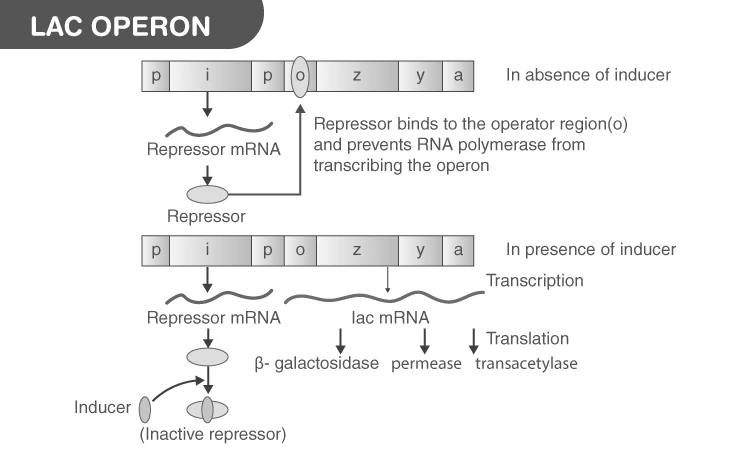
Illustration of the Lac Operon components and regulatory sites
The operon includes:
Regulatory gene (lacI): Produces the repressor protein that can inhibit transcription.
z gene (lacZ): Encodes beta-galactosidase, which breaks down lactose into glucose and galactose.
y gene (lacY): Codes for permease, facilitating lactose entry into the cell.
a gene (lacA): Produces transacetylase, assisting in lactose metabolism.
Lactose acts as an inducer by binding to the repressor protein, causing it to release from the operator site. This removal of repression allows RNA polymerase to transcribe the operon genes, enabling lactose utilization.
Example: Suppose a bacterial culture is grown in a medium containing lactose but no glucose. The presence of lactose inactivates the repressor, allowing transcription of the lac operon. Conversely, if glucose is abundant, the operon remains off to conserve energy.
Gene Regulation Strategies in Eukaryotic Organisms
Complex Control via Activators and Repressors
Eukaryotic gene expression is regulated through a sophisticated network of transcription factors that either promote or inhibit transcription. These factors bind to specific DNA sequences and influence the recruitment of RNA polymerase.
Unlike prokaryotes, eukaryotic transcription occurs in the nucleus, while translation takes place in the cytoplasm, adding additional layers of regulation. Post-transcriptional modifications such as RNA splicing further diversify gene expression outcomes.
Example: In eukaryotic cells, a repressor protein may bind to an enhancer region to block transcription of a gene involved in cell division, thereby preventing uncontrolled proliferation.
Summary Table: Key Points on Gene Regulation
Aspect | Prokaryotes | Eukaryotes |
|---|---|---|
Primary Regulation Level | Transcription initiation | Multiple levels including chromatin remodeling, transcription, and post-transcription |
Regulatory Proteins | Activators and repressors binding to operators and promoters | Transcription factors binding to enhancers, silencers, and promoters |
Operon Presence | Common (e.g., lac operon) | Rare or absent |
Location of Transcription and Translation | Both in cytoplasm | Transcription in nucleus, translation in cytoplasm |
Inducers and Corepressors | Lactose as inducer, glucose affects activation | Various hormones and signaling molecules |
Glossary of Essential Terms
Term | Definition |
|---|---|
Gene Expression | The process by which information from a gene is used to synthesize a functional product, usually a protein. |
Operon | A cluster of genes under the control of a single promoter, transcribed together in prokaryotes. |
Promoter | A DNA sequence where RNA polymerase binds to initiate transcription. |
Repressor | A protein that binds to DNA to inhibit gene transcription. |
Activator | A protein that increases gene transcription by assisting RNA polymerase binding. |
Inducer | A molecule that binds to a repressor to inactivate it, allowing gene expression. |
Beta-galactosidase | An enzyme that breaks down lactose into glucose and galactose. |
Permease | A protein that facilitates the transport of lactose into the bacterial cell. |
Transcription Factor | A protein that regulates gene expression by binding to specific DNA sequences. |
RNA Splicing | Post-transcriptional modification where introns are removed from pre-mRNA. |
Frequently Asked Questions
What is the main function of the lac operon in bacteria?
The lac operon controls the metabolism of lactose by regulating genes responsible for its transport and breakdown, enabling bacteria to use lactose as an energy source when glucose is absent.
How does lactose act as an inducer in the lac operon?
Lactose binds to the repressor protein, causing it to detach from the operator region, which allows RNA polymerase to transcribe the operon genes.
Why is gene regulation important for cells?
Gene regulation allows cells to adapt to environmental changes, conserve energy, and ensure proteins are produced only when needed.
At which stage is gene regulation most common in prokaryotes?
Gene regulation in prokaryotes primarily occurs at the initiation of transcription.
How do eukaryotic cells differ from prokaryotes in gene regulation?
Eukaryotic gene regulation is more complex, involving multiple levels such as chromatin remodeling, transcription factors, and RNA processing, with transcription and translation occurring in separate cellular compartments.