Comprehensive Overview of Ecosystems: Structure, Types, and Functions
Understanding Ecosystems: Definition and Core Concept
What Constitutes an Ecosystem?
An ecosystem represents a dynamic unit where living organisms coexist and interact with the physical environment around them. This interaction forms a complex network of relationships that sustain life and maintain ecological balance. The term was introduced by A.G. Tansley in 1935 to describe this integrated system of biotic and abiotic elements.
In essence, an ecosystem is a functional and structural ecological unit where energy flows and matter cycles through living beings and their surroundings.
Example: Consider a small pond where fish, plants, microorganisms, water, and sunlight interact. This pond forms a miniature ecosystem where each component influences the others, maintaining a balanced environment.
Illustration shows a forested mountainous landscape with the word "ECOSYSTEM" written across it.
Components and Organization of Ecosystems
Living Elements: Biotic Components
Biotic components encompass all living organisms within an ecosystem. These are classified based on their nutritional habits into producers, consumers, and decomposers. Producers, mainly plants, synthesize their own food through photosynthesis, forming the base of the food chain. Consumers rely on other organisms for nourishment and are further divided into primary (herbivores), secondary (carnivores or omnivores), tertiary, and sometimes quaternary consumers, which occupy higher trophic levels. Decomposers, such as fungi and bacteria, break down dead organic matter, recycling nutrients back into the ecosystem.
Example: In a forest ecosystem, trees act as producers, deer as primary consumers feeding on plants, wolves as secondary consumers preying on deer, and fungi as decomposers breaking down fallen leaves and dead animals.
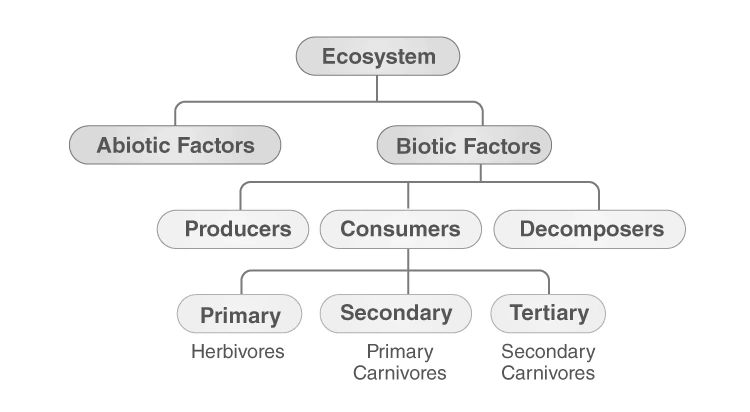
Representation of biotic components in an ecosystem
Non-living Elements: Abiotic Components
Abiotic factors are the physical and chemical elements that influence the living organisms in an ecosystem. These include air, water, soil, minerals, sunlight, temperature, wind, altitude, and other environmental conditions. These components provide the necessary conditions for life and affect the distribution and functioning of organisms.
Example: In a desert ecosystem, abiotic factors like high temperature, low rainfall, and sandy soil shape the types of plants and animals that can survive there.
Varieties and Roles of Ecosystems
Classification of Ecosystems by Habitat
Ecosystems vary widely in size and type, ranging from tiny ponds to vast oceans. They are broadly categorized into terrestrial and aquatic ecosystems based on their location.
Terrestrial Ecosystems
These ecosystems exist on land and include diverse habitats such as forests, grasslands, tundras, and deserts. Each type supports unique communities of plants and animals adapted to specific climatic and soil conditions.
Example: A tropical rainforest is a terrestrial ecosystem characterized by dense vegetation, high rainfall, and rich biodiversity, whereas a tundra is cold, treeless, and has limited vegetation.
Aquatic Ecosystems
Aquatic ecosystems are found in water bodies and are divided into freshwater and marine ecosystems. Freshwater ecosystems include lakes, rivers, and wetlands with low salt content, while marine ecosystems cover oceans and seas with higher salinity and diverse marine life.
Components and interactions within an aquatic ecosystem
Example: A coral reef is a marine ecosystem known for its vibrant biodiversity, whereas a freshwater lake supports fish, aquatic plants, and microorganisms adapted to low salinity.
Essential Functions and Ecological Principles of Ecosystems
Key Roles Performed by Ecosystems
Ecosystems perform vital functions that sustain life and maintain environmental stability. They regulate ecological processes, facilitate nutrient cycling between living and non-living components, balance trophic levels, and enable energy flow through various organisms.
Important functional units include:
Productivity: The rate at which biomass is generated by producers.
Energy Flow: The transfer of energy from the sun through producers to consumers and decomposers.
Decomposition: Breakdown of dead organic matter, primarily occurring in soil.
Nutrient Cycling: Recycling of essential elements for reuse by organisms.
Example: In a grassland, sunlight energy is captured by grasses (producers), consumed by herbivores (primary consumers), then by carnivores (secondary consumers), and finally decomposed by microbes, completing the nutrient cycle.
Fundamental Ecological Concepts
Food Chain
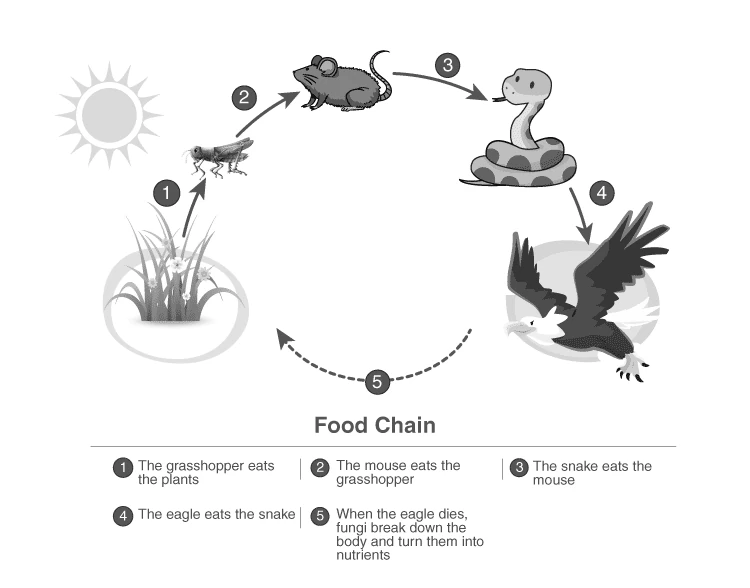
The food chain illustrates the linear flow of energy from the sun to producers and through various consumer levels until apex predators or decomposers. It highlights the dependency of organisms on one another for energy.
Ecological Pyramid
An ecological pyramid graphically represents the number, biomass, or energy at each trophic level. Typically, producers form the broad base, followed by successive consumer levels with decreasing numbers and biomass.
Example: Grasshoppers feed on abundant crops, mice prey on grasshoppers, snakes consume mice, and eagles hunt snakes, demonstrating the pyramid of numbers in a terrestrial ecosystem.
Food Web
A food web is a complex network of interconnected food chains within an ecosystem, showing multiple feeding relationships and energy pathways. It emphasizes the interdependence of species and the stability of ecosystems.
Quick Reference: Ecosystem Summary Table
Aspect | Description | Examples |
|---|---|---|
Definition | Community of living organisms interacting with non-living environment | Forest, Pond, Desert |
Biotic Components | Producers, Consumers (Primary to Quaternary), Decomposers | Trees, Deer, Wolves, Fungi |
Abiotic Components | Non-living factors like air, water, soil, sunlight, temperature | Sunlight, Minerals, Wind |
Types | Terrestrial and Aquatic ecosystems | Forest, Desert, Freshwater, Marine |
Functions | Energy flow, nutrient cycling, decomposition, productivity | Photosynthesis, Food chains, Decomposition |
Ecological Concepts | Food chain, Food web, Ecological pyramid | Grasshopper-mouse-snake-eagle chain |
Glossary of Key Terms
Term | Meaning |
|---|---|
Autotroph | Organisms that produce their own food via photosynthesis |
Biotic Components | Living parts of an ecosystem such as plants and animals |
Abiotic Components | Non-living physical and chemical factors in an ecosystem |
Decomposers | Organisms that break down dead matter and recycle nutrients |
Food Chain | Sequence of organisms each dependent on the next as a source of food |
Food Web | Interconnected food chains within an ecosystem |
Ecological Pyramid | Graphical representation of trophic levels by number, biomass, or energy |
Productivity | Rate of biomass production by producers in an ecosystem |
Nutrient Cycling | Movement and exchange of organic and inorganic matter back into the production of living matter |
Trophic Level | Position an organism occupies in a food chain |
Frequently Asked Questions
What defines an ecosystem?
An ecosystem is a community of living organisms interacting with their physical environment, forming a system of energy flow and nutrient cycling.
What are the main types of ecosystems?
There are two primary types: terrestrial ecosystems (land-based) and aquatic ecosystems (water-based), each with various subtypes like forests, deserts, freshwater, and marine ecosystems.
What are the key functional components of an ecosystem?
The main functional components include productivity, energy flow, decomposition, and nutrient cycling, which together sustain ecosystem processes.
Which ecosystem do humans primarily inhabit?
Humans mainly live in terrestrial ecosystems, which include forests, grasslands, deserts, and urban environments.
Why are decomposers important in ecosystems?
Decomposers break down dead organic matter, recycling nutrients back into the soil, which supports plant growth and maintains ecosystem health.