Understanding Ecological Pyramids and Their Significance
Fundamentals of Ecological Pyramids
Concept and Structure of Ecological Pyramids
An ecological pyramid visually illustrates the relationships among organisms across various trophic levels within an ecosystem. Originating from Charles Elton's pyramid of numbers, the concept was further expanded by G. Evelyn Hutchinson and Raymond Lindeman to include pyramids of energy and productivity. These pyramids typically resemble a geometric pyramid, with the broad base representing producers, followed by successive consumer levels above.
When constructing these pyramids, it is essential to consider all organisms within a trophic level to avoid significant inaccuracies that arise from sampling only a few species or individuals.
Example: In a forest ecosystem, if the producer level consists of 10,000 plants, the primary consumers might be 1,000 herbivores, and secondary consumers 100 carnivores, the pyramid visually represents this decrease in numbers at higher trophic levels.
Classification of Ecological Pyramids
Numerical Pyramid: Counting Organisms at Each Level
The pyramid of numbers quantifies the count of organisms present at each trophic level. Typically, this pyramid is upright, indicating a larger number of producers compared to consumers. However, exceptions exist, such as in detritus food chains where numerous decomposers feed on a single dead organism, resulting in an inverted pyramid.
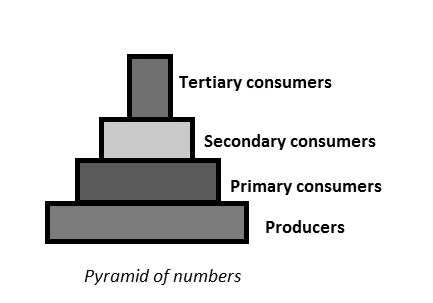
Diagram showing the pyramid of numbers
Example: In a grassland, if 500 grass plants support 50 grasshoppers, which in turn support 5 frogs, the pyramid of numbers will be upright. But in a tree ecosystem, one tree may support hundreds of insects, creating an inverted pyramid.
Biomass Pyramid: Measuring Organic Matter at Each Level
This pyramid represents the total biomass, or organic material, present at each trophic level. Usually, the biomass pyramid is upright, reflecting greater mass at the producer level. However, in aquatic ecosystems, the pyramid can be inverted because small phytoplankton biomass supports a larger biomass of zooplankton.
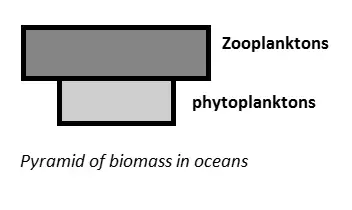
Pyramid of biomass illustrating oceanic trophic levels
Example: In a pond, if phytoplankton biomass is 2 kg, and zooplankton biomass is 5 kg, the biomass pyramid is inverted, showing more biomass at the consumer level than producers.
Energy Pyramid: Flow of Energy Through Trophic Levels
The energy pyramid depicts the amount of energy transferred through each trophic level. It is always upright because energy transfer is unidirectional and energy is lost as heat at each step, following the second law of thermodynamics.
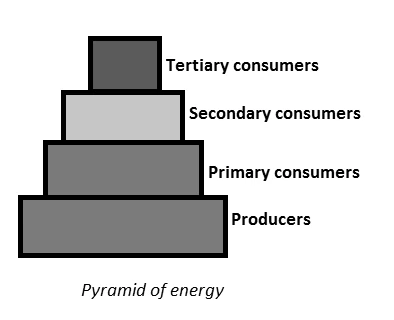
Energy pyramid showing energy decrease at higher trophic levels
Example: If producers capture 10,000 kJ of energy, primary consumers receive 1,000 kJ, and secondary consumers get 100 kJ, the energy pyramid clearly shows the diminishing energy available at each level.
Significance and Constraints of Ecological Pyramids
Role of Ecological Pyramids in Ecosystem Analysis
Ecological pyramids serve as valuable tools to understand feeding relationships and energy flow within ecosystems. They help assess the efficiency of energy transfer and monitor ecosystem health, enabling early detection of environmental disturbances.
Example: By analyzing the energy pyramid of a forest, ecologists can identify if energy transfer is efficient or if certain trophic levels are under stress, indicating potential ecosystem imbalance.
Limitations and Challenges in Ecological Pyramid Application
Despite their usefulness, ecological pyramids have several limitations. They do not account for complex food webs where species occupy multiple trophic levels. Saprophytes, which play a crucial role in nutrient cycling, are often excluded. Additionally, these pyramids are best suited for simple food chains and do not reflect seasonal or climatic variations. The presence of the same species at different trophic levels is also not considered.
Example: In a forest, a bird species might feed on both insects and fruits, occupying multiple trophic levels, which a simple pyramid cannot accurately represent.
Quick Reference: Summary of Ecological Pyramid Types
Type of Pyramid | Basis | Typical Shape | Notable Exception |
|---|---|---|---|
Pyramid of Numbers | Count of organisms at each trophic level | Usually upright | Inverted in detritus food chains |
Pyramid of Biomass | Total biomass of organisms | Generally upright | Inverted in aquatic ecosystems |
Pyramid of Energy | Energy flow through trophic levels | Always upright | None |
Glossary of Key Terms
Term | Definition |
|---|---|
Ecological Pyramid | A graphical model showing the number, biomass, or energy of organisms at different trophic levels. |
Trophic Level | A position in a food chain occupied by a group of organisms with similar feeding habits. |
Producers | Organisms, usually plants, that produce energy through photosynthesis. |
Primary Consumers | Herbivores that feed directly on producers. |
Secondary Consumers | Carnivores that feed on primary consumers. |
Biomass | The total mass of living organisms in a given area or trophic level. |
Energy Flow | The transfer of energy from one trophic level to another in an ecosystem. |
Detritus Food Chain | A food chain that begins with dead organic matter and involves decomposers. |
Saprophytes | Organisms that feed on dead or decaying organic matter. |
10% Law | The principle that only about 10% of energy is transferred from one trophic level to the next. |
Frequently Asked Questions
What are the main types of ecological pyramids?
The three primary types are the pyramid of numbers, pyramid of biomass, and pyramid of energy, each representing different ecological parameters.
How does an ecological pyramid represent energy flow?
It shows the decreasing amount of energy available at each successive trophic level due to energy loss as heat and metabolic processes.
Why is the energy pyramid always upright?
Because energy transfer is unidirectional and energy is lost at each level, the energy available decreases from producers to top consumers, ensuring an upright shape.
Can one species occupy multiple trophic levels?
Yes, some species feed at different levels, which ecological pyramids do not fully capture, limiting their representation of complex food webs.
What is the significance of the 10% law in ecology?
It states that only about 10% of energy from one trophic level is passed to the next, explaining the decrease in energy and biomass at higher levels.