Understanding Double Fertilization in Flowering Plants
Fundamentals of Double Fertilization in Angiosperms
Concept and Mechanism of Double Fertilization
Double fertilization is a distinctive reproductive feature found exclusively in flowering plants, or angiosperms. This process involves the fusion of two male gametes with components of the female gametophyte. Specifically, one male gamete merges with the egg cell to form a diploid zygote, while the other male gamete fuses with two polar nuclei located in the central cell, resulting in a triploid primary endosperm nucleus. This dual fusion event is essential for seed and fruit development.
This mechanism ensures that the plant efficiently uses both sperm cells delivered by the pollen grain, promoting successful reproduction and nourishment of the developing embryo.
Example: In a hypothetical flowering plant, if the egg cell has a haploid chromosome number of \( n = 12 \), determine the chromosome number of the zygote and the primary endosperm nucleus formed after double fertilization.
Solution:
The egg cell is haploid with \( n = 12 \) chromosomes.
One male gamete (also haploid, \( n = 12 \)) fuses with the egg cell:
\[ \text{Zygote chromosome number} = n + n = 2n = 24 \]
The other male gamete fuses with two polar nuclei, each haploid (\( n = 12 \)):
\[ \text{Primary endosperm nucleus chromosome number} = n + n + n = 3n = 36 \]
Thus, the zygote is diploid with 24 chromosomes, and the primary endosperm nucleus is triploid with 36 chromosomes.
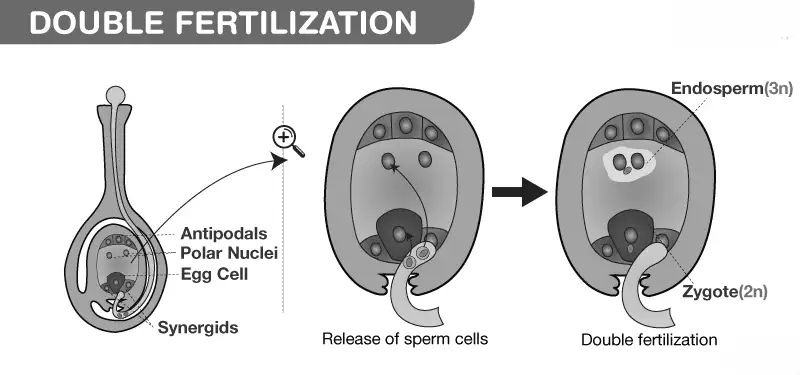
Illustration of the double fertilization process in angiosperms
Stages and Development Following Double Fertilization
Embryo Formation and Seed Development
After the completion of double fertilization, the zygote undergoes a series of cell divisions initiating embryogenesis. The first division produces two cells: the upper terminal cell, which forms the embryo proper, and the lower basal cell, which develops into the suspensor. The suspensor functions as a conduit, facilitating nutrient transfer from the parent plant to the growing embryo.
The embryo progresses through distinct stages: starting as a globular structure, then developing cotyledons that give it a heart shape, followed by bending and filling the seed cavity completely. Concurrently, the fertilized ovule matures into a seed, and the surrounding ovary tissue transforms into a fruit that encloses the seed.
Example: Consider a flowering plant where the zygote divides into a terminal and basal cell. Describe the roles of these two cells in embryonic development.
Solution:
The terminal cell divides repeatedly to form the pro-embryo, which eventually develops into the mature embryo.
The basal cell elongates and forms the suspensor, anchoring the embryo and facilitating nutrient transport from maternal tissues.
Importance and Biological Implications of Double Fertilization
Significance in Plant Reproduction and Survival
Double fertilization plays a crucial role in the reproductive success of angiosperms. It ensures the formation of both the embryo and the nutritive endosperm, which supports embryo growth. This process also triggers the ovary to develop into a fruit, aiding seed dispersal. Additionally, the utilization of both male gametes enhances reproductive efficiency and may lead to polyembryony, increasing the chances of seedling survival.
Example: Explain why double fertilization is absent in gymnosperms and how this affects their reproductive strategy.
Solution:
Gymnosperms lack ovaries; their male and female gametophytes are located on separate cones rather than within flowers.
Pollination occurs via wind, and fertilization involves only one sperm cell fusing with the egg, without the formation of endosperm.
As a result, gymnosperms do not exhibit double fertilization, relying instead on other mechanisms for seed nourishment.
Quick Reference: Key Points on Double Fertilization
Aspect | Details |
|---|---|
Definition | Fusion of one female gamete with two male gametes in angiosperms |
Products | Diploid zygote and triploid primary endosperm nucleus |
Significance | Formation of embryo and nutritive endosperm; fruit development |
Unique Feature | Exclusive to flowering plants (angiosperms) |
Embryo Development | Terminal cell forms embryo; basal cell forms suspensor |
Endosperm Role | Provides nourishment to the developing embryo |
Polyembryony | Possible due to double fertilization, enhancing survival |
Absence in Gymnosperms | Due to lack of ovaries and different fertilization process |
Discovery | Identified by Nawaschin in 1898 |
Pollination | Transfers pollen grains to stigma initiating fertilization |
Glossary of Terms Related to Double Fertilization
Term | Explanation |
|---|---|
Angiosperms | Flowering plants that produce seeds enclosed within fruits |
Double Fertilization | Process where two male gametes fertilize egg and polar nuclei |
Egg Cell | Female gamete involved in fertilization |
Endosperm | Nutrient-rich tissue formed after fusion of male gamete with polar nuclei |
Polar Nuclei | Two nuclei in the central cell of the embryo sac that fuse with a male gamete |
Primary Endosperm Nucleus (PEN) | Triploid nucleus formed by fusion of male gamete and polar nuclei |
Pro-embryo | Early stage of embryo formed from the terminal cell |
Suspensor | Structure derived from basal cell that supports embryo development |
Zygote | Diploid cell formed by fusion of egg and male gamete |
Triple Fusion | Fusion of one male gamete with two polar nuclei forming triploid endosperm |
Frequently Asked Questions on Double Fertilization
What exactly is double fertilization?
It is a process in flowering plants where one male gamete fertilizes the egg cell, and the other fuses with two polar nuclei, resulting in the formation of both a zygote and endosperm.
Why is double fertilization important for plants?
This process ensures the formation of a viable embryo and a nutritive endosperm, which supports embryo growth and triggers fruit development, enhancing reproductive success.
What are the main outcomes of double fertilization?
The two primary products are a diploid zygote that develops into the embryo and a triploid primary endosperm nucleus that forms the endosperm.
Why do gymnosperms not exhibit double fertilization?
Gymnosperms lack ovaries and have different reproductive structures; their fertilization involves only one sperm cell, so double fertilization does not occur.
Who discovered the phenomenon of double fertilization?
Double fertilization was first observed by Nawaschin in 1898 in certain liliaceous plants.