Understanding the Breakdown of Organic Matter: Decomposition Explained
The Role and Mechanism of Organic Matter Breakdown
Fundamentals of Organic Matter Decomposition
Decomposition refers to the natural process where complex organic materials are broken down into simpler substances through the activity of microorganisms. This transformation is vital for ecosystem sustainability as it recycles nutrients back into the environment. Microorganisms such as bacteria and fungi, collectively called decomposers, initiate this process by feeding on dead plants and animals, converting their complex compounds into simpler inorganic forms like carbon dioxide, water, and mineral nutrients.
These dead organic materials, known as detritus, serve as the primary input for decomposers, which are also termed saprophytes. The metabolic activities of these organisms facilitate the gradual disintegration of organic matter, ensuring the continuous availability of essential nutrients for living organisms.
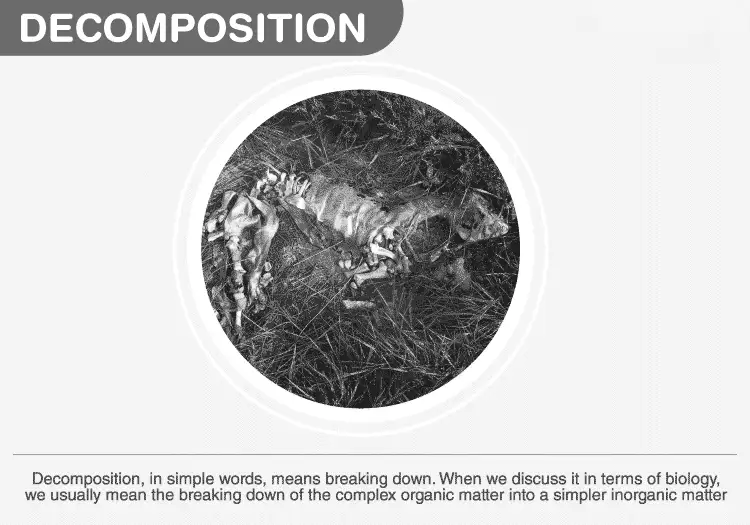
Illustration depicting the decomposition of organic substances by microorganisms
Example Problem
In a forest ecosystem, a fallen tree weighing 50 kg undergoes decomposition. If the decomposers convert 80% of the organic matter into inorganic nutrients over a period of 6 months, calculate the mass of inorganic nutrients released.
Solution:
The mass of inorganic nutrients released is calculated as:
\[ \text{Mass of inorganic nutrients} = 0.80 \times 50 \text{ kg} = 40 \text{ kg} \]
Therefore, 40 kg of inorganic nutrients are returned to the soil, enriching it for plant growth.
Key Factors Influencing the Rate of Decomposition
The speed at which decomposition occurs is influenced by several environmental and chemical factors. Understanding these helps in predicting nutrient cycling in different ecosystems.
Quality of Organic Material: The chemical composition and structure of the litter affect decomposition. For instance, materials rich in lignin decompose more slowly due to their complex structure.
Temperature: Microbial activity is temperature-dependent. Warmer conditions generally accelerate decomposition, while colder climates slow it down.
Oxygen Availability: Aerobic microorganisms require oxygen to thrive. In waterlogged or compacted soils where oxygen is scarce, anaerobic decomposition predominates, which is slower.
Soil pH: The acidity or alkalinity of soil affects microbial populations and their efficiency in breaking down organic matter.
Presence of Inorganic Nutrients: Elements like potassium, calcium, and magnesium released during decomposition can influence microbial growth and activity.
Moisture Content: Adequate water is essential for microbial metabolism and enzymatic reactions involved in decomposition.
Example Problem
In a garden, two piles of leaf litter are placed: one in a shaded, moist area and another in a dry, sunny spot. Which pile will decompose faster and why?
Solution:
The pile in the shaded, moist area will decompose faster because moisture supports microbial activity and cooler temperatures prevent drying out. The dry, sunny pile lacks sufficient moisture, slowing down microbial processes.
Stages Involved in the Decomposition Process
Stepwise Breakdown of Organic Matter
Decomposition unfolds through a series of distinct phases, each contributing to the gradual transformation of organic material into nutrient-rich soil components. These stages ensure the efficient recycling of matter within ecosystems.
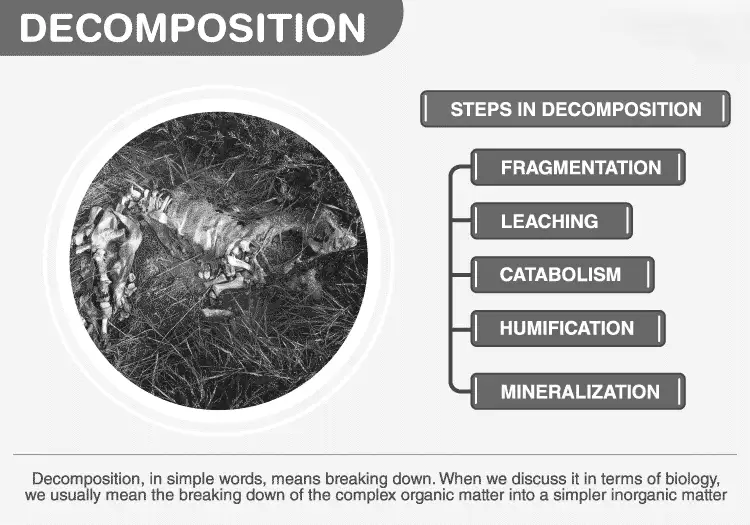
Phases illustrating the decomposition of organic matter
Fragmentation
This initial phase involves the physical breakdown of dead organic material into smaller fragments by detritivores such as earthworms and insects. This increases the surface area available for microbial action.
Leaching
Water-soluble nutrients are washed out from the fragmented material and percolate into the soil. This process removes inorganic substances like nitrates and phosphates, making them accessible to plants.
Catabolic Breakdown
Microorganisms secrete enzymes that chemically degrade complex organic molecules into simpler inorganic compounds. This enzymatic activity is crucial for nutrient release.
Humus Formation
Some organic matter resists complete breakdown and forms humus, a dark, nutrient-rich, and stable substance that enhances soil fertility and water retention.
Mineralization
The final phase where humus is further decomposed, releasing essential inorganic nutrients like nitrogen, phosphorus, and potassium back into the soil for plant uptake.
Example Problem
During the mineralization phase, 25% of humus mass is converted into inorganic nutrients over 3 months. If the initial humus mass is 200 kg, calculate the amount of nutrients released.
Solution:
\[ \text{Nutrients released} = 0.25 \times 200 \text{ kg} = 50 \text{ kg} \]
Thus, 50 kg of inorganic nutrients become available for plant absorption.
Environmental Conditions Affecting Decomposition Efficiency
Impact of Temperature and Moisture on Decomposer Activity
The effectiveness of decomposition is highly sensitive to environmental conditions, particularly temperature and moisture. These factors regulate microbial metabolism and population dynamics.
Low temperatures tend to inhibit microbial growth, slowing down the breakdown of organic matter. Conversely, moderate to warm temperatures enhance enzymatic reactions, accelerating decomposition. Moisture availability is equally critical; insufficient water limits microbial activity, while excessive water can create anaerobic conditions, reducing decomposition rates.
Exam Tip: Remember that low temperature and lack of oxygen slow down decomposition, while optimal moisture and temperature promote it.
Example Problem
Which of the following conditions would most likely slow down the decomposition process?
A) Warm temperature with adequate moisture
B) Low temperature with dry soil
C) Moderate temperature with good aeration
D) Warm temperature with high oxygen levels
Answer: Option B – Low temperature with dry soil inhibits microbial activity, thus slowing decomposition.
Quick Reference: Summary of Decomposition Essentials
Aspect | Description |
|---|---|
Definition | Breakdown of complex organic matter into simpler inorganic substances by microorganisms. |
Primary Agents | Bacteria, fungi, and detritivores (saprophytes). |
Key Stages | Fragmentation, Leaching, Catabolism, Humification, Mineralization. |
Influencing Factors | Temperature, moisture, oxygen availability, litter quality, soil pH, inorganic nutrients. |
End Products | Carbon dioxide, water, mineral nutrients, humus. |
Glossary of Key Terms
Term | Meaning |
|---|---|
Decomposition | The process of breaking down organic matter into simpler substances. |
Detritus | Dead organic material such as fallen leaves and dead animals. |
Decomposers | Microorganisms like bacteria and fungi that break down dead matter. |
Saprophytes | Organisms that feed on dead organic material. |
Fragmentation | Physical breakdown of organic matter into smaller pieces. |
Leaching | Removal of water-soluble nutrients from organic matter into the soil. |
Catabolism | Enzymatic breakdown of complex molecules into simpler compounds. |
Humus | Stable, dark organic material formed during decomposition. |
Mineralization | Conversion of organic matter into inorganic nutrients. |
Aerobic | Processes or organisms that require oxygen. |
Frequently Asked Questions
What organisms are primarily responsible for decomposition?
Decomposers such as bacteria and fungi play the main role in breaking down dead organic matter into simpler substances.
How does temperature affect the decomposition process?
Higher temperatures generally speed up microbial activity and decomposition, while low temperatures slow it down.
Why is oxygen important for decomposition?
Oxygen supports aerobic decomposers, which are more efficient at breaking down organic matter compared to anaerobic organisms.
What is humus and why is it important?
Humus is a stable organic substance formed during decomposition that enriches soil fertility and improves its structure.
Can decomposition occur in waterlogged soils?
Yes, but mainly through anaerobic microorganisms, which decompose organic matter more slowly due to lack of oxygen.