Understanding the Carbon Cycle: Movement and Impact of Carbon on Earth
Overview of Carbon Movement Across Earth's Systems
Fundamentals of the Carbon Cycle
The carbon cycle describes the continuous exchange of carbon atoms through Earth's various spheres including the atmosphere, biosphere, geosphere, hydrosphere, and pedosphere. Carbon exists in elemental forms such as diamond and graphite, and in combined forms like carbonates in minerals and carbon dioxide gas in the atmosphere. This cycle ensures the recycling of carbon essential for life and environmental balance.
Carbon compounds circulate through living organisms, the air, water bodies, and geological formations, maintaining equilibrium in Earth's ecosystems.
Example: Consider a forest ecosystem where carbon dioxide from the air is absorbed by trees during photosynthesis, converted into organic molecules, and then transferred through herbivores and carnivores. When these organisms die, decomposers break down their bodies, releasing carbon back into the atmosphere, completing the cycle.
Visualizing Carbon Flow
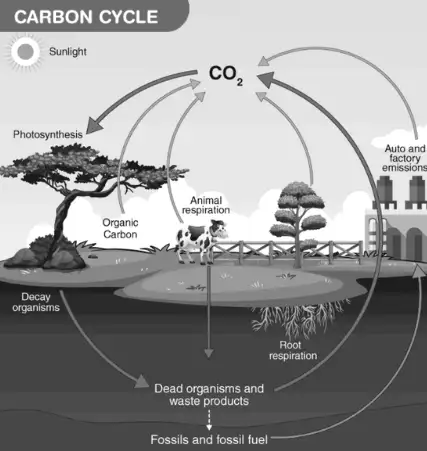
Illustration of the carbon cycle showing carbon sources and pathways
Carbon Exchange Processes on Land
Carbon Dynamics in Terrestrial Environments
Carbon dioxide in the atmosphere is absorbed by plants through photosynthesis, where it is converted into carbohydrates using sunlight energy. This process forms the foundation of the terrestrial carbon cycle. Animals consume these plants, incorporating carbon into their bodies. Respiration by plants and animals releases carbon dioxide back into the atmosphere. Decomposers further facilitate this return by breaking down dead organic matter.
The photosynthesis reaction can be represented as:
Example: A tree absorbs 15 kg of carbon dioxide daily for photosynthesis. If a herbivore consumes 5 kg of this biomass, calculate the amount of carbon dioxide released back into the atmosphere through respiration by the herbivore assuming 80% of the consumed carbon is respired.
Solution:
Carbon consumed by herbivore = 5 kg
Carbon respired = 80% of 5 kg = \(0.8 \times 5 = 4 \text{ kg}\)
Therefore, the herbivore releases 4 kg of carbon dioxide back into the atmosphere daily through respiration.
Carbon Cycle in Marine Ecosystems
Role of Oceans as Carbon Reservoirs
Oceans act as significant carbon sinks by absorbing more carbon dioxide than they emit. Marine organisms utilize carbon to form calcium carbonate shells, which contribute to the oceanic carbon cycle. When these organisms die, their shells accumulate on the seabed, eventually forming sedimentary rocks like limestone under pressure. Weathering of these rocks releases carbon dioxide back into the atmosphere, completing the cycle.
Example: Suppose a marine ecosystem produces 2000 kg of calcium carbonate shells annually. If 10% of these shells dissolve and release carbon dioxide into the atmosphere, calculate the amount of carbon dioxide released.
Solution:
Shells dissolving = 10% of 2000 kg = \(0.10 \times 2000 = 200 \text{ kg}\)
Assuming all dissolved shells release an equivalent mass of carbon dioxide, 200 kg of carbon dioxide is released into the atmosphere annually from this process.
Significance of the Carbon Cycle for Life and Climate
Environmental and Biological Importance
Although carbon dioxide constitutes a small fraction of the atmosphere, it plays a crucial role in regulating Earth's temperature by trapping heat, acting like a thermal blanket. Disruptions in the carbon cycle can lead to climate change and global warming. Biologically, carbon is fundamental to all life forms, forming the backbone of essential molecules such as proteins, lipids, and DNA. The carbon cycle, alongside nitrogen and oxygen cycles, sustains life by maintaining the balance of these vital elements.
Exam Tip: Remember that the carbon cycle links living organisms with the physical environment, making it essential for both ecological balance and climate regulation.
Example: Explain why an increase in fossil fuel combustion affects the carbon cycle and climate.
Answer:
Burning fossil fuels releases stored carbon as carbon dioxide into the atmosphere.
This excess CO2 enhances the greenhouse effect, trapping more heat.
It disrupts the natural carbon balance, contributing to global warming.
Long-term effects include climate change and altered ecosystems.
Summary Table: Key Aspects of the Carbon Cycle
Aspect | Description |
|---|---|
Definition | Exchange of carbon compounds among Earth's spheres: atmosphere, biosphere, geosphere, hydrosphere, and pedosphere. |
Main Processes | Photosynthesis, respiration, decomposition, fossil fuel formation, and combustion. |
Forms of Carbon | Elemental (diamond, graphite), combined (carbonates, CO2). |
Carbon Reservoirs | Atmosphere, terrestrial plants and animals, oceans, fossil fuels, sedimentary rocks. |
Environmental Role | Regulates Earth's temperature by trapping heat; essential for climate stability. |
Biological Role | Fundamental element in organic molecules necessary for life. |
Types of Carbon Cycle | Short-term (days to years) and long-term (thousands of years) cycles. |
Human Impact | Fossil fuel burning increases atmospheric CO2, affecting climate. |
Oceanic Role | Acts as a carbon sink; forms calcium carbonate shells and limestone. |
Decomposers | Break down dead matter, returning carbon to the atmosphere. |
Glossary of Terms Related to the Carbon Cycle
Term | Meaning |
|---|---|
Atmosphere | The layer of gases surrounding Earth, containing carbon dioxide. |
Biosphere | All living organisms on Earth that participate in the carbon cycle. |
Carbon Sink | A reservoir that absorbs more carbon than it releases, e.g., oceans. |
Decomposers | Organisms that break down dead matter, releasing carbon back to the environment. |
Fossil Fuels | Carbon-rich energy sources formed from ancient organic matter. |
Geosphere | Earth's solid parts including rocks and soil involved in carbon storage. |
Hydrosphere | All water bodies on Earth that interact with carbon compounds. |
Photosynthesis | Process by which plants convert CO2 and water into organic matter using sunlight. |
Respiration | Metabolic process releasing CO2 by organisms through energy production. |
Carbonate | A compound containing carbonate ions, often found in minerals and shells. |
Frequently Asked Questions About the Carbon Cycle
What is the carbon cycle and why is it important?
The carbon cycle is the natural process of exchanging carbon among Earth's spheres. It is vital because it sustains life by recycling carbon and regulates the planet's climate by controlling atmospheric carbon dioxide levels.
What are the main stages of the carbon cycle?
Carbon moves through photosynthesis, consumption by animals, respiration, decomposition, fossil fuel formation, and combustion, continuously cycling through living and non-living components.
How do oceans contribute to the carbon cycle?
Oceans absorb large amounts of carbon dioxide, support marine life that forms calcium carbonate shells, and store carbon in sediments, acting as a major carbon sink.
What happens when fossil fuels are burned?
Burning fossil fuels releases stored carbon as carbon dioxide into the atmosphere, increasing greenhouse gases and contributing to global warming.
How does the carbon cycle affect climate change?
Disruptions in the carbon cycle, especially increased CO2 from human activities, enhance the greenhouse effect, leading to climate change and global temperature rise.