Understanding Cancer: Causes, Types, Diagnosis, and Treatment
Fundamentals of Cancer and Tumour Formation
What Defines Cancer and How Tumours Develop
Cancer is a serious health condition that affects millions globally, with over 1.1 million new cases annually in India alone. It arises when the normal regulation of cell growth and division is disrupted, leading to uncontrolled proliferation. Normally, cells stop dividing when they come into contact with neighboring cells, a process known as contact inhibition. This mechanism prevents excessive cell growth.
In cancerous cells, contact inhibition fails, allowing cells to multiply unchecked. This loss of control often results in the formation of tumours, which are masses of abnormal cells. However, it is important to note that not all tumours are cancerous; only those that invade other tissues and spread are classified as malignant.
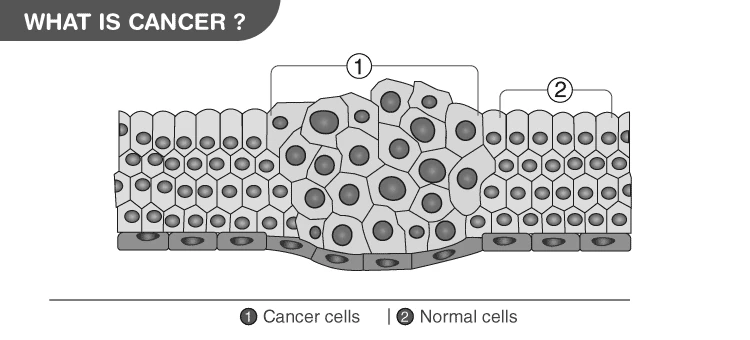
Microscopic image showing cancer cells
Example Problem
A healthy tissue has cells that stop dividing when they touch each other due to contact inhibition. If this mechanism fails, what is the likely outcome in terms of cell growth?
Solution:
Contact inhibition normally halts cell division upon cell contact.
If this fails, cells continue to divide uncontrollably.
This leads to the formation of tumours and potentially cancer.
Classification of Tumours and Their Characteristics
Understanding Different Tumour Types
Tumours are categorized based on their ability to spread or metastasize. There are three main types:
Benign Tumours: These remain confined to one area and do not invade other tissues. They are generally non-threatening but can be dangerous if located in sensitive areas like the brain. Surgical removal is often curative, and recurrence is rare.
Malignant Tumours: These are cancerous and grow rapidly. They invade surrounding healthy tissues and can spread to distant body parts through blood or lymphatic systems, forming secondary tumours.
Premalignant Tumours: These tumours have not yet spread but possess characteristics that may lead to malignancy. They represent an intermediate stage with a risk of becoming cancerous.
Example Problem
A patient has a tumour that has not spread but shows abnormal cell growth with potential to invade other tissues. How would this tumour be classified?
Solution:
The tumour is not yet metastatic but shows malignant features.
This fits the description of a premalignant tumour.
Close monitoring and treatment may prevent progression to malignancy.
Varieties of Cancer Based on Cell Origin
Types of Cancer According to Tissue Source
Cancers are medically classified by the type of cells from which they originate. The main categories include:
Carcinoma: The most prevalent type, arising from epithelial cells that line organs and skin.
Sarcoma: Originates in connective tissues such as bone, cartilage, and fat.
Melanoma: Develops from melanocytes, the pigment-producing cells in the skin.
Lymphoma and Leukaemia: Begin in blood-forming tissues or immune cells like lymphocytes and white blood cells.
Example Problem
A tumour is found to originate from the connective tissue of a patient's bone. What type of cancer is this most likely to be?
Solution:
Since the tumour arises from connective tissue, it is classified as a sarcoma.
Sarcomas affect tissues like bone, cartilage, and fat.
Treatment and prognosis differ from carcinomas and other cancer types.
Factors Leading to Cancer Development
Common Causes and Carcinogens
Cancer can be triggered by various external and internal factors known as carcinogens. These include:
Physical Agents: Exposure to ionizing radiation such as X-rays and gamma rays can damage DNA and initiate cancer.
Chemical Substances: Tobacco smoke and certain industrial chemicals are linked to cancer development.
Biological Factors: Some viruses and genetic mutations in oncogenes can promote uncontrolled cell growth.
Example Problem
Identify which of the following is NOT a carcinogen: Ionizing radiation, tobacco smoke, ultraviolet light, or water.
Solution:
Ionizing radiation, tobacco smoke, and ultraviolet light are known carcinogens.
Water is not a carcinogen.
Therefore, water does not contribute to cancer development.
Methods for Detecting and Diagnosing Cancer
Techniques Used to Identify Cancer Early
Early detection of cancer is crucial for effective treatment. Several diagnostic tools are employed, including:
Biopsy: Removal and microscopic examination of tissue samples.
Histopathology: Detailed study of tissue structure and abnormalities.
Imaging Techniques: Radiography, computed tomography (CT), and magnetic resonance imaging (MRI) help visualize tumours.
Molecular Biology: Genetic testing to identify cancer-related gene mutations.
Example Problem
A patient undergoes a CT scan and a biopsy to confirm the presence of a tumour. Why are both tests important?
Solution:
CT scan provides a visual map of the tumour's size and location.
Biopsy confirms the cellular nature and malignancy of the tumour.
Combining both ensures accurate diagnosis and treatment planning.
Approaches to Cancer Treatment
Common Therapeutic Strategies
Treatment options for cancer vary depending on the type and stage of the disease. The primary methods include:
Surgery: Physical removal of the tumour, especially effective for benign or localized cancers.
Radiation Therapy: Use of high-energy radiation to destroy cancer cells.
Chemotherapy: Administration of drugs that target rapidly dividing cells, though side effects like hair loss are common.
To mitigate side effects, immunotherapy agents such as interferons may be used to boost the patient's immune response during chemotherapy.
Example Problem
A patient with a localized benign tumour is advised to undergo surgery. What are the advantages of this treatment in such a case?
Solution:
Surgery can completely remove the tumour.
It prevents further growth and potential malignancy.
Recovery is usually faster with minimal side effects compared to other treatments.
Quick Reference Summary
Aspect | Key Points |
|---|---|
Definition | Uncontrolled cell division due to loss of contact inhibition |
Tumour Types | Benign (localized), Premalignant (potential to spread), Malignant (cancerous and metastatic) |
Cancer Types | Carcinoma, Sarcoma, Melanoma, Lymphoma & Leukaemia |
Causes | Physical (radiation), Chemical (tobacco), Biological (viruses, oncogenes) |
Diagnosis | Biopsy, Histopathology, Imaging (X-ray, CT, MRI), Molecular tests |
Treatment | Surgery, Radiation therapy, Chemotherapy, Immunotherapy |
Glossary of Important Terms
Term | Meaning |
|---|---|
Contact Inhibition | Process where cells stop dividing when touching other cells |
Tumour | Mass of abnormal cells formed by uncontrolled cell growth |
Benign Tumour | Non-cancerous tumour that does not spread |
Malignant Tumour | Cancerous tumour capable of invading other tissues |
Metastasis | Spread of cancer cells to distant body parts |
Carcinoma | Cancer originating from epithelial cells |
Sarcoma | Cancer arising from connective tissues |
Biopsy | Removal of tissue sample for examination |
Radiation Therapy | Use of radiation to kill cancer cells |
Chemotherapy | Drug treatment targeting rapidly dividing cells |
Frequently Asked Questions
What is the most concerning feature of malignant tumours?
Malignant tumours are dangerous because they grow rapidly and spread to other parts of the body through metastasis, invading healthy tissues and forming secondary tumours.
How does contact inhibition prevent cancer?
Contact inhibition stops cells from dividing when they touch each other, maintaining controlled growth. Loss of this mechanism leads to uncontrolled cell division and tumour formation.
Can benign tumours become cancerous?
Yes, benign tumours can develop into premalignant tumours and eventually become malignant if they acquire the ability to invade and spread.
What are the main methods used to diagnose cancer?
Diagnosis involves biopsy, histopathological examination, imaging techniques like X-rays, CT scans, MRI, and molecular biology tests to detect cancerous changes.
Why do chemotherapy patients often experience hair loss?
Chemotherapy drugs target rapidly dividing cells, including healthy hair follicle cells, leading to hair loss as a common side effect.