Comprehensive Overview of Biodiversity and Its Conservation
Understanding the Dimensions of Biodiversity
Exploring the Varied Forms of Biodiversity
Biodiversity encompasses the vast array of living organisms on Earth, including plants, animals, and microorganisms. It is broadly categorized into three fundamental types that highlight different levels of biological variation.
Genetic diversity refers to the range of genetic material present within a species. This diversity enables species to adapt to changing environments and is exemplified by the genetic differences observed in medicinal plants like Rauwolfia vomitoria.
Species diversity indicates the variety and abundance of different species within a particular ecological community. For instance, the Western Ghats exhibit a richer variety of amphibian species compared to the Eastern Ghats, reflecting higher species diversity.
Ecological diversity pertains to the diversity of ecosystems within a region, such as deserts, mangroves, and rainforests, each supporting distinct communities of organisms.
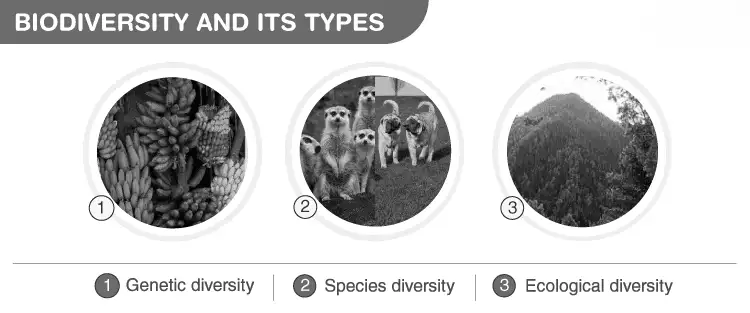
Illustration of the three primary biodiversity types
Example Problem: Identifying Biodiversity Types
Consider a forest where a rare medicinal plant shows significant genetic variation, the number of bird species is high, and the area includes both wetlands and dry forests. Classify the types of biodiversity represented in this forest.
Solution:
The genetic variation in the medicinal plant represents genetic diversity.
The high number of bird species indicates species diversity.
The presence of wetlands and dry forests reflects ecological diversity.
Patterns and Distribution of Biodiversity Across the Globe
Latitudinal Variation in Species Richness
Species richness tends to decline as one moves from the equator towards the poles. Tropical regions harbor a greater number of species compared to temperate and polar zones. This pattern arises due to several factors:
Tropical areas have experienced fewer disturbances over geological time, allowing species to diversify extensively.
The relatively stable and predictable climate in the tropics supports a wide range of species.
Abundant solar energy in these regions enhances primary productivity, fostering greater biodiversity.
Relationship Between Species Richness and Area
The number of species found in a habitat generally increases with the size of the area. This relationship is often represented by a rectangular hyperbola when plotted on a linear scale.
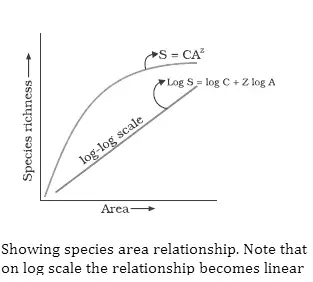
Graph illustrating the species-area relationship
On a logarithmic scale, this relationship can be expressed mathematically as:
\[ \log S = \log C + Z \log A \]
where:
\( S \) = species richness
\( A \) = area size
\( Z \) = slope of the regression line (indicating rate of increase)
\( C \) = intercept on the y-axis
Example Problem: Calculating Species Richness
In a study, the constants for a particular region are \( C = 2 \) and \( Z = 0.3 \). Estimate the species richness when the area is \( 500 \text{ km}^2 \).
Solution:
Using the formula:
\[ \log S = \log 2 + 0.3 \log 500 \]
Calculate each term:
\[ \log 2 = 0.3010, \quad \log 500 = 2.6990 \]
Substitute values:
\[ \log S = 0.3010 + 0.3 \times 2.6990 = 0.3010 + 0.8097 = 1.1107 \]
Find \( S \) by taking antilog:
\[ S = 10^{1.1107} \approx 12.9 \]
Therefore, approximately 13 species are expected in the area.
Threats to Biodiversity and Strategies for Its Preservation
Factors Leading to Biodiversity Decline
The reduction in biodiversity within ecosystems can cause several adverse effects, including:
Lowered plant productivity, affecting food chains and ecosystem stability.
Reduced resilience to environmental stresses such as droughts and climate change.
Increased fluctuations in ecosystem functions like water cycling and pest control.
Key causes of biodiversity loss include:
Habitat destruction and fragmentation: Conversion of natural habitats into urban or agricultural land.
Over-exploitation: Excessive hunting, fishing, or harvesting of species.
Invasion by alien species: Non-native species outcompeting indigenous flora and fauna.
Co-extinctions: Extinction of one species leading to the loss of dependent species.
Approaches to Safeguard Biodiversity
Conserving biodiversity involves protecting and managing biological resources to ensure their sustainability for future generations. Two primary conservation methods are:
In situ conservation: Preserving species within their natural habitats, such as in national parks, wildlife sanctuaries, biosphere reserves, and biodiversity hotspots.
Ex situ conservation: Protecting species outside their natural environments, including zoos, botanical gardens, aquariums, and gene banks.
Visual representation of biodiversity conservation techniques
Example Problem: Conservation Method Identification
A rare orchid species is cultivated in a botanical garden to protect it from extinction. Identify the conservation strategy used and explain its significance.
Solution:
This is an example of ex situ conservation because the species is preserved outside its natural habitat.
Such methods are crucial for protecting species that are critically endangered or whose natural habitats are severely threatened.
Ex situ conservation allows controlled breeding and research to aid in species recovery.
Exam Tip: Remember that in situ conservation maintains ecological processes and interactions, while ex situ conservation is vital for species that cannot survive in the wild.
Quick Reference: Key Points on Biodiversity and Conservation
Concept | Definition/Description |
|---|---|
Genetic Diversity | Variation of genes within a species enabling adaptability. |
Species Diversity | Number and variety of species in a community. |
Ecological Diversity | Diversity of ecosystems in a region. |
Latitudinal Gradient | Species richness decreases from equator to poles. |
Species-Area Relationship | Species number increases with habitat area, expressed as \(\log S = \log C + Z \log A\). |
Habitat Fragmentation | Breaking up of habitats into smaller, isolated patches. |
In situ Conservation | Protection of species in their natural habitats. |
Ex situ Conservation | Preservation of species outside their natural environments. |
Co-extinction | Extinction of one species causing loss of dependent species. |
Alien Species | Non-native species introduced to new habitats, often invasive. |
Glossary of Important Terms
Term | Meaning |
|---|---|
Biodiversity | The variety of life forms on Earth, including genetic, species, and ecosystem diversity. |
Genetic Diversity | Differences in DNA among individuals within a species. |
Species Richness | The count of different species in a given area. |
Ecological Diversity | Variety of ecosystems in a geographical location. |
Habitat Fragmentation | Division of habitats into smaller, isolated sections. |
In situ Conservation | Conservation of species in their natural habitats. |
Ex situ Conservation | Conservation of species outside their natural habitats. |
Co-extinction | Loss of one species leading to extinction of another dependent species. |
Alien Species | Species introduced to a new environment where they are not native. |
Species-Area Curve | Graph showing the relationship between area size and species number. |
Frequently Asked Questions (FAQs)
What causes the decline in biodiversity?
Biodiversity declines mainly due to habitat destruction, over-exploitation, invasive species, pollution, and climate change.
Why is biodiversity conservation important?
It ensures ecosystem stability, provides resources for humans, maintains genetic diversity, and supports ecological services like pollination.
What is the difference between in situ and ex situ conservation?
In situ conservation protects species in their natural habitats, while ex situ conservation involves safeguarding species outside their natural environments.
How does species richness vary with latitude?
Species richness is highest near the equator and decreases towards the poles due to climatic stability and productivity differences.
What is the significance of the species-area relationship?
It helps predict how many species an area can support and guides conservation planning by showing the impact of habitat size on biodiversity.