Understanding Asexual Reproduction in Animals
Fundamentals of Asexual Reproduction
Defining Asexual Reproduction and Its Characteristics
Asexual reproduction is a biological process where a single organism generates offspring without the involvement of gamete fusion. This mode of reproduction is predominantly observed in unicellular organisms and some multicellular animals. The offspring produced are genetically identical to the parent, forming clones, as there is no exchange or mixing of genetic material.
Key attributes of asexual reproduction include:
Absence of gamete formation and fertilization.
Involvement of only one parent organism.
Rapid reproduction cycle enabling quick population growth.
Offspring are exact genetic replicas of the parent, resulting in no genetic variation.
Efficient and straightforward growth of new individuals.
Example: Consider a bacterium that divides to form two identical daughter cells. This process exemplifies asexual reproduction where no gametes are involved, and the progeny are clones of the original cell.
Common Modes of Asexual Reproduction in Animals
Binary Fission: Splitting into Two Equal Parts
Binary fission is a straightforward method where a single parent cell divides into two equal daughter cells, each containing a nucleus. This process results in offspring that are genetically identical to the parent. Organisms such as amoeba, bacteria, and euglena reproduce through this mechanism.
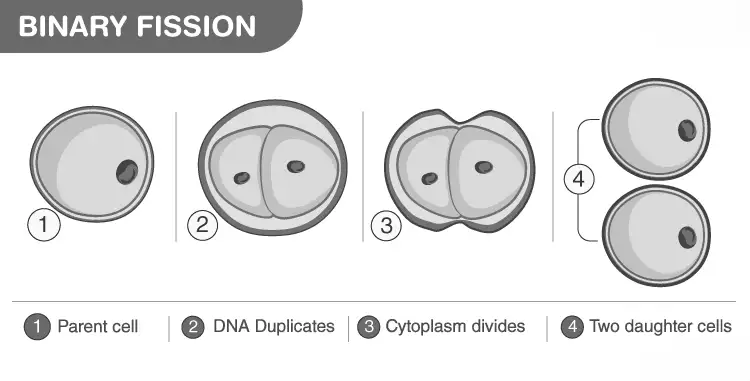
Illustration of Binary Fission
Example Problem: A single amoeba undergoes binary fission every 3 hours. Starting with one amoeba, how many amoebas will be present after 12 hours?
Solution:
The number of amoebas doubles every 3 hours.
Number of divisions in 12 hours = \( \frac{12}{3} = 4 \)
Total amoebas after 12 hours = \( 2^4 = 16 \)
Therefore, 16 amoebas will be present after 12 hours.
Budding: Growth from a Parent Outgrowth
Budding involves the formation of a new organism from a protrusion or bud on the parent’s body. This bud receives nourishment from the parent until it matures and detaches to live independently. Hydra is a classic example of an animal reproducing by budding.
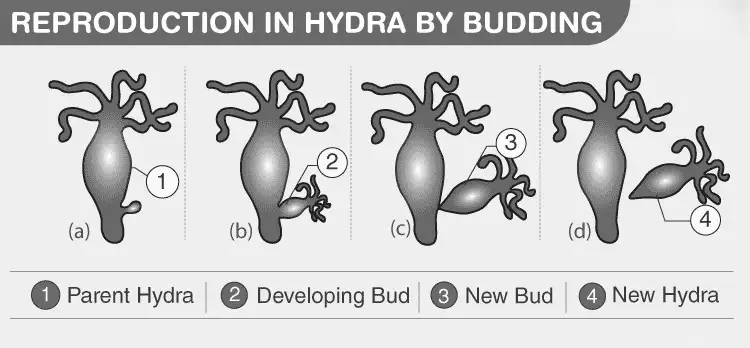
Budding observed in Hydra
Example Problem: A hydra produces 3 buds every week. If each bud takes 2 weeks to mature and detach, how many independent hydras will be present after 4 weeks starting from one hydra?
Solution:
Week 1: 1 hydra produces 3 buds (not yet detached)
Week 2: Those 3 buds mature and detach; original hydra produces 3 more buds
Total hydras at end of week 2 = 1 (original) + 3 (detached buds) = 4
Week 3: 4 hydras produce \(4 \times 3 = 12\) buds (not detached)
Week 4: 12 buds mature and detach; 4 hydras produce 12 more buds
Total hydras at end of week 4 = 4 + 12 = 16 hydras
Hence, after 4 weeks, there will be 16 independent hydras.
Fragmentation: Regeneration from Body Parts
Fragmentation is a process where the parent organism breaks into multiple fragments, each capable of growing into a new individual. This intentional separation is common in animals like planaria, where each piece regenerates the missing parts to form a complete organism.
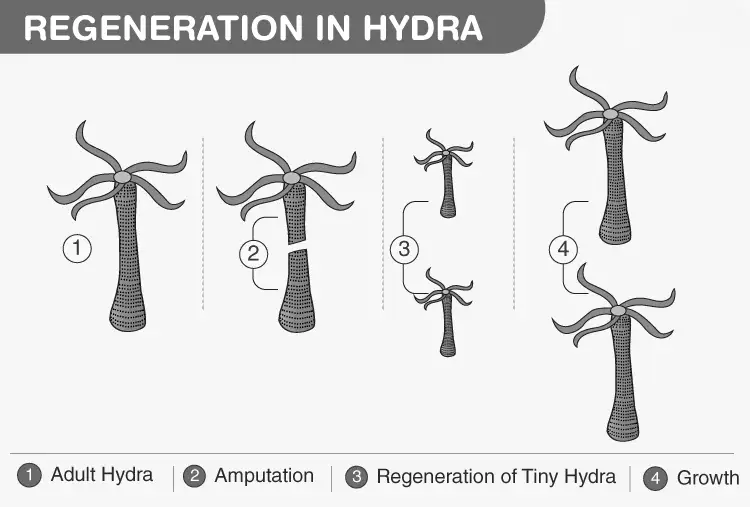
Fragmentation observed in Planaria
Example Problem: A planarian is cut into 5 pieces. If each piece regenerates into a full organism within 10 days, how many planarians will be present after regeneration?
Solution:
Each piece forms one complete planarian.
Number of new planarians = 5
Therefore, after regeneration, there will be 5 planarians.
Regeneration: New Organisms from Detached Parts
Regeneration refers to the ability of certain animals to regrow lost body parts, which can develop into new individuals. This phenomenon is notably seen in echinoderms like starfish, where a detached arm can grow into a new starfish.
Example Problem: A starfish loses 2 arms, each capable of regenerating into a new starfish. If the regeneration period is 30 days, how many starfish will exist after complete regeneration starting from one starfish?
Solution:
Original starfish remains.
Each arm regenerates into a new starfish.
Total starfish after regeneration = 1 (original) + 2 (new) = 3 starfish.
Evaluating the Pros and Cons of Asexual Reproduction
Benefits and Limitations of Asexual Reproduction
Asexual reproduction offers several advantages, such as rapid population increase and no need for a mate, which is beneficial in stable environments. However, it also has drawbacks, primarily the lack of genetic diversity, which limits adaptability to changing conditions.
Advantages: Quick reproduction, energy-efficient, and produces numerous offspring.
Disadvantages: Offspring are genetically identical, reducing variation and adaptability.
Exam Tip: Remember that asexual reproduction is ideal for stable environments but can be disadvantageous when environmental conditions change due to lack of genetic variation.
Summary Table: Key Points on Asexual Reproduction
Aspect | Description |
|---|---|
Parent Involvement | Single parent organism |
Gamete Fusion | Absent |
Genetic Variation | None; offspring are clones |
Reproduction Speed | Rapid |
Common Methods | Binary fission, budding, fragmentation, regeneration |
Examples | Amoeba, hydra, planaria, starfish |
Advantages | Fast population growth, no mate needed |
Disadvantages | Lack of genetic diversity, less adaptability |
Glossary of Important Terms
Term | Meaning |
|---|---|
Asexual Reproduction | Reproduction without gamete fusion, producing genetically identical offspring. |
Binary Fission | Division of a single cell into two equal daughter cells. |
Budding | Formation of a new organism from an outgrowth of the parent. |
Clones | Offspring genetically identical to the parent. |
Fragmentation | Breaking of the parent body into parts that develop into new individuals. |
Regeneration | Ability to regrow lost body parts that can form new organisms. |
Gametes | Sex cells involved in sexual reproduction. |
Genetic Variation | Differences in DNA among individuals of a species. |
Offspring | New individuals produced by reproduction. |
Parent Organism | The original organism producing offspring. |
Frequently Asked Questions
Which animals commonly reproduce asexually?
Animals such as planarians, hydra, amoeba, and some annelids reproduce through asexual methods.
What are the main types of asexual reproduction in animals?
The primary modes include budding, fragmentation, binary fission, and regeneration.
Is asexual reproduction more advantageous than sexual reproduction?
While asexual reproduction is faster and requires only one parent, sexual reproduction is generally more advantageous due to genetic variation, which enhances adaptability.
Why is parthenogenesis considered a form of asexual reproduction?
Parthenogenesis involves development of offspring from unfertilized eggs, thus not requiring male gametes, making it a type of asexual reproduction.
How does asexual reproduction affect genetic diversity?
Asexual reproduction produces genetically identical offspring, resulting in minimal genetic diversity within the population.