Comprehensive Guide to Animal Husbandry and Farm Management
Foundations of Animal Husbandry
Understanding the Role and Importance of Animal Care
As global populations surge, the demand for nutritious food sources intensifies. Animals have long been pivotal in agriculture, providing essentials such as milk, meat, eggs, wool, and labor. Despite housing over 70% of the world's livestock, countries like India and China contribute only about 25% to global farm output, highlighting the need for improved productivity. This gap has led to the evolution of animal husbandry, a scientific discipline focused on the effective care, breeding, and management of farm animals to enhance yield and quality.
Example: Consider a region with 1,000 buffaloes producing an average of 4 liters of milk daily. If scientific husbandry practices increase yield by 25%, calculate the new total daily milk production.
Solution:
Original total milk = \( 1,000 \times 4 = 4,000 \text{ liters} \)
Increase = 25% of 4,000 = \( 0.25 \times 4,000 = 1,000 \text{ liters} \)
New total milk production = \( 4,000 + 1,000 = 5,000 \text{ liters} \)
Effective Management of Livestock and Farms
Optimizing Dairy and Poultry Farm Operations
Modern farm management integrates professional methods to boost food production. In dairy farming, the focus lies on maintaining high-yielding, disease-resistant animals under hygienic conditions with adequate nutrition and water. Regular health checks and meticulous record-keeping are essential to sustain milk quality and quantity.
Poultry farming involves raising birds such as chickens, ducks, turkeys, and geese for meat and eggs. Success depends on selecting healthy breeds, ensuring cleanliness, providing balanced feed and water, and administering proper healthcare.
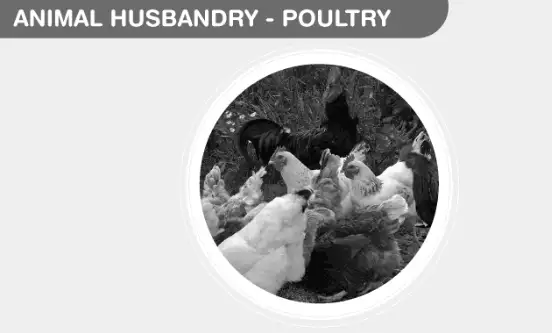
Diverse poultry species reared for meat and eggs
Example: A poultry farm has 500 chickens producing 3 eggs each per day. If improved management increases egg production by 15%, what is the new daily egg output?
Solution:
Initial eggs per day = \( 500 \times 3 = 1,500 \)
Increase = 15% of 1,500 = \( 0.15 \times 1,500 = 225 \)
New egg production = \( 1,500 + 225 = 1,725 \) eggs per day
Advancements in Animal Breeding Techniques
Enhancing Livestock Traits through Selective Mating
Animal breeding aims to improve desirable characteristics such as yield and disease resistance. Inbreeding involves mating closely related superior animals within the same breed over several generations to establish pure lines. However, excessive inbreeding can reduce fertility and productivity, a condition known as inbreeding depression.
Out-breeding, on the other hand, involves mating unrelated animals and includes methods like out-crossing (unrelated individuals of the same breed), crossbreeding (superior males and females of different breeds), and interspecific hybridization (mating across related species). Modern techniques such as artificial insemination and Multiple Ovulation Embryo Transfer Technology (MOET) further enhance breeding efficiency.
Example: A breeder mates two unrelated cows from different breeds, each producing 10 liters and 8 liters of milk daily respectively. If the crossbred offspring produces 18% more milk than the average of the parents, calculate the offspring's daily milk yield.
Solution:
Average milk yield of parents = \( \frac{10 + 8}{2} = 9 \text{ liters} \)
Increase = 18% of 9 = \( 0.18 \times 9 = 1.62 \text{ liters} \)
Offspring's milk yield = \( 9 + 1.62 = 10.62 \text{ liters} \)
Quick Reference Summary
Concept | Definition | Key Points |
|---|---|---|
Animal Husbandry | Scientific care and breeding of domestic animals | Focus on productivity, disease resistance, and quality |
Dairy Farm Management | Care of milch animals to improve milk yield | Hygiene, nutrition, breed selection, record-keeping |
Poultry Farm Management | Raising birds for meat and eggs | Breed health, cleanliness, feeding, and healthcare |
Inbreeding | Mating closely related superior animals | Develops pure lines but risks inbreeding depression |
Out-breeding | Mating unrelated animals | Includes out-crossing, crossbreeding, hybridization |
Artificial Insemination | Controlled breeding using collected semen | Enhances genetic improvement and breeding success |
MOET | Multiple Ovulation Embryo Transfer Technology | Increases offspring from superior females |
Glossary of Key Terms
Term | Meaning |
|---|---|
Animal Husbandry | Scientific care and breeding of farm animals |
Milch Animals | Animals raised primarily for milk production |
Inbreeding | Mating of closely related animals to maintain traits |
Out-crossing | Mating unrelated individuals of the same breed |
Crossbreeding | Mating animals of different breeds to combine traits |
Interspecific Hybridization | Mating between different but related species |
Artificial Insemination | Introducing semen into female reproductive tract artificially |
MOET | Technique to produce multiple embryos from one female |
Fodder | Food given to domesticated animals |
Inbreeding Depression | Reduced fertility and productivity due to close breeding |
Frequently Asked Questions
What is the main goal of animal husbandry?
To scientifically manage and breed farm animals for improved productivity, health, and quality of produce.
How does inbreeding affect livestock?
While it helps maintain pure lines, excessive inbreeding can cause reduced fertility and lower productivity, known as inbreeding depression.
What distinguishes crossbreeding from out-crossing?
Crossbreeding involves mating animals of different breeds, whereas out-crossing is mating unrelated individuals within the same breed.
Why is hygiene important in poultry farming?
Maintaining cleanliness prevents disease outbreaks, ensuring healthy birds and better egg and meat production.
What role does artificial insemination play in animal breeding?
It allows controlled mating, improving genetic traits and increasing the chances of successful breeding.