Understanding Temperature: Concepts, Measurement, and Effects
Fundamentals of Temperature and Particle Motion
Defining Temperature and Its Physical Meaning
Temperature quantifies how hot or cold an object is by reflecting the average kinetic energy of its particles. When particles move more rapidly, the temperature rises; slower particle motion corresponds to lower temperatures. This concept is essential across various scientific fields and daily life, providing a precise way to describe thermal conditions rather than subjective terms like "hot" or "cold."

.An iron rod heated to a high temperature
Example: Calculating Temperature from Particle Motion
Consider a metal rod whose particles have an average kinetic energy of \( 3.0 \times 10^{-21} \text{J} \). If the Boltzmann constant is \( 1.38 \times 10^{-23} \text{J/K} \), estimate the temperature of the rod.
Solution:
The average kinetic energy per particle is related to temperature by:
\[ \text{KE}_{avg} = \frac{3}{2} k_B T \]
Rearranging for \( T \):
\[ T = \frac{2 \times \text{KE}_{avg}}{3 k_B} \]
Substituting values:
\[ T = \frac{2 \times 3.0 \times 10^{-21}}{3 \times 1.38 \times 10^{-23}} = \frac{6.0 \times 10^{-21}}{4.14 \times 10^{-23}} \approx 145 \text{K} \]
Thus, the rod's temperature is approximately 145 Kelvin.
Linking Temperature to Kinetic Energy of Particles
The kinetic energy of particles arises from their motion, which varies among molecules. When a substance absorbs heat, its particles move faster, increasing the average kinetic energy and thus the temperature. This principle is central to the kinetic-molecular theory, which explains temperature as a measure of particle motion intensity. In solids, particles vibrate in place; as temperature rises, these vibrations intensify, eventually leading to phase changes like melting when vibrational energy overcomes molecular attractions.
Example: Effect of Heating on Particle Motion
A solid sample at 300 K is heated until its temperature reaches 600 K. How does the average kinetic energy of its particles change?
Solution:
Since average kinetic energy is proportional to temperature:
\[ \frac{\text{KE}_2}{\text{KE}_1} = \frac{T_2}{T_1} = \frac{600}{300} = 2 \]
The average kinetic energy doubles as the temperature doubles from 300 K to 600 K.
Distinguishing Heat and Temperature & Methods of Measurement
Clarifying the Difference Between Heat and Temperature
Heat and temperature are related but distinct concepts. Heat refers to the transfer of thermal energy between systems and is measured in joules. It is not a property an object possesses but rather energy in transit due to temperature differences. Temperature, on the other hand, measures the average kinetic energy of particles within a system and is expressed in units such as Celsius, Kelvin, or Fahrenheit. Understanding this distinction is crucial to avoid common misconceptions in thermodynamics.
Example: Heat Transfer vs Temperature Change
If 500 J of heat is added to two different substances, one with a large mass and one with a small mass, which will experience a greater temperature change?
Solution:
Temperature change depends on the substance's heat capacity and mass.
The smaller mass or lower heat capacity substance will have a larger temperature increase.
Heat is the same for both, but temperature change varies.
Principles Behind Temperature Measurement Devices
Since particles are microscopic, temperature is measured indirectly using devices that detect changes caused by particle motion. Thermometers commonly use thermal expansion, where liquids like mercury expand with temperature increases, moving up a calibrated scale. The Celsius scale is based on fixed points: the freezing and boiling points of water, marked as 0°C and 100°C respectively. This scale divides the range into 100 equal parts, allowing precise temperature readings.
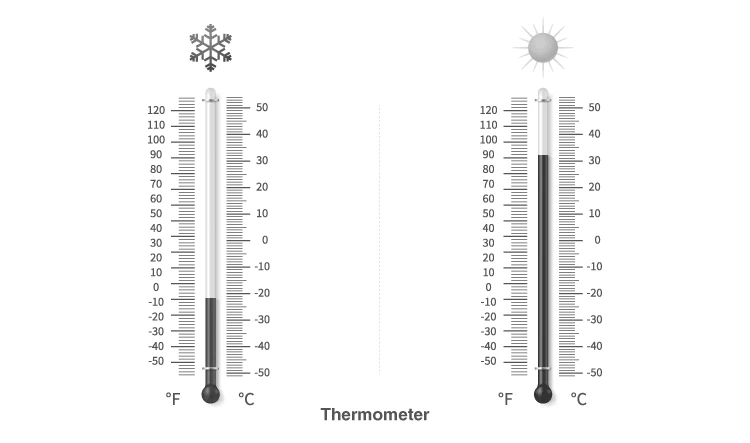
Mercury thermometer illustrating thermal expansion
Example: Reading Temperature from Mercury Expansion
A mercury thermometer shows the mercury level rising by 15 mm when heated. If a 10 mm rise corresponds to 10°C, what is the temperature increase?
Solution:
Temperature increase is proportional to mercury rise:
\[ \text{Temperature increase} = \frac{15 \text{ mm}}{10 \text{ mm}} \times 10^\circ C = 15^\circ C \]
Overview of Temperature Sensors Beyond Thermometers
Modern temperature measurement often employs sensors like Resistance Temperature Detectors (RTDs), thermocouples, thermistors, infrared sensors, and semiconductor devices. These sensors convert temperature data into electrical signals for precise monitoring in applications ranging from medical devices to industrial processes. While traditional thermometers are simple and widely used, these advanced sensors provide higher accuracy and faster response times.
Example: Application of a Thermocouple
A thermocouple generates a voltage of 5 mV at a certain temperature. If the voltage changes by 0.04 mV per degree Celsius, estimate the temperature.
Solution:
\[ \text{Temperature} = \frac{5 \text{ mV}}{0.04 \text{ mV/}^\circ C} = 125^\circ C \]
Temperature Scales, Thermal Equilibrium, and Impact of Temperature Changes
Comparing Common Temperature Scales and Their Conversions
Temperature is measured using various scales, primarily Celsius, Fahrenheit, and Kelvin. The Celsius scale sets water's freezing and boiling points at 0°C and 100°C, while Fahrenheit sets these at 32°F and 212°F. The Kelvin scale is absolute, starting at absolute zero (0 K), the theoretical lowest temperature. Conversion formulas allow switching between these scales:
\[ T_F = \frac{9}{5} T_C + 32 \]
\[ T_K = T_C + 273.15 \]
Example: Converting Room Temperature
Given room temperature is 22°C, find its equivalent in Fahrenheit and Kelvin.
Solution:
Fahrenheit:
\[ T_F = \frac{9}{5} \times 22 + 32 = 39.6 + 32 = 71.6^\circ F \]
Kelvin:
\[ T_K = 22 + 273.15 = 295.15 \text{ K} \]
Understanding Thermal Equilibrium in Temperature Measurement
Thermometers measure their own temperature, not directly the object's temperature. When two bodies are in thermal contact, heat flows from the warmer to the cooler until both reach the same temperature, a state called thermal equilibrium. At this point, no net heat transfer occurs, and the thermometer reading reflects the object's temperature accurately.
Example: Thermal Equilibrium Concept
If a thermometer at 20°C is placed in water at 60°C, what happens to the thermometer's temperature?
Answer: Heat flows from the water to the thermometer until both reach the same temperature, somewhere between 20°C and 60°C, depending on their thermal properties.
Absolute Temperature and Its Significance
Absolute temperature is measured from absolute zero, the lowest possible temperature where particle motion ceases. The Kelvin scale is the standard absolute scale, with 0 K representing absolute zero. At this temperature, molecular kinetic energy is minimal, and conventional electronic devices and life cannot function. Absolute zero is fundamental in thermodynamics and low-temperature physics.
Influence of Temperature on Physical and Chemical Processes
Temperature variations affect many material properties and processes:
Solubility, density, vapor pressure, and electrical conductivity change with temperature.
Chemical reaction rates typically increase as temperature rises.
Thermal radiation emitted by objects depends on their temperature.
Thermal radiation intensity increases with temperature
Quick Reference: Key Temperature Concepts and Formulas
Concept | Definition / Formula |
|---|---|
Temperature | Average kinetic energy of particles in a substance |
Heat | Energy transfer due to temperature difference (measured in joules) |
Thermal Expansion | Increase in volume of a substance with temperature rise |
Celsius to Fahrenheit | \( T_F = \frac{9}{5} T_C + 32 \) |
Celsius to Kelvin | \( T_K = T_C + 273.15 \) |
Absolute Zero | 0 K, lowest theoretical temperature where particle motion stops |
Thermal Equilibrium | State when two bodies in contact have equal temperature and no heat flow |
Kelvin Scale | Absolute temperature scale starting at 0 K (absolute zero) |
Thermometer Principle | Measures temperature via thermal expansion of liquids like mercury |
Temperature Sensor Types | Thermocouples, RTDs, thermistors, infrared sensors, semiconductors |
Glossary of Temperature-Related Terms
Term | Meaning |
|---|---|
Absolute Zero | The lowest possible temperature where particle motion ceases (0 K) |
Boltzmann Constant | A physical constant relating temperature to kinetic energy (\(1.38 \times 10^{-23} \text{J/K}\)) |
Heat | Energy transferred between systems due to temperature difference |
Kelvin Scale | Absolute temperature scale starting at absolute zero |
Thermal Expansion | Increase in volume of materials as temperature rises |
Thermal Equilibrium | Condition where two bodies have the same temperature and no heat exchange |
Thermocouple | A sensor that measures temperature by generating voltage from two different metals |
Thermistor | A resistor whose resistance varies with temperature |
Resistance Temperature Detector (RTD) | A sensor that measures temperature by correlating resistance changes in metals |
Temperature | Measure of average kinetic energy of particles in a substance |
Frequently Asked Questions (FAQs)
Do substances expand or contract when heated?
Most substances expand upon heating because increased particle motion causes atoms to vibrate more vigorously, increasing the space between them and thus the overall volume.
Which state of matter typically exhibits the highest temperature?
Gases generally have the highest temperatures because their particles move more freely and rapidly compared to solids and liquids.
What is the most widely used temperature scale globally?
The Celsius scale is the most commonly used temperature scale worldwide for everyday and scientific purposes.
What is the coldest temperature achievable?
Absolute zero, defined as 0 Kelvin or -273.15°C, is the lowest theoretical temperature where particle motion stops.
Which temperature scale is preferred in scientific research?
The Kelvin scale is predominantly used in scientific contexts because it is an absolute scale starting at absolute zero.