Understanding Refrigerators and Heat Pumps: Principles and Uses
Fundamentals of Refrigeration Systems
How Refrigerators Operate to Remove Heat
A refrigerator functions by transferring heat from its interior to the external environment, effectively cooling the stored items. This process involves a continuous cycle with five essential components: a refrigerant fluid, a compressor, condenser coils, evaporator coils, and an expansion device. The compressor compresses the refrigerant vapor, increasing its pressure and temperature, then pushes it through the condenser coils located outside the fridge. Here, the hot vapor releases heat to the surrounding air and condenses into a high-pressure liquid. This liquid then passes through an expansion valve, reducing its pressure and temperature before entering the evaporator coils inside the fridge. The refrigerant absorbs heat from the fridge’s interior, evaporates back into vapor, and returns to the compressor to repeat the cycle.
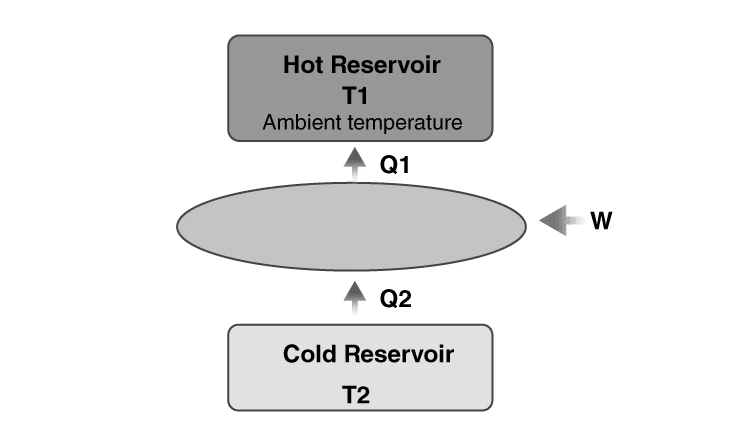
Example: Calculating Heat Removed by a Refrigerator
A refrigerator removes heat from its interior at a rate of 1500 J every 10 seconds. Calculate the power in watts used to remove this heat.
Solution:
Power is the rate of energy transfer, so
\[ \text{Power} = \frac{\text{Heat removed}}{\text{Time}} = \frac{1500 \text{ J}}{10 \text{ s}} = 150 \text{ W} \]
Therefore, the refrigerator removes heat at a power of 150 watts.
Practical Uses of Refrigeration Technology
Refrigeration plays a vital role in various industrial and everyday applications. It enables the separation of air into its components by fractional distillation, as different gases liquefy at distinct temperatures. Industries use refrigeration to condense gases like ammonia for easier storage and transport. Additionally, refrigeration helps in dehumidifying air by liquefying moisture, which is essential in maintaining controlled environments. Cold storage facilities preserve perishable goods such as vegetables, chemicals, and explosives by maintaining low temperatures to prevent spoilage or degradation.
Example: Why is Refrigeration Important in Gas Storage?
Explain why gases like ammonia are cooled and liquefied before storage.
Answer:
- Liquefying gases reduces their volume, making storage and transportation more efficient.
- It enhances safety by minimizing the risk of gas leaks and explosions.
- Cooling stabilizes the gas, preventing unwanted reactions or pressure build-up.
Mechanics and Applications of Heat Pumps
Operating Principles of Heat Pumps
A heat pump is a device that transfers heat energy from one place to another using mechanical work, and it can be reversed to either heat or cool a space. It consists mainly of two units: an indoor air handler and an outdoor unit. A refrigerant circulates between these units, absorbing heat from one side and releasing it on the other. The refrigerant gas is compressed by a compressor, which raises its temperature and pressure. This hot, high-pressure vapor then passes through a condenser where it releases heat and condenses into a liquid. The liquid’s pressure is then lowered by an expansion valve, cooling it before it absorbs heat again in the evaporator. This cycle repeats continuously to maintain the desired temperature.
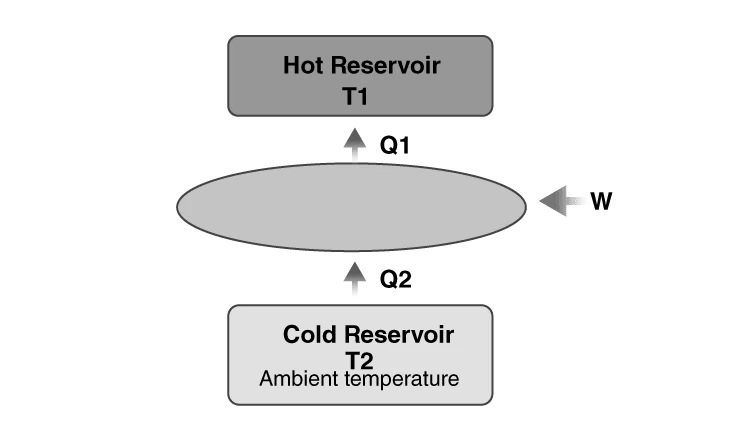
Example: Heat Pump Cycle Temperature Change
A heat pump compresses refrigerant gas at 300 K and 5 atm to a temperature of 360 K. After condensation, the refrigerant is expanded to 1 atm. Explain the temperature changes during this cycle.
Solution:
- Compression raises the temperature from 300 K to 360 K due to increased pressure.
- Condensation releases heat at 360 K, turning vapor into liquid.
- Expansion reduces pressure to 1 atm, causing the temperature to drop below 300 K.
- Evaporation absorbs heat from the environment, warming the refrigerant back to 300 K.
Common Uses of Heat Pumps in Daily Life and Industry
Heat pumps are widely used for space heating in homes, greenhouses, and workplaces by transferring heat from outside air or ground into the building. They also serve in heating water for domestic and industrial purposes by recovering heat from other processes. In manufacturing, heat pumps preheat fluids before chemical reactions, improving energy efficiency. Additionally, heat pumps are employed to reclaim waste heat from industrial processes, reducing overall energy consumption.
Example: Benefits of Heat Pumps in Industrial Heat Recovery
List three advantages of using heat pumps for recovering heat in industrial settings.
Answer:
- Reduces energy costs by reusing waste heat.
- Decreases environmental impact by lowering fuel consumption.
- Improves process efficiency by maintaining optimal temperatures.
Quick Reference: Refrigerators and Heat Pumps
| Aspect | Refrigerator | Heat Pump |
|---|---|---|
| Primary Function | Removes heat from enclosed space to cool it | Transfers heat to heat or cool a space |
| Main Components | Compressor, condenser, evaporator, expansion device, refrigerant | Compressor, condenser, evaporator, expansion valve, refrigerant |
| Working Principle | Refrigerant absorbs heat inside, releases outside | Refrigerant cycle reversed to heat or cool |
| Applications | Food preservation, gas liquefaction, dehumidification | Space heating, water heating, industrial process heating |
| Energy Source | Electrical energy to run compressor | Electrical energy to run compressor |
Glossary of Key Terms
| Term | Definition |
|---|---|
| Compressor | Device that increases refrigerant pressure and temperature by compression |
| Condenser | Heat exchanger where refrigerant releases heat and condenses to liquid |
| Evaporator | Component where refrigerant absorbs heat and evaporates to vapor |
| Expansion Valve | Device that reduces refrigerant pressure and temperature before evaporation |
| Refrigerant | Fluid that circulates in the refrigeration cycle to transfer heat |
| Heat Pump | System that transfers heat from one place to another using mechanical work |
| Fractional Distillation | Process of separating components of a mixture based on boiling points |
| Dehumidification | Removal of moisture from air by cooling and condensation |
| Cold Storage | Facility that maintains low temperatures to preserve perishable items |
| Heat Recovery | Process of capturing and reusing waste heat from industrial operations |
Frequently Asked Questions
What is the main purpose of a heat pump?
A heat pump transfers heat energy to either warm or cool a space by circulating a refrigerant through a compression cycle.
Where are heat pumps commonly used?
They are used for heating buildings, warming water, industrial process heating, and recovering waste heat.
How does a refrigerator maintain a cool interior?
By continuously cycling refrigerant that absorbs heat inside and releases it outside, lowering the temperature within the fridge.
Why is refrigerant compression important in these systems?
Compression raises the refrigerant’s temperature and pressure, enabling it to release heat efficiently in the condenser.
Can heat pumps be used for cooling as well as heating?
Yes, heat pumps can reverse their cycle to provide cooling by absorbing heat from indoors and releasing it outside.