Understanding Newton’s Third Law of Motion
Fundamentals of Newton’s Third Law
Conceptual Overview of Action-Reaction Forces
Force is essentially a push or pull that one object applies to another, resulting from their interaction. These forces always come in pairs, known as action and reaction forces. Newton’s third law articulates this by stating that whenever one object applies a force on a second object, the second object simultaneously applies a force of equal strength but in the opposite direction on the first object.
This principle highlights a fundamental symmetry in nature: forces never act alone but always in pairs, ensuring that no object can exert a force without experiencing a counterforce.
Mathematically, if object A exerts a force \( \vec{F}_{AB} \) on object B, then object B exerts a force \( \vec{F}_{BA} \) on object A such that:
\[ \vec{F}_{AB} = -\vec{F}_{BA} \]
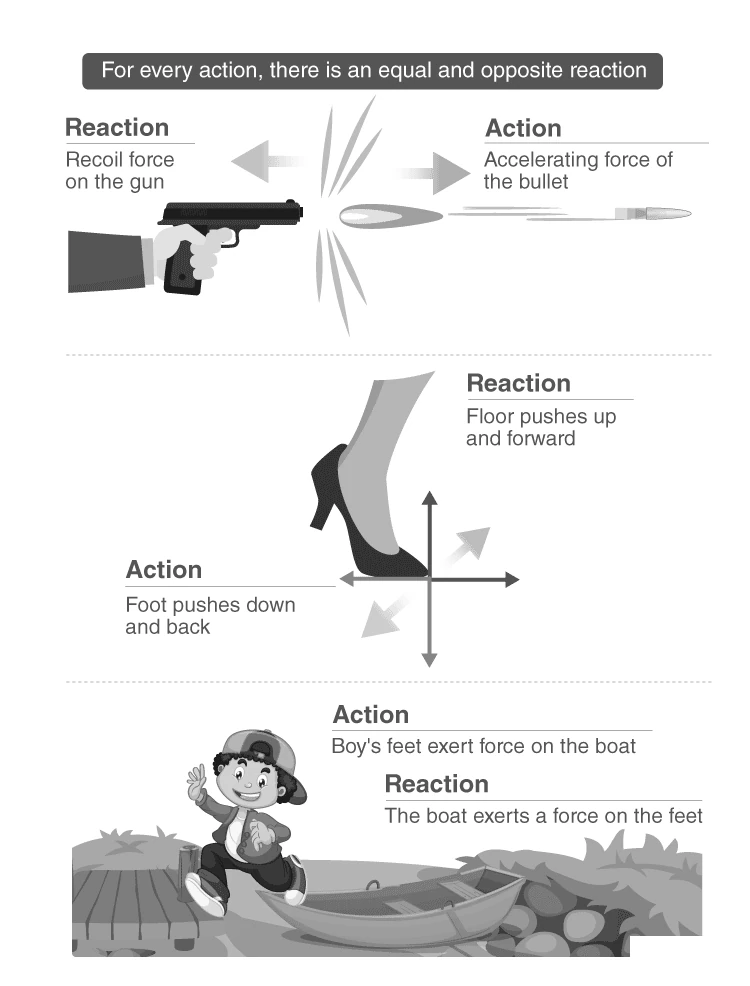
Illustration depicting Newton’s Third Law of Motion
Example Problem
Two ice skaters, Skater A and Skater B, push off from each other on a frictionless ice surface. Skater A has a mass of 50 kg and Skater B has a mass of 70 kg. If Skater A moves backward with a velocity of 3 m/s, what is the velocity of Skater B?
Solution:
According to Newton’s third law, the forces they exert on each other are equal and opposite, and by conservation of momentum:
\[ m_A v_A + m_B v_B = 0 \]
Rearranging to find \( v_B \):
\[ v_B = -\frac{m_A v_A}{m_B} = -\frac{50 \times (-3)}{70} = \frac{150}{70} \approx 2.14 \text{ m/s} \]
Thus, Skater B moves in the opposite direction with a speed of approximately 2.14 m/s.
Practical Examples of Interaction Forces
Real-World Instances of Action and Reaction
Newton’s third law is observable in many everyday phenomena where forces act in pairs. For example, when a fish swims, it pushes water backwards with its fins, and the water pushes the fish forward with an equal and opposite force, propelling it ahead.
Similarly, birds generate lift by pushing air downwards with their wings, and the air pushes them upwards, enabling flight. Swimmers push water backwards to move forward, and helicopters create lift by forcing air downwards, which results in an upward reaction force.
Rock climbers also demonstrate this law by pulling down on their ropes, which in turn pushes them upwards, allowing them to ascend.
Fish swimming by pushing water backwards
Bird flight demonstrating action-reaction forces
Example Problem
A helicopter pushes air downwards with a force of 10,000 N to hover. What is the reaction force exerted by the air on the helicopter?
Solution:
By Newton’s third law, the air exerts an equal and opposite force on the helicopter:
\[ F_{\text{air on helicopter}} = - F_{\text{helicopter on air}} = -10,000 \text{ N} \]
This upward force balances the helicopter’s weight, allowing it to hover.
Mathematical and Conceptual Insights
Understanding the Law Through Equations and Momentum
Newton’s third law is closely linked to the conservation of momentum. When two bodies interact, the forces they exert on each other are equal in magnitude and opposite in direction, ensuring the total momentum of the system remains constant.
For example, if object A exerts a force \( \vec{F} \) on object B, then object B exerts a force \( -\vec{F} \) on object A. This relationship can be expressed as:
\[ \vec{F}_{AB} = -\vec{F}_{BA} \]
This principle explains why when you jump off a boat, the boat moves backward as you move forward.
Forces acting between two interacting objects
Example Problem
A person weighing 600 N stands on a skateboard of mass 5 kg. If the person pushes a wall with a force of 200 N, what is the force exerted by the wall on the person? Also, what is the acceleration of the skateboard if the person and skateboard move together?
Solution:
According to Newton’s third law, the wall exerts an equal and opposite force on the person:
\[ F_{\text{wall on person}} = -200 \text{ N} \]
Assuming the person and skateboard move together, total mass \( m = 70 \text{ kg} + 5 \text{ kg} = 75 \text{ kg} \) (assuming person’s mass is \( \frac{600}{9.8} \approx 61.22 \text{ kg} \), but for simplicity, use 70 kg).
Acceleration \( a \) is given by:
\[ a = \frac{F}{m} = \frac{200}{75} \approx 2.67 \text{ m/s}^2 \]
Thus, the skateboard accelerates backward at approximately \( 2.67 \text{ m/s}^2 \).
Quick Reference Summary
Concept | Explanation |
|---|---|
Newton’s Third Law | For every force exerted by object A on object B, object B exerts an equal and opposite force on object A. |
Action-Reaction Pair | Two forces equal in magnitude and opposite in direction acting on two interacting bodies. |
Mathematical Expression | \( \vec{F}_{AB} = -\vec{F}_{BA} \) |
Relation to Momentum | Ensures conservation of momentum in isolated systems. |
Examples | Fish swimming, bird flight, helicopter lift, rock climbing. |
Glossary of Key Terms
Term | Definition |
|---|---|
Force | A push or pull upon an object resulting from its interaction with another object. |
Action Force | The initial force exerted by one object on another. |
Reaction Force | The force exerted in response, equal in magnitude and opposite in direction to the action force. |
Interaction Pair | Two forces that are equal and opposite acting on two interacting bodies. |
Contact Force | Force that occurs when objects physically touch each other. |
Non-contact Force | Force acting at a distance without physical contact, e.g., gravity. |
Conservation of Momentum | Principle stating total momentum remains constant in an isolated system. |
Acceleration | Rate of change of velocity of an object. |
Mass | Quantity of matter in an object, affecting its inertia. |
Equilibrium | State where all forces acting on an object are balanced. |
Frequently Asked Questions
What does Newton’s third law state?
It states that for every action force, there is an equal and opposite reaction force.
Can you give a simple example of Newton’s third law?
When a swimmer pushes water backwards, the water pushes the swimmer forward with an equal and opposite force.
How does Newton’s third law apply to rock climbing?
Rock climbers pull down on their ropes, and the ropes exert an equal upward force, helping them climb.
What are the two main types of forces?
Contact forces (like friction) and non-contact forces (like gravity).
Why is Newton’s third law important in physics?
It explains the mutual interactions between objects and is fundamental to understanding motion and momentum conservation.