Understanding Newton’s Cooling Law and Its Applications
Fundamentals of Newton’s Cooling Principle
Conceptual Overview and Mathematical Expression
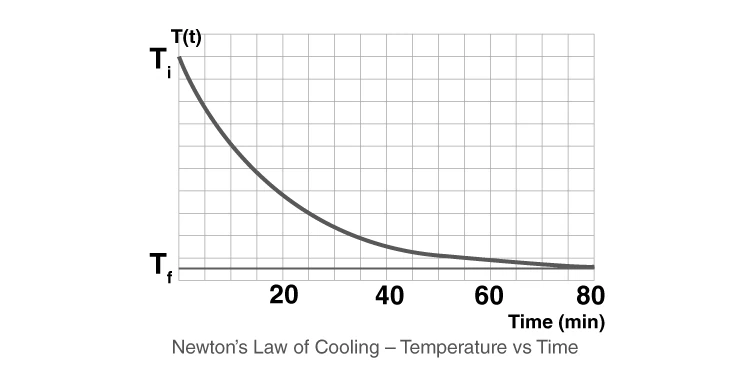
Newton’s cooling principle states that the speed at which an object loses heat to its environment is roughly proportional to the temperature difference between the object and its surroundings, assuming this difference remains small. This relationship is crucial in understanding how objects cool down over time when exposed to ambient conditions.
The law can be mathematically expressed as a differential equation:
\[ \frac{dT}{dt} = -k \bigl(T(t) - T_s\bigr) \]
Here, \(T(t)\) represents the temperature of the object at time \(t\), \(T_s\) is the constant temperature of the surroundings, and \(k\) is a positive constant dependent on the object's surface characteristics and area.
Solving this differential equation yields the temperature at any time \(t\):
\[ T(t) = T_s + (T_0 - T_s) e^{-kt} \]
where \(T_0\) is the initial temperature of the object at \(t=0\).
Stepwise Derivation of the Cooling Formula
The rate of heat loss is proportional to the temperature difference and the exposed surface area. Starting from the proportionality:
\[ \frac{dQ}{dt} \propto -(T - T_s) \]
Introducing the constant of proportionality \(k\), we write:
\[ \frac{dQ}{dt} = -k (T - T_s) \]
Using the relation between heat loss and temperature change, and integrating over time, we arrive at:
\[ \int_{T_1}^{T_2} \frac{dT}{T - T_s} = -k \int_0^t dt \]
which simplifies to:
\[ \ln \frac{T_2 - T_s}{T_1 - T_s} = -kt \]
Rearranging gives the temperature at time \(t\):
\[ T(t) = T_s + (T_0 - T_s) e^{-kt} \]
Example Problem 1
A metal rod initially at 90ºC is placed in a room maintained at 25ºC. After 15 minutes, the rod’s temperature drops to 70ºC. Calculate the time required for the rod to cool further to 50ºC.
Solution:
Given: \(T_0 = 90^\circ C\), \(T_s = 25^\circ C\), \(T(15) = 70^\circ C\).
Using the cooling formula:
\[ 70 = 25 + (90 - 25) e^{-15k} \implies 45 = 65 e^{-15k} \]
\[ e^{-15k} = \frac{45}{65} = \frac{9}{13} \]
\[ -15k = \ln \frac{9}{13} \implies k = -\frac{1}{15} \ln \frac{9}{13} = \frac{\ln \frac{13}{9}}{15} \]
Next, find time \(t\) when \(T(t) = 50^\circ C\):
\[ 50 = 25 + 65 e^{-kt} \implies 25 = 65 e^{-kt} \implies e^{-kt} = \frac{25}{65} = \frac{5}{13} \]
\[ -kt = \ln \frac{5}{13} \implies t = -\frac{1}{k} \ln \frac{5}{13} = \frac{\ln \frac{13}{5}}{k} \]
Substitute \(k\):
\[ t = \frac{\ln \frac{13}{5}}{\frac{\ln \frac{13}{9}}{15}} = 15 \times \frac{\ln \frac{13}{5}}{\ln \frac{13}{9}} \approx 15 \times \frac{0.9555}{0.3646} \approx 39.3 \text{ minutes} \]
The rod will take approximately 39.3 minutes to cool from 70ºC to 50ºC.
Practical Applications and Approximate Methods in Cooling
Using Average Temperature for Simplified Calculations
In many practical scenarios, an approximate method is used where the cooling rate is assumed constant and equal to the rate at the average temperature during the cooling interval. This simplifies calculations when exact precision is not critical.
The average temperature \(\langle T \rangle\) between initial and final temperatures \(T_i\) and \(T_f\) is:
\[ \langle T \rangle = \frac{T_i + T_f}{2} \]
The rate of temperature change can then be approximated as:
\[ \frac{dT}{dt} = -k (\langle T \rangle - T_s) \]
This method provides a quick estimate but should be used cautiously as it is less accurate than the exact exponential model.
Example Problem 2
An object cools from 60ºC to 50ºC in 8 minutes in a room at 20ºC. Estimate the time it will take to cool from 50ºC to 40ºC using the average temperature method.
Solution:
Calculate the average temperature for the first interval:
\[ \langle T \rangle = \frac{60 + 50}{2} = 55^\circ C \]
Using the approximate rate:
\[ \frac{50 - 60}{8} = -k (55 - 20) \implies -\frac{10}{8} = -k \times 35 \implies k = \frac{10}{8 \times 35} = \frac{10}{280} = \frac{1}{28} \text{ min}^{-1} \]
For the next interval, average temperature is:
\[ \langle T \rangle = \frac{50 + 40}{2} = 45^\circ C \]
Calculate time \(t\):
\[ \frac{40 - 50}{t} = -k (45 - 20) \implies -\frac{10}{t} = -\frac{1}{28} \times 25 \implies \frac{10}{t} = \frac{25}{28} \implies t = \frac{10 \times 28}{25} = 11.2 \text{ minutes} \]
The object will take approximately 11.2 minutes to cool from 50ºC to 40ºC.
Constraints and Validity of Newton’s Cooling Law
Newton’s cooling law is most accurate under specific conditions:
- The temperature difference between the object and surroundings should be relatively small.
- Heat loss must primarily occur through radiation or convection, without significant conduction or other modes.
- The surrounding temperature must remain constant during the cooling process.
Violating these conditions can lead to deviations from the predicted cooling behavior.
Real-World Examples Demonstrating Cooling Calculations
Example: Cooling of Heated Oil
An oil sample heated to 80ºC cools to 60ºC in 5 minutes in a room at 30ºC. Determine the time required for the oil to cool from 60ºC to 45ºC.
Solution:
Given: \(T_0 = 80^\circ C\), \(T_s = 30^\circ C\), \(T(5) = 60^\circ C\).
Apply the cooling formula:
\[ 60 = 30 + (80 - 30) e^{-5k} \implies 30 = 50 e^{-5k} \implies e^{-5k} = \frac{30}{50} = 0.6 \]
\[ -5k = \ln 0.6 \implies k = -\frac{1}{5} \ln 0.6 = \frac{\ln \frac{5}{3}}{5} \approx 0.102 \]
Find time \(t\) for cooling from 60ºC to 45ºC:
\[ 45 = 30 + 50 e^{-kt} \implies 15 = 50 e^{-kt} \implies e^{-kt} = \frac{15}{50} = 0.3 \]
\[ -kt = \ln 0.3 \implies t = -\frac{\ln 0.3}{k} = \frac{\ln \frac{10}{3}}{0.102} \approx \frac{1.204}{0.102} = 11.8 \text{ minutes} \]
The oil will take approximately 11.8 minutes to cool from 60ºC to 45ºC.
Example: Cooling of Water in a Room
Water initially at 90ºC cools to 65ºC in 12 minutes in a room at 25ºC. Calculate the temperature after 20 minutes.
Solution:
Given: \(T_0 = 90^\circ C\), \(T_s = 25^\circ C\), \(T(12) = 65^\circ C\), find \(T(20)\).
Calculate \(k\):
\[ 65 = 25 + (90 - 25) e^{-12k} \implies 40 = 65 e^{-12k} \implies e^{-12k} = \frac{40}{65} = \frac{8}{13} \]
\[ -12k = \ln \frac{8}{13} \implies k = -\frac{1}{12} \ln \frac{8}{13} = \frac{\ln \frac{13}{8}}{12} \approx 0.049 \]
Find \(T(20)\):
\[ T(20) = 25 + 65 e^{-0.049 \times 20} = 25 + 65 e^{-0.98} = 25 + 65 \times 0.375 = 25 + 24.4 = 49.4^\circ C \]
After 20 minutes, the water temperature will be approximately 49.4ºC.
Summary Table for Quick Review
| Parameter | Symbol | Description |
|---|---|---|
| Temperature of object at time \(t\) | \(T(t)\) | Instantaneous temperature of the cooling body |
| Surrounding temperature | \(T_s\) | Constant ambient temperature |
| Initial temperature | \(T_0\) | Temperature of the object at \(t=0\) |
| Cooling constant | \(k\) | Proportionality constant depending on surface and medium |
| Average temperature (approximation) | \(\langle T \rangle\) | Mean temperature between two points in time |
| Newton’s cooling differential equation | \(\frac{dT}{dt} = -k (T - T_s)\) | Rate of temperature change proportional to difference |
| Exponential cooling formula | \(T(t) = T_s + (T_0 - T_s) e^{-kt}\) | Temperature at any time \(t\) |
| Approximate rate formula | \(\frac{dT}{dt} = -k (\langle T \rangle - T_s)\) | Used for simplified calculations over intervals |
| Limitations | – | Small temperature difference, radiation dominant, constant surroundings |
| Heat transfer mode | – | Primarily radiation or convection for Newton’s law validity |
Key Terms and Definitions
| Term | Meaning |
|---|---|
| Newton’s Law of Cooling | The principle that the rate of heat loss of a body is proportional to the temperature difference with its surroundings. |
| Cooling Constant (\(k\)) | A positive constant depending on the object's surface area and nature, influencing cooling rate. |
| Surrounding Temperature (\(T_s\)) | The constant temperature of the environment around the cooling object. |
| Initial Temperature (\(T_0\)) | The temperature of the object at the start of observation. |
| Exponential Decay | A process where quantity decreases at a rate proportional to its current value. |
| Average Temperature (\(\langle T \rangle\)) | The mean of initial and final temperatures over a time interval, used in approximate calculations. |
| Heat Transfer | The movement of thermal energy from one body or substance to another. |
| Radiation | Transfer of heat through electromagnetic waves without involving particles. |
| Convection | Heat transfer through fluid motion, such as air or liquid. |
| Differential Equation | An equation involving derivatives that describes how a quantity changes over time. |
Frequently Asked Questions
What does Newton’s law of cooling describe?
It explains how the temperature of an object changes over time as it loses heat to its surroundings, proportional to the temperature difference.
When is Newton’s cooling law applicable?
The law applies best when the temperature difference is small, heat loss is mainly by radiation or convection, and the surrounding temperature remains constant.
How is the cooling constant \(k\) determined?
The constant \(k\) depends on the object's surface area, material properties, and the nature of the surrounding medium, often found experimentally.
Can Newton’s law of cooling be used for large temperature differences?
No, the law is an approximation valid for small temperature differences; for large differences, other heat transfer laws are more accurate.
What is the difference between exact and approximate methods in cooling calculations?
The exact method uses the exponential decay formula, while the approximate method assumes a constant cooling rate based on average temperature, which is less precise.