Understanding Modulation and Demodulation in Communication Systems
Fundamentals of Signal Modulation
Concept and Purpose of Modulation
Modulation is the technique of embedding a low-frequency information signal onto a high-frequency carrier wave. This carrier wave, typically a sine wave with a fixed frequency, by itself does not convey meaningful data such as speech or digital information. To transmit useful content, the carrier's properties are altered in accordance with the input signal, a process known as modulation. Essentially, modulation encodes the message by changing the carrier wave's characteristics, enabling efficient transmission over long distances.
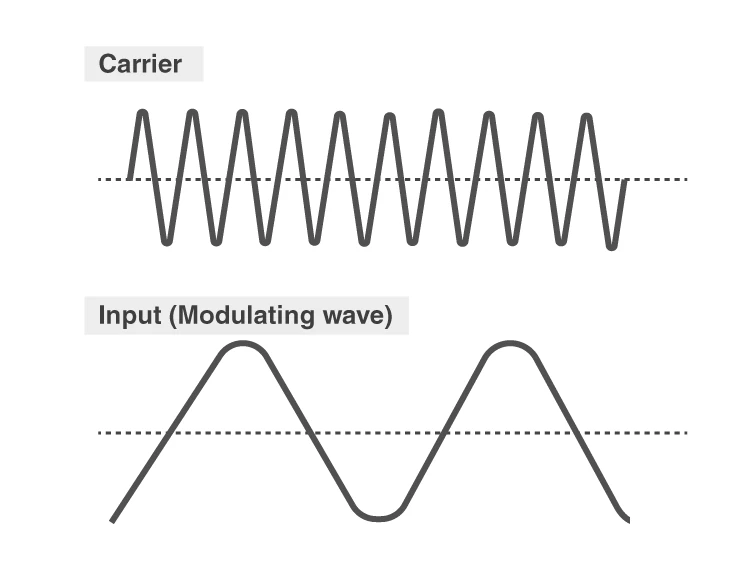
Diagram illustrating the modulation and demodulation process
Example: Encoding a Voice Signal onto a Carrier
Suppose a voice signal with a frequency of 1 kHz needs to be transmitted using a carrier wave of frequency 100 MHz. Explain how modulation helps in this transmission.
Solution:
The voice signal (1 kHz) is a low-frequency signal that cannot travel long distances effectively. By modulating this signal onto a high-frequency carrier (100 MHz), the carrier wave's amplitude, frequency, or phase is varied in accordance with the voice signal. This modulation shifts the signal to a higher frequency band suitable for transmission through antennas and reduces signal loss. At the receiver, demodulation extracts the original voice signal from the carrier.
Varieties of Modulation Techniques
Classification and Characteristics of Modulation Types
Modulation can be categorized primarily into three types based on which property of the carrier wave is varied: amplitude, phase, or frequency. Each method modifies the carrier differently to encode the message signal while keeping other parameters constant. Additionally, modulation can be analog or digital, depending on whether the input signal changes continuously or in discrete steps.
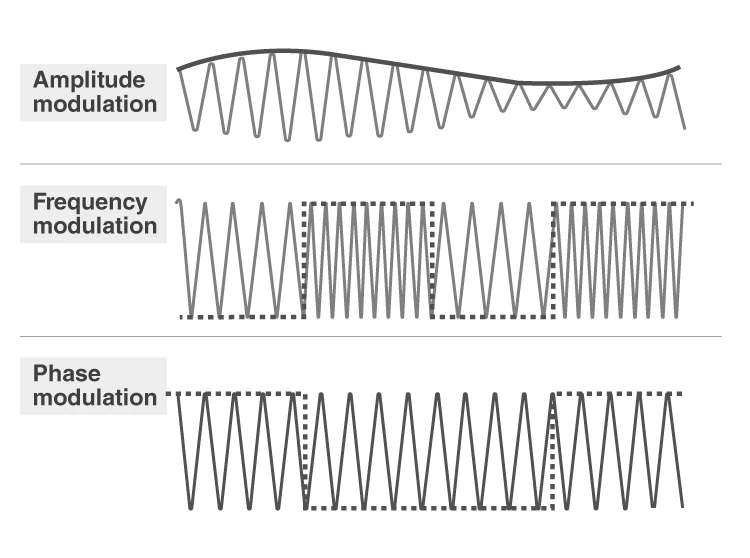
Overview of different modulation types
Example: Identifying Modulation Types
A communication system varies the carrier wave's phase in response to the input signal. What type of modulation is this, and what remains unchanged?
Solution:
This is phase modulation, where the carrier's phase shifts according to the message signal.
The carrier's amplitude and frequency remain constant during this process.
Detailed Insights into Amplitude, Phase, and Frequency Modulation
Amplitude Modulation Explained
Amplitude Modulation (AM) involves varying the amplitude of the carrier wave in direct proportion to the instantaneous amplitude of the message signal. The carrier's frequency and phase remain fixed. This method is widely used in radio broadcasting where the strength of the carrier wave changes to represent the information.
Waveform representation of Amplitude Modulation
Example: Calculating Modulated Signal Amplitude
A carrier wave with amplitude \( A_c = 10 \text{ V} \) is amplitude modulated by a message signal with amplitude \( A_m = 4 \text{ V} \). Find the modulation index and the maximum amplitude of the modulated wave.
Solution:
The modulation index \( m \) is given by:
\[ m = \frac{A_m}{A_c} = \frac{4}{10} = 0.4 \]
The maximum amplitude of the modulated wave is:
\[ A_{max} = A_c (1 + m) = 10 \times (1 + 0.4) = 14 \text{ V} \]
Understanding Phase Modulation
Phase Modulation (PM) changes the phase angle of the carrier wave in direct relation to the instantaneous amplitude of the input signal. The amplitude and frequency of the carrier remain unchanged. This technique is useful in digital communication systems where phase shifts represent data.
Illustration of Phase Modulation
Example: Phase Shift Calculation
If a carrier wave undergoes a phase shift of \( 30^\circ \) due to modulation, express this phase shift in radians and explain its significance.
Solution:
Converting degrees to radians:
\[ 30^\circ = \frac{30 \pi}{180} = \frac{\pi}{6} \text{ radians} \]
This phase shift represents the instantaneous change in the carrier's phase caused by the modulating signal, encoding the information in the phase variations.
Frequency Modulation Fundamentals
Frequency Modulation (FM) involves varying the frequency of the carrier wave in proportion to the instantaneous amplitude of the message signal, while the amplitude and phase remain constant. FM is widely used in high-fidelity radio broadcasting due to its resilience to noise and interference.
Waveform of Frequency Modulation
Example: Frequency Deviation in FM
A carrier frequency of 100 MHz is frequency modulated by a signal causing a maximum frequency deviation of 75 kHz. Calculate the modulation index if the modulating frequency is 5 kHz.
Solution:
The modulation index \( \beta \) is:
\[ \beta = \frac{\Delta f}{f_m} = \frac{75 \times 10^3}{5 \times 10^3} = 15 \]
Here, \( \Delta f \) is the peak frequency deviation and \( f_m \) is the modulating frequency.
Extracting Information: The Demodulation Process
What is Demodulation and Its Role?
Demodulation is the reverse operation of modulation. It involves retrieving the original low-frequency information signal from the modulated carrier wave at the receiver end. Specialized electronic circuits called demodulators perform this task, enabling the recovery of audio, video, or digital data from the transmitted signal.
Schematic representation of demodulation
Example: Recovering Audio from an AM Signal
Describe how an AM demodulator extracts the original audio signal from the received modulated wave.
Solution:
The AM demodulator detects the envelope of the modulated carrier wave.
It filters out the high-frequency carrier, leaving the low-frequency audio signal.
The recovered audio signal is then amplified and sent to the output device such as a speaker.
Contrasting Modulation and Demodulation
While modulation encodes the message onto a carrier wave for transmission, demodulation decodes the received signal to retrieve the original information. Both processes are essential for effective communication, ensuring minimal distortion and efficient spectrum use. Devices called modems perform both modulation and demodulation, facilitating data exchange in telecommunication systems.
Example: Comparing Modulation and Demodulation
Explain the primary difference between modulation and demodulation in communication systems.
Solution:
Modulation is the process of embedding information onto a carrier wave for transmission.
Demodulation is the process of extracting the original information from the received modulated wave.
Summary Table for Quick Review
Aspect | Modulation | Demodulation |
|---|---|---|
Definition | Embedding information onto a carrier wave | Extracting information from a modulated carrier |
Purpose | Enable transmission over long distances | Recover original message signal |
Process | Alters carrier wave properties (amplitude, frequency, phase) | Detects and decodes modulated signal |
Devices | Modulator | Demodulator |
Example | AM, FM, PM | AM detector, FM discriminator |
Glossary of Key Terms
Term | Meaning |
|---|---|
Carrier Wave | A high-frequency wave that carries the information signal |
Modulation | Process of varying a carrier wave to encode information |
Demodulation | Process of extracting the original signal from a modulated wave |
Amplitude Modulation (AM) | Modulation by varying the amplitude of the carrier |
Frequency Modulation (FM) | Modulation by varying the frequency of the carrier |
Phase Modulation (PM) | Modulation by varying the phase of the carrier |
Modulation Index | Ratio indicating the extent of modulation applied |
Envelope | Imaginary curve connecting the peaks of a modulated wave |
Demodulator | Electronic circuit that recovers the original signal |
Modem | Device that performs both modulation and demodulation |
Frequently Asked Questions
What happens if the modulating signal's amplitude exceeds the carrier's amplitude?
If the modulating signal's amplitude is greater than the carrier's, distortion occurs, leading to incorrect transmission of information.
What is the reference line used in modulation?
The carrier peak line serves as the reference for the modulating signal during modulation.
Is the carrier frequency affected in amplitude modulation?
No, in amplitude modulation, only the amplitude of the carrier changes; the frequency remains constant.
What does the term 'envelope' refer to in modulation?
The envelope is an imaginary line that connects the positive and negative peaks of the carrier waveform, representing the modulating signal.
What is a modulating wave?
The modulating wave, also called the measuring wave, is the low-frequency signal superimposed on the high-frequency carrier wave.