Understanding Frictional Forces and Their Types
Fundamentals of Frictional Force
Defining Friction and Its Influencing Factors
Friction is a resistive force that arises when two surfaces come into contact and attempt to move relative to each other. This force opposes motion and plays a crucial role in everyday phenomena, from vehicle traction to the operation of machinery. The magnitude of friction depends primarily on the texture of the surfaces involved and the force pressing them together.
The orientation and angle at which an object rests on a surface also affect friction. For instance, when an object lies flat, the frictional force typically equals the object's weight. However, if the object is pushed against the surface, the frictional force increases beyond the object's weight due to the additional normal force.
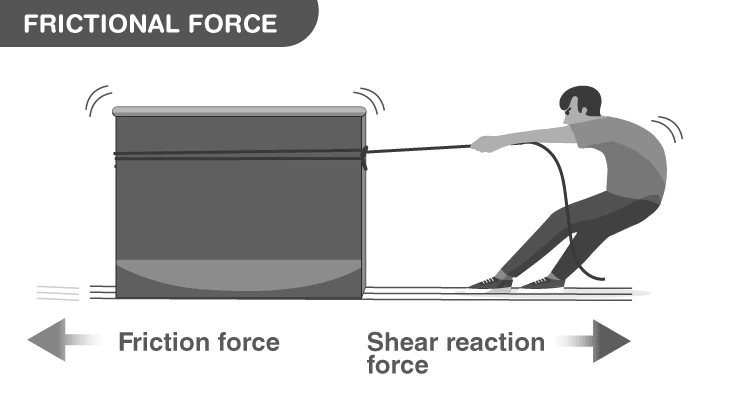
Diagram illustrating frictional force between contacting surfaces
Example Problem: Calculating Frictional Force on a Wooden Block
A wooden block with a mass of 3 kg rests on a flat surface. The coefficient of static friction between the block and the surface is 0.4. Calculate the maximum frictional force that can act on the block before it starts moving.
Solution:
Step 1: Calculate the normal force \( N \) using the formula:
\[ N = mg = 3 \text{ kg} \times 9.8 \text{ m/s}^2 = 29.4 \text{ N} \]
Step 2: Use the friction formula \( F = \mu N \) where \( \mu = 0.4 \):
\[ F = 0.4 \times 29.4 \text{ N} = 11.76 \text{ N} \]
Therefore, the maximum static frictional force is 11.76 N.
Methods to Determine Frictional Force
Calculating Normal Force and Selecting the Correct Coefficient
The frictional force can be quantified using the formula \( F = \mu N \), where \( \mu \) is the coefficient of friction and \( N \) is the normal force. The normal force represents the perpendicular support force exerted by a surface on an object resting on it.
On a horizontal surface, the normal force is simply the weight of the object, calculated as \( N = mg \), where \( m \) is mass and \( g \) is gravitational acceleration. For inclined planes, the normal force decreases and is given by \( N = mg \cos(\theta) \), where \( \theta \) is the angle of inclination.
The coefficient of friction varies depending on whether the object is stationary or moving. For objects at rest, the coefficient of static friction \( \mu_{static} \) applies, while for moving objects, the coefficient of kinetic (sliding) friction \( \mu_{kinetic} \) is used. These coefficients depend on the materials in contact.
Forces acting on an object on an inclined plane
Example Problem: Friction on an Inclined Surface
A 5 kg box rests on a surface inclined at 30°. The coefficient of static friction between the box and the surface is 0.3. Calculate the frictional force acting on the box.
Solution:
Step 1: Calculate the normal force:
\[ N = mg \cos(\theta) = 5 \times 9.8 \times \cos(30^\circ) = 5 \times 9.8 \times 0.866 = 42.4 \text{ N} \]
Step 2: Calculate frictional force:
\[ F = \mu N = 0.3 \times 42.4 = 12.72 \text{ N} \]
The frictional force opposing motion is 12.72 N.
Classification of Frictional Forces
Types of Friction and Their Characteristics
Friction can be broadly categorized into dry friction and fluid friction. Dry friction occurs between solid surfaces and includes static, kinetic, rolling, and sliding friction. Fluid friction arises when objects move through liquids or gases, causing resistance.
Static friction prevents motion between surfaces at rest relative to each other. Kinetic friction acts when surfaces slide past one another. Rolling friction occurs when an object rolls over a surface, and sliding friction is the resistance during sliding motion.
Illustration of different friction types
Understanding Fluid Friction and Its Effects
Fluid friction, also known as viscous friction, is the resistance experienced by objects moving through fluids such as liquids or gases. This friction depends on the fluid's viscosity and the object's speed and shape. Lubrication reduces fluid friction, enabling smoother motion, such as in door hinges or engine parts.
Example of fluid friction reducing resistance
Example Problem: Calculating Frictional Force on Ice
A 250 kg ice block slides over a frozen surface with a kinetic friction coefficient of 0.04. Determine the frictional force opposing the motion.
Solution:
Step 1: Calculate the normal force:
\[ N = mg = 250 \times 9.8 = 2450 \text{ N} \]
Step 2: Calculate frictional force:
\[ F = \mu N = 0.04 \times 2450 = 98 \text{ N} \]
The frictional force resisting the ice block's movement is 98 N.
Practical Applications and Problem Solving with Friction
Real-World Examples and Calculations
Friction plays a vital role in many practical scenarios, from vehicle traction to machinery operation. Understanding how to calculate frictional forces helps in designing safer and more efficient systems.
Friction as a contact force between surfaces
Example Problem 1: Acceleration with Friction
A force of 4800 N pulls a 140 kg object overcoming a frictional force of 250 N. Calculate the acceleration of the object.
Solution:
Step 1: Calculate net force:
\[ F_{net} = 4800 \text{ N} - 250 \text{ N} = 4550 \text{ N} \]
Step 2: Calculate acceleration using Newton's second law:
\[ a = \frac{F_{net}}{m} = \frac{4550}{140} = 32.5 \text{ m/s}^2 \]
The object accelerates at 32.5 m/s².
Example Problem 2: Reaction Force on a Log and Crate
A crate of mass 8 kg is placed on a wooden log weighing 35 N resting on the ground. Find the total reaction force exerted by the ground on the log and crate.
Solution:
Step 1: Calculate the weight of the crate:
\[ W_{crate} = mg = 8 \times 9.8 = 78.4 \text{ N} \]
Step 2: Total reaction force is the sum of weights:
\[ R = W_{log} + W_{crate} = 35 + 78.4 = 113.4 \text{ N} \]
The ground exerts a reaction force of 113.4 N upward.
Quick Reference: Key Formulas and Concepts
Concept | Formula/Description |
|---|---|
Frictional Force | \( F = \mu N \), where \( \mu \) is coefficient of friction, \( N \) is normal force |
Normal Force (Flat Surface) | \( N = mg \), mass times gravitational acceleration |
Normal Force (Inclined Surface) | \( N = mg \cos(\theta) \), \( \theta \) is angle of incline |
Static Friction | Friction preventing motion between stationary surfaces |
Kinetic Friction | Friction opposing motion between sliding surfaces |
Rolling Friction | Resistance when an object rolls over a surface |
Fluid Friction | Resistance experienced by objects moving through fluids |
Coefficient of Friction | Dimensionless value depending on materials in contact |
Acceleration | \( a = \frac{F_{net}}{m} \), net force divided by mass |
Weight | \( W = mg \), force due to gravity on an object |
Glossary of Important Terms
Term | Definition |
|---|---|
Friction | Force opposing relative motion between two surfaces in contact |
Normal Force | Perpendicular force exerted by a surface supporting an object |
Coefficient of Friction | Ratio representing the frictional resistance between two materials |
Static Friction | Friction that prevents motion between stationary surfaces |
Kinetic Friction | Friction acting between moving surfaces |
Rolling Friction | Resistance encountered when an object rolls over a surface |
Fluid Friction | Resistance experienced by objects moving through liquids or gases |
Viscosity | Measure of a fluid's resistance to flow |
Inclined Plane | A flat surface tilted at an angle to the horizontal |
Acceleration | Rate of change of velocity of an object |
Frequently Asked Questions
Does the texture of a surface influence friction?
Yes, rougher surfaces generally produce higher friction due to increased interlocking between surface irregularities.
What is the standard formula to calculate frictional force?
The frictional force is calculated using \( F = \mu N \), where \( \mu \) is the coefficient of friction and \( N \) is the normal force.
How is fluid friction different from dry friction?
Fluid friction occurs when an object moves through a liquid or gas, causing resistance, whereas dry friction happens between solid surfaces in contact.
What defines static friction?
Static friction is the force that resists the initiation of motion between two surfaces at rest relative to each other.
Is frictional force a vector or scalar quantity?
Frictional force is a vector quantity because it has both magnitude and direction, always opposing the direction of motion.