Understanding Friction: Concepts, Types, and Applications
Fundamentals of Frictional Forces
Defining the Nature of Friction
Friction is the force that opposes the relative motion or attempted motion between two surfaces in contact. When an object moves or tries to move over another, friction acts to resist this movement. This force is essential in everyday activities, such as walking, where it prevents slipping by providing necessary grip.
While friction is beneficial in many scenarios, it also causes resistance that can reduce efficiency, such as in engines where a significant portion of power is lost overcoming frictional forces.
Illustrative Example: Why Does a Rolling Ball Stop?
Imagine rolling a ball on a smooth floor. According to Newton's first law, if no external force acts on it, the ball should continue moving indefinitely. However, it eventually stops. This happens because frictional force acts opposite to the ball's motion, gradually reducing its speed until it halts.
Key Influences on Frictional Force
Surface Characteristics and Their Impact
The magnitude of friction depends largely on the texture of the surfaces in contact. Rough surfaces have more microscopic bumps and irregularities that interlock, increasing friction. Conversely, smoother surfaces have fewer such irregularities, resulting in lower frictional resistance.
Additionally, the force pressing the two surfaces together affects friction; greater normal force typically increases friction.
Example Problem: Calculating Friction Based on Surface Roughness
A wooden block weighing 8 kg rests on a rough surface. The coefficient of static friction between the block and surface is 0.45. Calculate the maximum static friction force that can act on the block before it starts moving.
Solution:
The normal force \( N \) equals the weight of the block:
\[ N = mg = 8 \times 9.8 = 78.4 \text{ N} \]
Maximum static friction \( f_s \) is:
\[ f_s = \mu_s N = 0.45 \times 78.4 = 35.28 \text{ N} \]
Thus, the block will resist motion up to a frictional force of 35.28 N.
Origins and Classification of Friction
What Generates Friction Between Surfaces?
Friction arises due to the microscopic irregularities present on all surfaces. When two objects come into contact, these uneven features interlock and resist relative motion. The rougher the surfaces, the more pronounced these irregularities, leading to higher frictional forces.
Types of Friction and Their Characteristics
Friction can be categorized into four main types:
Static Friction: Acts when surfaces are at rest relative to each other, preventing motion.
Sliding Friction: Occurs when one surface slides over another, opposing the sliding motion.
Rolling Friction: Resists the motion when an object rolls over a surface, generally much less than sliding friction.
Fluid Friction: Resistance experienced by objects moving through fluids like air or water.
Each type plays a distinct role depending on the context of motion and surfaces involved.
Visualizing Friction Types
Illustration of various friction types acting between surfaces
Practical Uses and Problem Solving with Friction
Everyday Applications of Frictional Forces
Friction is vital in numerous daily activities and technologies:
Igniting matchsticks by rubbing them against a rough surface.
Ensuring pistons move smoothly inside engine cylinders.
Allowing writing instruments to leave marks on paper or boards.
Problem: Determining Acceleration of Blocks with Friction
Two blocks, C and D, are stacked with block C on top of block D. The coefficient of static friction between C and D is 0.55, and between D and the floor is 0.45. The kinetic friction coefficients are 0.35 and 0.25 respectively. A horizontal force of 70 N is applied to block D. Given masses: block C = 6 kg, block D = 12 kg. Find the acceleration of both blocks assuming they move together.
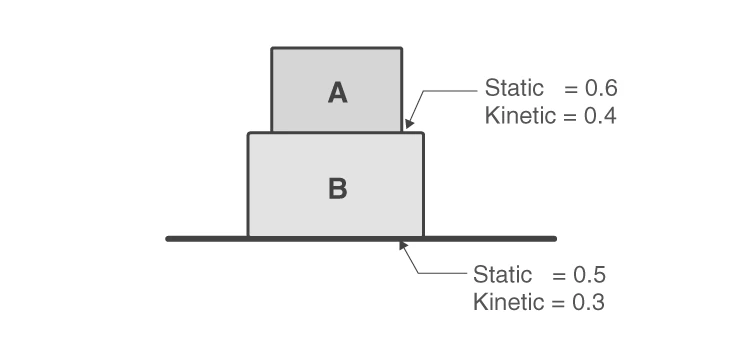
Setup showing blocks C and D with friction coefficients
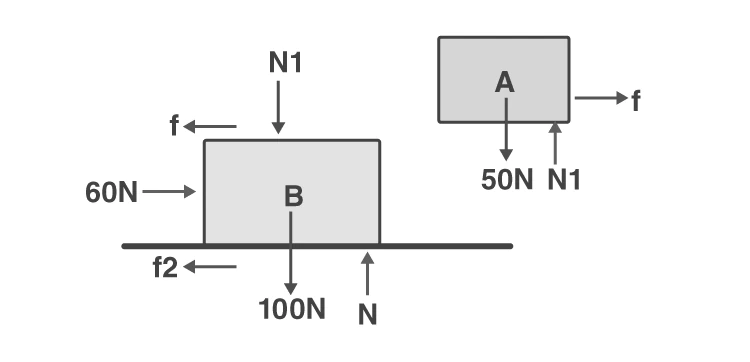
Free body diagram illustrating forces on blocks
Solution:
Assuming both blocks move with acceleration \( a \), total mass is:
\[ m_{total} = 6 + 12 = 18 \text{ kg} \]
Friction force between block D and floor (kinetic friction):
\[ f_1 = \mu_k \times m_{total} \times g = 0.25 \times 18 \times 9.8 = 44.1 \text{ N} \]
Applying Newton's second law on the system:
\[ 70 - f_1 = m_{total} \times a \implies 70 - 44.1 = 18a \]
\[ 25.9 = 18a \implies a = \frac{25.9}{18} = 1.44 \text{ m/s}^2 \]
Friction force between blocks C and D (kinetic friction):
\[ f_2 = \mu_k \times m_C \times g = 0.35 \times 6 \times 9.8 = 20.58 \text{ N} \]
Since \( f_2 \) is less than maximum static friction \( \mu_s m_C g = 0.55 \times 6 \times 9.8 = 32.34 \text{ N} \), blocks move together.
Therefore, acceleration of both blocks is \( 1.44 \text{ m/s}^2 \).
Clarifying Common Misunderstandings About Friction
How Friction Adjusts Itself
Friction is a self-regulating force that adapts to the applied force up to a maximum limit. For example, static friction increases to match the applied force preventing motion until it reaches its maximum value, beyond which sliding occurs.
Graph depicting how friction force varies with applied force
Friction in Human Movement
Walking is possible due to friction between our feet and the ground. This frictional force prevents slipping and allows us to push off the ground effectively.
Frictional force enabling walking motion
Is Friction an Impulsive Force?
Friction is generally a continuous force opposing motion rather than an impulsive force, which acts over a very short time interval. However, in some cases like sudden contact, friction can have impulsive characteristics.
Effect of friction on projectile motion on an inclined plane
Summary Table for Quick Review
Aspect | Details |
|---|---|
Definition | Force opposing relative motion between surfaces in contact |
Factors Affecting Friction | Surface roughness and normal force |
Types | Static, Sliding, Rolling, Fluid |
Applications | Walking, ignition of matches, piston movement, writing |
Coefficient of Friction | Ratio determining friction magnitude between surfaces |
Frictional Force Formula | \( f = \mu N \), where \( \mu \) is coefficient, \( N \) is normal force |
Effect on Motion | Opposes motion, converts kinetic energy to heat |
Static vs Kinetic Friction | Static prevents motion; kinetic acts during motion |
Self-Adjusting Nature | Friction force increases with applied force up to max limit |
Energy Loss | Friction converts mechanical energy into heat energy |
Glossary of Key Terms
Term | Meaning |
|---|---|
Friction | Force resisting relative motion between surfaces |
Static Friction | Friction acting when objects are stationary relative to each other |
Sliding Friction | Friction opposing motion when one surface slides over another |
Rolling Friction | Resistance when an object rolls over a surface |
Fluid Friction | Resistance experienced by objects moving through fluids |
Coefficient of Friction (\( \mu \)) | Dimensionless number representing frictional interaction between surfaces |
Normal Force (\( N \)) | Force perpendicular to the contact surface |
Kinetic Friction | Friction acting during relative motion of surfaces |
Free Body Diagram (F.B.D.) | Diagram showing forces acting on an object |
Traction | Frictional grip that prevents slipping |
Frequently Asked Questions
How does friction generate heat?
Friction converts mechanical energy into thermal energy due to the microscopic collisions and deformations at the contact surfaces, causing temperature rise.
In what ways is friction beneficial?
Friction enables walking without slipping, allows vehicles to brake, helps in writing, and ignites matches, among other practical uses.
Why is friction considered a non-conservative force?
Because friction dissipates mechanical energy as heat, it does not conserve the total mechanical energy of the system.
Does friction increase with speed?
Generally, kinetic friction remains approximately constant with speed, but fluid friction can increase as speed rises.
Is it possible to have zero friction?
In ideal conditions like frictionless surfaces or in space, friction can be negligible, but in everyday life, some friction is always present.
Visual representation related to friction concepts