Understanding Electron Emission and Its Varieties
Fundamentals of Electron Emission
Concept and Mechanism of Electron Release
Electrons, the negatively charged constituents of atoms, are held tightly within metals due to the attractive force exerted by positively charged protons in the nucleus. This electrostatic pull keeps electrons confined inside the metal. However, when electrons acquire enough external energy, they can overcome this attraction and escape from the metal's surface. This phenomenon is known as electron emission.
Within metals, electrons are free to move between atoms, which accounts for metals' excellent electrical conductivity. Yet, these electrons cannot leave the metal surface easily because as electrons attempt to escape, the metal surface becomes positively charged, creating an opposing force that pulls them back. This opposing force forms a barrier called the surface barrier, preventing electron escape.
To liberate electrons, they must gain a minimum energy called the work function, which is the energy required to overcome the surface barrier. The work function varies depending on the metal's intrinsic properties, its purity, and the condition of its surface.
Example Problem
A metal has a work function of \( 3.2 \text{ eV} \). Calculate the minimum energy in joules required to eject an electron from this metal surface.
Solution:
Given, work function \( W = 3.2 \text{ eV} \).
We know, \( 1 \text{ eV} = 1.6 \times 10^{-19} \text{ J} \).
Therefore, minimum energy required,
\[ E = 3.2 \times 1.6 \times 10^{-19} = 5.12 \times 10^{-19} \text{ J} \]
Hence, an electron must gain at least \( 5.12 \times 10^{-19} \text{ J} \) to escape the metal surface.
Different Modes of Electron Emission
Thermionic Emission: Heat-Induced Electron Release
Thermionic emission occurs when a metal is heated to a high temperature, providing electrons with enough kinetic energy to overcome the surface barrier and escape. The thermal energy supplied increases the electrons' motion, enabling them to break free from the metal surface.
Example Problem
A tungsten filament is heated to \( 2500 \text{ K} \). If the work function of tungsten is \( 4.5 \text{ eV} \), explain why electrons are emitted from the filament.
Solution:
At \( 2500 \text{ K} \), electrons gain significant thermal energy.
The thermal energy increases their kinetic energy beyond the work function threshold.
Consequently, electrons overcome the surface barrier and are emitted.
Field Emission: Electron Extraction by Strong Electric Fields
Field emission involves applying an intense electric field to a metal surface, which lowers the surface barrier and pulls electrons out. This process does not require heating; instead, the electric field's force enables electrons to tunnel through the barrier and escape.
Example Problem
A metal tip is subjected to an electric field of \( 1.0 \times 10^{9} \text{ V/m} \). Describe how this leads to electron emission.
Solution:
The strong electric field distorts the surface barrier.
Electrons tunnel through the reduced barrier due to quantum mechanical effects.
This results in electron emission without the need for heating.
Photoelectric Emission: Light-Induced Electron Ejection
Photoelectric emission happens when light of sufficient frequency strikes a metal surface, transferring energy to electrons. If the photon energy exceeds the work function, electrons absorb this energy and are emitted from the surface.
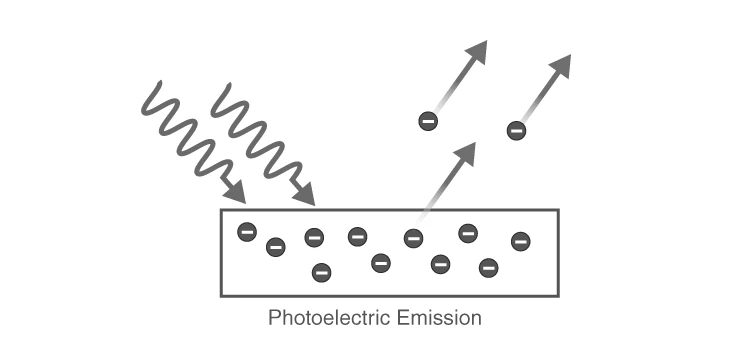
Illustration of Photoelectric Emission
Example Problem
Light with a wavelength of \( 400 \text{ nm} \) falls on a metal surface with a work function of \( 2.5 \text{ eV} \). Determine if electrons will be emitted.
Solution:
Energy of photon,
\[ E = \frac{hc}{\lambda} \]
Where, \( h = 6.63 \times 10^{-34} \text{ Js} \), \( c = 3.0 \times 10^{8} \text{ m/s} \), \( \lambda = 400 \times 10^{-9} \text{ m} \).
Calculating,
\[ E = \frac{6.63 \times 10^{-34} \times 3.0 \times 10^{8}}{400 \times 10^{-9}} = 4.97 \times 10^{-19} \text{ J} \]
Converting to eV,
\[ E = \frac{4.97 \times 10^{-19}}{1.6 \times 10^{-19}} = 3.11 \text{ eV} \]
Since \( 3.11 \text{ eV} > 2.5 \text{ eV} \), electrons will be emitted.
Summary and Quick Reference
Type of Emission | Energy Source | Key Feature |
|---|---|---|
Thermionic Emission | Heat | Electrons gain kinetic energy from temperature |
Field Emission | Strong Electric Field | Electrons tunnel through surface barrier |
Photoelectric Emission | Light (Photons) | Photon energy ejects electrons |
Glossary of Key Terms
Term | Definition |
|---|---|
Electron | Negatively charged subatomic particle orbiting the nucleus |
Work Function | Minimum energy needed to remove an electron from a metal surface |
Surface Barrier | Energy barrier preventing electrons from escaping the metal |
Thermionic Emission | Electron emission caused by heating a metal |
Field Emission | Electron emission due to a strong electric field |
Photoelectric Effect | Emission of electrons when light hits a metal surface |
Photon | Quantum of light energy |
Free Electrons | Electrons that can move freely within a metal |
Electric Field | Region around charged particles exerting force |
Kinetic Energy | Energy possessed by a body due to its motion |
Frequently Asked Questions
What is the work function in electron emission?
The work function is the minimum energy required to free an electron from the surface of a metal.
Who are free electrons in metals?
Free electrons are those that can move easily between atoms within a metal, enabling electrical conductivity.
How does field emission differ from thermionic emission?
Field emission uses a strong electric field to extract electrons without heating, while thermionic emission requires heating the metal.
What is a cathode ray tube?
A cathode ray tube is a device that uses electron beams emitted from a heated cathode to create images on a screen.
In photoelectric emission, what energy form helps electrons escape?
Electrons gain energy from incident light photons to overcome the work function and escape the metal surface.
Additional Visual Reference
Conceptual Diagram of Electron Emission