Understanding Electric Cells and Their Electromotive Force
Fundamentals of Electric Cells and Their Operation
Basic Structure and Functioning of an Electric Cell
An electric cell is a simple device designed to sustain an electric current within a circuit by converting chemical energy into electrical energy. It consists of two electrodes: a positive terminal and a negative terminal, both immersed in an electrolyte solution. The positive terminal is typically capped with a metal cover, while the negative terminal is a flat metal disc. When these terminals are connected to an external electrical device, current begins to flow due to chemical reactions occurring inside the cell. Over time, the chemicals inside the cell are consumed, causing the cell to lose its ability to generate electricity. Multiple cells connected together form what is known as a battery.
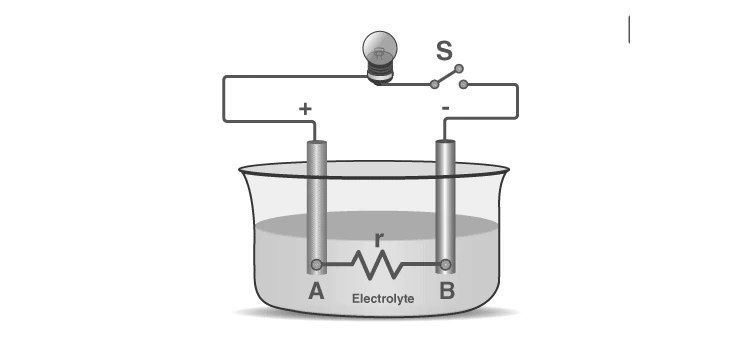
Illustration of an Electric Cell with Electrodes and Electrolyte
Example Problem
Question: Describe the main components of an electric cell and explain how it produces electric current.
Answer:
An electric cell contains two electrodes: a positive terminal (metal cap) and a negative terminal (flat metal disc).
These electrodes are immersed in an electrolyte solution where chemical reactions occur.
When connected to an external device, chemical reactions generate a flow of electrons, producing electric current.
As the chemicals get used up, the cell eventually stops producing electricity.
Electromotive Force (EMF) and Potential Difference in Cells
Defining Electromotive Force and Its Significance
The electromotive force (EMF) of a cell is the energy supplied per unit charge to move the charge between two points in a circuit, typically the terminals of the cell. It represents the maximum potential difference the cell can provide when no current is flowing (open circuit condition). Although called a force, EMF is actually a measure of potential difference and is expressed in volts. The EMF is denoted by the symbol \( \varepsilon \) and mathematically defined as:
\[ \varepsilon = \frac{W}{q} = V_{AB} \]
where:
\( W \) is the work done to move the charge
\( q \) is the amount of charge
\( V_{AB} \) is the potential difference between terminals A and B
Symbolic Representation of EMF in an Electric Cell
Example Problem
Question: What is the electromotive force of a cell and how is it related to the potential difference across its terminals?
Answer:
EMF is the energy supplied per unit charge to move charges through the cell.
It equals the potential difference across the terminals when no current flows.
EMF is measured in volts and denoted by \( \varepsilon \).
Internal Resistance and Terminal Voltage of Electric Cells
Impact of Internal Resistance When the Cell Supplies Current
Every electric cell has an inherent resistance to current flow within its materials, known as internal resistance, symbolized by \( r \) and measured in ohms. When the cell is connected to an external circuit and supplies current (discharging), this internal resistance causes a voltage drop inside the cell. As a result, the terminal voltage \( V_{AB} \) measured across the cell's terminals is less than the EMF. The relationship is given by:
\[ V_{AB} = \varepsilon - i r \]
where:
\( V_{AB} \) is the terminal voltage
\( \varepsilon \) is the EMF of the cell
\( i \) is the current flowing through the circuit
\( r \) is the internal resistance
The negative sign indicates that the voltage drop due to internal resistance reduces the terminal voltage when current flows out of the positive terminal.
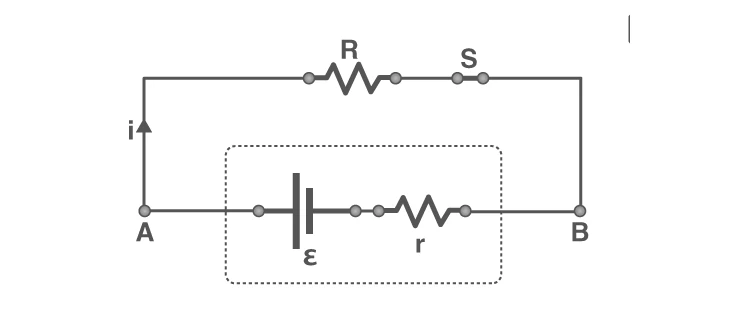
Electric Cell Discharging with Internal Resistance Effect
Example Problem
Question: A cell with an EMF of 4 volts and internal resistance of 0.5 Ω is connected to a circuit drawing a current of 2 A. Calculate the terminal voltage of the cell.
Solution:
Using the formula:
\[ V_{AB} = \varepsilon - i r = 4 - (2)(0.5) = 4 - 1 = 3 \text{ volts} \]
The terminal voltage is 3 volts.
Behavior of the Cell When It Is Being Charged
When a cell is recharged, it acts as a load rather than a source. In this scenario, the current flows into the positive terminal of the cell, causing the terminal voltage to be higher than the EMF. The terminal voltage in this charging condition is expressed as:
\[ V_{AB} = \varepsilon + i r \]
where the symbols have the same meanings as before. This increase in terminal voltage accounts for the energy required to reverse the chemical reactions inside the cell during charging.
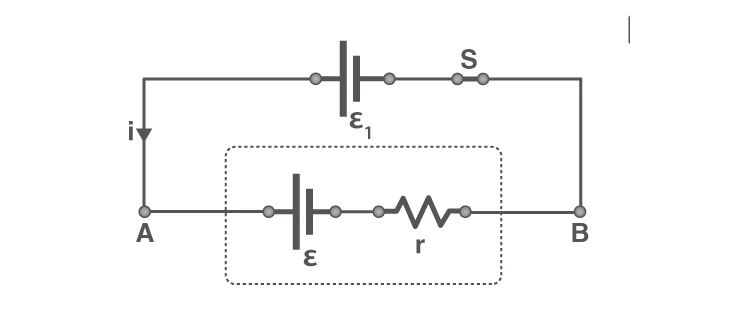
Electric Cell Charging with Increased Terminal Voltage
Example Problem
Question: A rechargeable cell has an EMF of 6 volts and internal resistance of 0.2 Ω. If a charging current of 3 A flows into the positive terminal, find the terminal voltage.
Solution:
Applying the charging formula:
\[ V_{AB} = \varepsilon + i r = 6 + (3)(0.2) = 6 + 0.6 = 6.6 \text{ volts} \]
The terminal voltage during charging is 6.6 volts.
Summary Table for Quick Review
Concept | Definition/Formula | Unit |
|---|---|---|
Electric Cell | Device converting chemical energy to electrical energy | – |
Electromotive Force (EMF) | \( \varepsilon = \frac{W}{q} = V_{AB} \) (open circuit) | Volt (V) |
Internal Resistance | Resistance inside the cell opposing current flow | Ohm (Ω) |
Terminal Voltage (Discharging) | \( V_{AB} = \varepsilon - i r \) | Volt (V) |
Terminal Voltage (Charging) | \( V_{AB} = \varepsilon + i r \) | Volt (V) |
Current | Flow of electric charge | Ampere (A) |
Key Terms and Definitions
Term | Meaning |
|---|---|
Electric Cell | A device that converts chemical energy into electrical energy. |
Electrode | Conductive material where oxidation or reduction occurs in a cell. |
Electrolyte | Solution that allows ionic conduction between electrodes. |
Electromotive Force (EMF) | Energy supplied per unit charge by the cell; potential difference at open circuit. |
Terminal Voltage | Potential difference measured across the cell terminals when current flows. |
Internal Resistance | Resistance within the cell opposing current flow. |
Discharging | Process of the cell supplying current to an external circuit. |
Charging | Process of restoring the cell’s chemical energy by passing current into it. |
Battery | A collection of two or more cells connected together. |
Potential Difference | Work done per unit charge to move charge between two points. |
Frequently Asked Questions
What is the primary function of an electric cell?
An electric cell converts chemical energy into electrical energy to provide current in a circuit.
How is electromotive force (EMF) different from terminal voltage?
EMF is the potential difference when no current flows (open circuit), while terminal voltage is the potential difference when current flows and is affected by internal resistance.
Why does the terminal voltage drop when the cell supplies current?
Because of the internal resistance inside the cell, some voltage is lost as heat, reducing the terminal voltage below the EMF.
What happens to the terminal voltage when the cell is being charged?
During charging, current enters the positive terminal, causing the terminal voltage to be higher than the EMF.
What is the unit of electromotive force?
The unit of EMF is the volt (V), the same as potential difference.