Understanding Vision Impairments and Their Remedies
Fundamentals of Eye Function and Accommodation
How the Eye Adjusts Focus for Clear Vision
The human eye is a remarkable organ capable of adjusting its focus to view objects at varying distances. This adjustment is achieved by changing the curvature of the eye's lens, which is made of a flexible, jelly-like substance. The ciliary muscles surrounding the lens contract or relax to alter its shape, thereby modifying the focal length.
When the ciliary muscles relax, the lens flattens, increasing the focal length, which allows clear vision of distant objects. Conversely, contraction of these muscles makes the lens more curved, reducing the focal length to focus on nearby objects. This dynamic ability to change focal length is known as accommodation.
Accommodation is essential for maintaining sharp vision across different distances, and any impairment in this mechanism can lead to vision problems.
Example: If the focal length of the eye lens when relaxed is \( 25 \text{ mm} \), and it decreases to \( 20 \text{ mm} \) when focusing on a close object, calculate the change in focal length due to accommodation.
Solution:
The change in focal length is given by:
\[ \Delta f = f_{\text{relaxed}} - f_{\text{contracted}} = 25 \text{ mm} - 20 \text{ mm} = 5 \text{ mm} \]
This change allows the eye to focus on objects at different distances effectively.
Common Refractive Vision Disorders and Their Causes
Near-Sightedness (Myopia): Difficulty Seeing Distant Objects
Myopia, or near-sightedness, is a condition where individuals can clearly see objects close to them but struggle to view distant objects sharply. This occurs when the eye's shape causes light rays to converge before reaching the retina, resulting in blurred distance vision.
Typically, the eyeball is elongated or the cornea is too curved, causing the focal point to fall in front of the retina rather than directly on it.
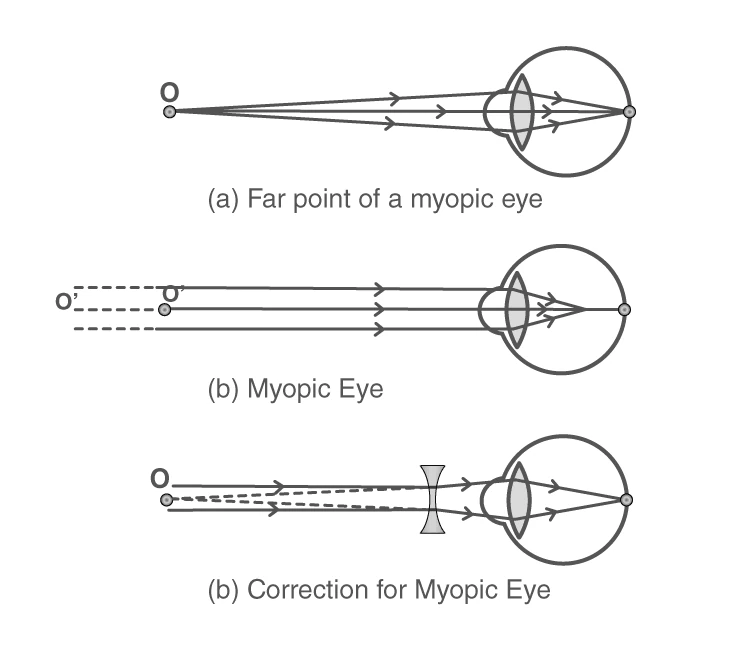
Illustration of Myopia (Near-Sightedness)
Symptoms include:
Blurred vision when looking at distant objects
Difficulty driving, especially at night
Frequent headaches caused by eye strain
Correction: The use of concave lenses in spectacles helps diverge light rays before they enter the eye, moving the focal point back onto the retina for clear distant vision.
Example: A person with myopia has a far point of \( 50 \text{ cm} \). Calculate the power of the concave lens needed to correct their vision for distant objects (assumed at infinity).
Solution:
The lens power \( P \) in diopters is given by:
\[ P = -\frac{100}{d} = -\frac{100}{50} = -2 \text{ D} \]
where \( d = 50 \text{ cm} \) is the far point distance.
A concave lens of power \(-2 \text{ D}\) will correct the myopia.
Far-Sightedness and Age-Related Vision Changes
Understanding Hypermetropia: Challenges with Near Vision
Hypermetropia, or far-sightedness, is a condition where distant objects are seen clearly, but nearby objects appear blurry. This happens when light rays from close objects focus behind the retina, often due to a shorter eyeball or a less curved cornea.
People with hypermetropia often squint to improve focus on near objects.
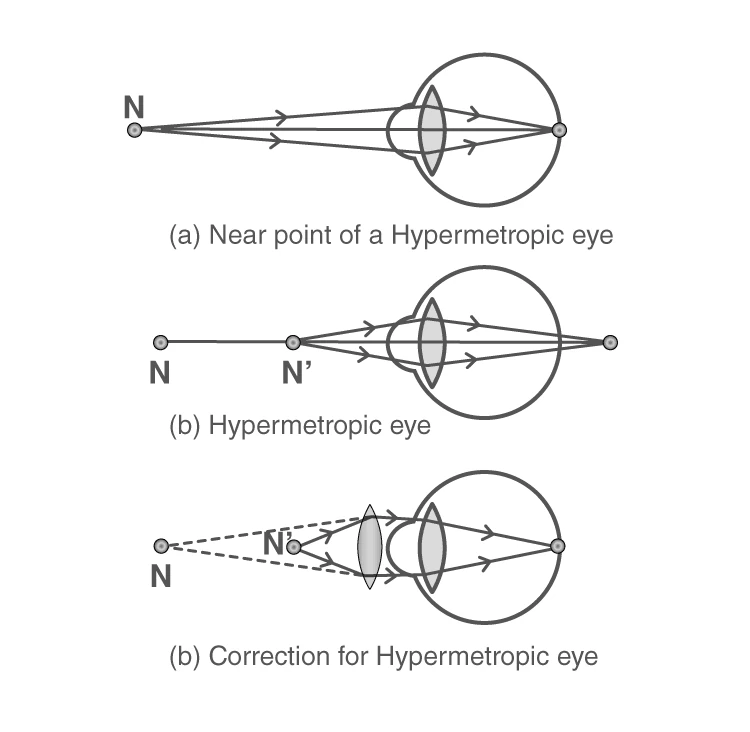
Diagram Depicting Hypermetropia (Far-Sightedness)
Symptoms include:
Blurred vision for close objects
Eye strain and headaches
Squinting to see clearly
Correction: Convex lenses are used in glasses to converge light rays before they enter the eye, shifting the focal point onto the retina for clear near vision.
Example: A hypermetropic person has a near point of \( 150 \text{ cm} \). Find the power of the convex lens required to correct their near vision to the normal near point of \( 25 \text{ cm} \).
Solution:
The lens power \( P \) is calculated by:
\[ P = \frac{100}{v} - \frac{100}{u} \]
where \( v = 25 \text{ cm} \) (desired near point) and \( u = -150 \text{ cm} \) (actual near point, negative as object is virtual).
\[ P = \frac{100}{25} - \frac{100}{-150} = 4 + \frac{2}{3} = 4.67 \text{ D} \]
A convex lens of approximately \( +4.67 \text{ D} \) will correct the near vision.
Presbyopia: Age-Related Decline in Accommodation
With advancing age, the eye's lens loses elasticity, and the ciliary muscles weaken, reducing the eye's ability to change its focal length. This condition, called presbyopia, makes it difficult to focus on nearby objects, typically affecting individuals over 40 years old.
Symptoms include blurred near vision and headaches due to eye strain.
Correction: Presbyopia is managed using reading glasses with convex lenses or contact lenses. In some cases, surgical options are available to restore accommodation.
Example: A 50-year-old person finds it difficult to read text at \( 30 \text{ cm} \). If their near point has shifted to \( 75 \text{ cm} \), calculate the power of the lens needed to correct their vision.
Solution:
Using the lens formula for near point correction:
\[ P = \frac{100}{v} - \frac{100}{u} = \frac{100}{30} - \frac{100}{-75} = 3.33 + 1.33 = 4.66 \text{ D} \]
A convex lens of power \( +4.66 \text{ D} \) will help the person see clearly at normal reading distance.
Combined Vision Disorders and When to Seek Medical Advice
Managing Multiple Refractive Errors with Bifocal Lenses
Some individuals experience both myopia and hypermetropia simultaneously, making it challenging to see clearly at both near and far distances. Bifocal lenses are specially designed to address this by combining two types of lenses in one frame.
The upper section of a bifocal lens is concave to correct distant vision (myopia), while the lower section is convex to aid near vision (hypermetropia).
This dual functionality allows seamless vision correction for different focal lengths without changing glasses.
Example: A person requires a concave lens of power \(-3 \text{ D}\) for distance and a convex lens of power \(+2 \text{ D}\) for near vision. Describe the structure of the bifocal lens needed.
Solution:
The upper part of the bifocal lens will have a concave lens with power \(-3 \text{ D}\) to correct myopia.
The lower part will have a convex lens with power \(+2 \text{ D}\) to correct hypermetropia.
This arrangement allows the wearer to see clearly at both distances by looking through the appropriate section.
Recognizing Symptoms That Require Professional Evaluation
It is crucial to consult an eye specialist if you experience any of the following symptoms:
Sudden blurring of vision, especially for close objects
Loss of vision in one or both eyes, with or without pain
Seeing halos or black spots around lights
Flashes of light or double vision
Persistent headaches related to eye strain
Early diagnosis and treatment can prevent permanent vision loss and improve quality of life.
Summary of Vision Defects and Their Corrections
Vision Disorder | Cause | Symptoms | Correction Method |
|---|---|---|---|
Myopia (Near-Sightedness) | Light focuses before retina due to elongated eyeball | Blurred distant vision, headaches, night driving difficulty | Concave lenses to diverge light rays |
Hypermetropia (Far-Sightedness) | Light focuses behind retina due to short eyeball | Blurred near vision, squinting, eye strain | Convex lenses to converge light rays |
Presbyopia | Loss of lens elasticity with age | Difficulty focusing on near objects, headaches | Convex reading glasses or surgery |
Combined Myopia and Hypermetropia | Presence of both refractive errors | Blurred vision at multiple distances | Bifocal lenses combining concave and convex sections |
Key Terms and Definitions
Term | Definition |
|---|---|
Accommodation | The eye's ability to change lens curvature to focus on objects at different distances |
Concave Lens | A lens that diverges light rays, used to correct myopia |
Convex Lens | A lens that converges light rays, used to correct hypermetropia and presbyopia |
Myopia | Near-sightedness; difficulty seeing distant objects clearly |
Hypermetropia | Far-sightedness; difficulty seeing nearby objects clearly |
Presbyopia | Age-related loss of accommodation causing near vision difficulty |
Bifocal Lens | Eyeglass lens with two distinct optical powers for near and far vision |
Focal Length | The distance between the lens and the point where light rays converge |
Ciliary Muscles | Muscles that control the curvature of the eye lens for focusing |
Retina | The light-sensitive layer at the back of the eye where images are formed |
Frequently Asked Questions
What causes cataracts and how do they affect vision?
Cataracts occur when the eye's crystalline lens becomes cloudy with age, leading to partial or complete vision loss if untreated. Surgery can restore vision by replacing the cloudy lens.
Which lenses are used to correct myopia and hypermetropia?
Myopia is corrected with concave lenses that diverge light rays, while hypermetropia is corrected with convex lenses that converge light rays.
What is the function of bifocal lenses?
Bifocal lenses combine concave and convex lenses to correct both near and distant vision problems in the same pair of glasses.
Why does presbyopia occur with age?
Presbyopia results from the loss of elasticity in the eye lens and weakening of ciliary muscles, reducing the eye's ability to focus on close objects.
When should one consult an eye specialist?
Consult a doctor if you experience sudden vision changes, persistent blurriness, eye pain, double vision, or see halos and flashes of light.