Understanding the Phenomenon of Light Refraction
Fundamentals of Light Refraction
Concept and Nature of Refraction
Refraction refers to the alteration in the path of a wave as it crosses from one medium into another with a different density. This bending occurs because the wave changes speed when entering the new medium. While light is the most familiar example, other waves such as sound and water waves also exhibit refraction. This phenomenon is crucial for the operation of many optical devices including lenses, prisms, and magnifying glasses, and it enables the human eye to focus images on the retina effectively.
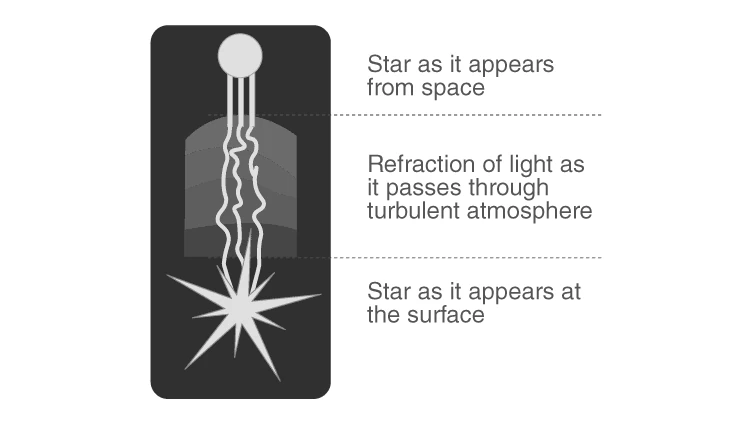
Illustration showing the bending of light as it passes through different media
Example Problem
A beam of light moves from air into water at an angle of 30°. Explain why the light bends and describe the direction of bending.
Solution:
Light travels from a less dense medium (air) to a denser medium (water), causing its speed to decrease.
This reduction in speed results in the light bending towards the normal line at the interface.
Therefore, the refracted ray inside the water is closer to the normal compared to the incident ray in air.
Atmospheric Refraction and Twinkling of Stars
The twinkling of stars is a direct consequence of atmospheric refraction. As starlight travels through Earth's atmosphere, it passes through layers with varying densities and refractive indices. This causes the light to bend multiple times, leading to fluctuations in the star's apparent position and brightness, which we perceive as twinkling.
Mechanics and Principles Governing Refraction
Why Does Light Change Direction?
When a light ray enters a new medium at an angle, its velocity changes due to the difference in optical density between the two media. This change in speed causes the ray to bend. For instance, when light moves from air into glass, it slows down and bends towards the normal line. However, if the light strikes the boundary perpendicularly, it continues straight without bending despite the speed change.
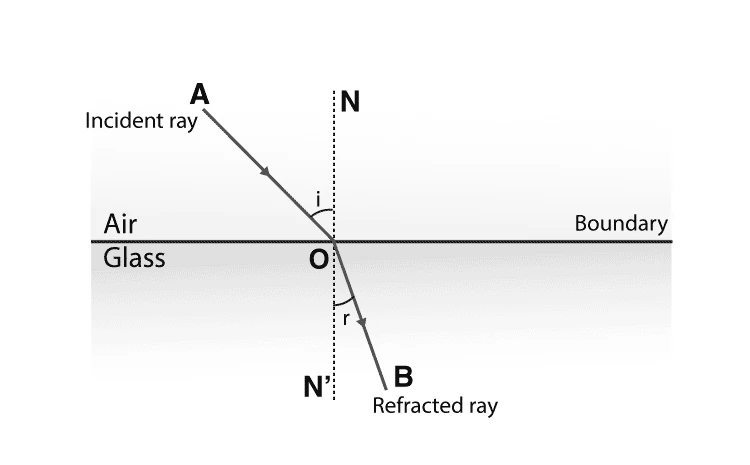
Refraction of light as it passes from air into glass
Fundamental Laws of Refraction
The behavior of refracted light rays is governed by two key laws:
The incident ray, the refracted ray, and the normal to the interface all lie in the same plane.
The ratio of the sine of the angle of incidence to the sine of the angle of refraction remains constant for a given pair of media. This is mathematically expressed as Snell's Law:
\[ \frac{\sin i}{\sin r} = \text{constant} \]
Example Problem
Light enters a glass slab from air at an incidence angle of 25°. Given the refractive index of glass is 1.5, calculate the angle of refraction inside the glass.
Solution:
Let air be medium 1 and glass be medium 2. Then, \( n_1 = 1.00 \), \( n_2 = 1.50 \), and \( i = 25^\circ \).
Using Snell's law:
\[ n_1 \sin i = n_2 \sin r \]
\[ 1.00 \times \sin 25^\circ = 1.50 \times \sin r \]
\[ \sin r = \frac{\sin 25^\circ}{1.50} = \frac{0.4226}{1.50} = 0.2817 \]
\[ r = \sin^{-1}(0.2817) \approx 16.4^\circ \]
Thus, the refracted angle inside the glass is approximately \(16.4^\circ\).
Understanding the Refractive Index
The refractive index of a material quantifies how much the speed of light is reduced inside that medium compared to its speed in a vacuum. It is a dimensionless number defined as:
\[ n = \frac{c}{v} \]
where \( c \) is the speed of light in vacuum and \( v \) is the speed of light in the medium. A higher refractive index indicates a greater bending of light towards the normal when entering that medium.
Practical Examples and Technological Uses of Refraction
Everyday Phenomena Involving Refraction
Refraction is responsible for several common optical effects and illusions. For example, a swimming pool appears shallower than it actually is because light rays bend when they pass from water to air. Similarly, the formation of rainbows occurs when sunlight refracts through raindrops, dispersing into its constituent colors. Additionally, when white light passes through a prism, it splits into a spectrum of colors due to refraction.
Rainbow created by refraction and dispersion of sunlight
Applications in Optical Devices
Refraction is fundamental to the design and function of many optical instruments:
Lenses use refraction to magnify or focus images, essential in glasses, microscopes, and cameras.
Spectacles correct vision by bending light appropriately to focus images on the retina.
Devices like peepholes, telescopes, and projectors rely on refraction to manipulate light paths for clear viewing.
Lens bending light rays to form clear images
Numerical Problems on Refraction
Problem 1
A light ray travels from air into an optical fiber with a refractive index of 1.50. If the angle of incidence is \(20^\circ\), determine the angle of refraction inside the fiber and the direction of bending.
Solution:
Since light moves from air (rarer medium) to optical fiber (denser medium), it bends towards the normal.
Given: \( n_1 = 1.00 \), \( n_2 = 1.50 \), \( i = 20^\circ \).
Using Snell's law:
\[ n_1 \sin i = n_2 \sin r \]
\[ 1.00 \times \sin 20^\circ = 1.50 \times \sin r \]
\[ \sin r = \frac{\sin 20^\circ}{1.50} = \frac{0.3420}{1.50} = 0.228 \]
\[ r = \sin^{-1}(0.228) \approx 13.2^\circ \]
The refracted ray inside the fiber makes an angle of approximately \(13.2^\circ\) with the normal.
Problem 2
Light exits an optical fiber (refractive index 1.50) into air. If the angle of incidence inside the fiber at the boundary is \(35^\circ\), find the angle of refraction in air and describe the bending direction.
Solution:
Here, light moves from a denser medium (fiber) to a rarer medium (air), so it bends away from the normal.
Given: \( n_1 = 1.50 \), \( n_2 = 1.00 \), \( i = 35^\circ \).
Applying Snell's law:
\[ n_1 \sin i = n_2 \sin r \]
\[ 1.50 \times \sin 35^\circ = 1.00 \times \sin r \]
\[ \sin r = 1.50 \times 0.574 = 0.861 \]
\[ r = \sin^{-1}(0.861) \approx 59.5^\circ \]
The refracted ray in air forms an angle of approximately \(59.5^\circ\) with the normal, bending away from it.
Summary and Key Terms
Quick Reference Table
Concept | Definition/Formula | Notes |
|---|---|---|
Refraction | Bending of waves when passing between media of different densities | Occurs due to change in wave speed |
Snell's Law | \( \frac{\sin i}{\sin r} = \text{constant} \) | Relates angles of incidence and refraction |
Refractive Index (n) | \( n = \frac{c}{v} \) | Ratio of light speed in vacuum to medium |
Incident Ray | Incoming light ray striking the boundary | Measured with respect to normal |
Refracted Ray | Light ray after bending in new medium | Direction changes based on refractive indices |
Normal | Perpendicular line to the interface | Reference for measuring angles |
Optical Density | Measure of how much a medium slows light | Higher optical density means slower light |
Dispersion | Separation of light into colors by refraction | Observed in prisms and rainbows |
Total Internal Reflection | Complete reflection inside denser medium | Occurs beyond critical angle |
Apparent Depth | Perceived depth due to refraction | Objects appear closer than actual |
Glossary of Terms
Term | Meaning |
|---|---|
Refraction | Change in direction of a wave passing between media |
Incident Ray | Ray of light striking the surface |
Refracted Ray | Ray of light bending inside the new medium |
Normal | Line perpendicular to the interface at point of incidence |
Refractive Index | Ratio of speed of light in vacuum to that in medium |
Optical Density | Property of a medium that affects light speed |
Snell's Law | Mathematical relation between angles of incidence and refraction |
Dispersion | Splitting of white light into colors |
Total Internal Reflection | Reflection of light entirely within a denser medium |
Apparent Depth | Perceived depth of an object due to refraction |
Frequently Asked Questions
What is refraction in simple terms?
Refraction is the bending of a wave, such as light, when it passes from one medium to another with a different density.
When does refraction occur?
Refraction happens when a wave crosses the boundary between two media at an angle and changes speed, causing it to bend.
Can refraction occur if light hits the boundary straight on?
No, if light strikes the boundary perpendicularly, it changes speed but does not bend.
How is refraction different from reflection?
Reflection involves light bouncing back into the original medium, while refraction involves light passing into a new medium and bending.
Give an example of refraction in daily life.
A swimming pool appears shallower than it really is because of the bending of light rays as they move from water to air.