Fundamentals and Properties of Sound Waves
Understanding the Nature of Sound and Its Propagation
Vibrations as the Source of Sound
Sound is a type of energy similar to heat, light, or electricity. When an object like a bell is struck, it vibrates, producing sound waves. These vibrations are rapid back-and-forth movements of the object’s particles. If you place your finger on the bell after striking it, you can feel these vibrations directly. This oscillatory motion is fundamental to the generation of sound.
Sound travels through a medium by causing alternating compressions and rarefactions in the particles of that medium. These pressure variations propagate as waves, which our ears detect as sound. Since sound requires particles to transmit these vibrations, it cannot travel through a vacuum where no particles exist.
Visualizing Sound Waves Through Waveforms
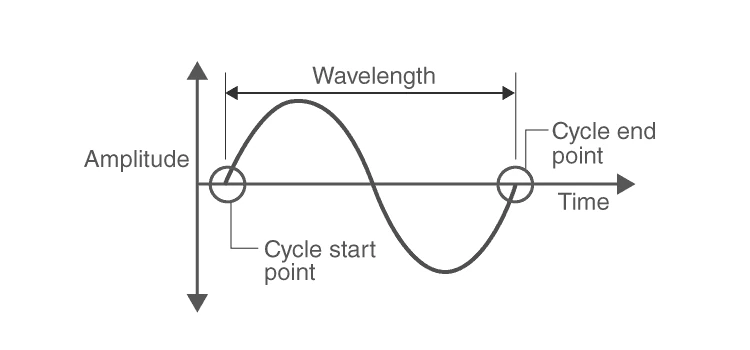
Sound waves can be graphically represented as waveforms, illustrating the changes in air pressure over time. These waveforms display alternating regions of high pressure (compressions) and low pressure (rarefactions). This graphical representation helps us understand sound waves similarly to how we view light waves, highlighting their wave-like nature.
Solution: The frequency of a sound wave is the number of vibrations per second. Here, the bell vibrates 440 times per second, so the frequency is 440 Hz.
Key Characteristics of Sound Waves
Amplitude and Loudness
Amplitude in sound waves refers to the maximum displacement of particles from their rest position during vibration. It corresponds to the extent of compression and expansion in the medium. A larger amplitude means the sound wave carries more energy, which our ears interpret as a louder sound. Thus, amplitude directly influences the loudness of the sound we perceive.
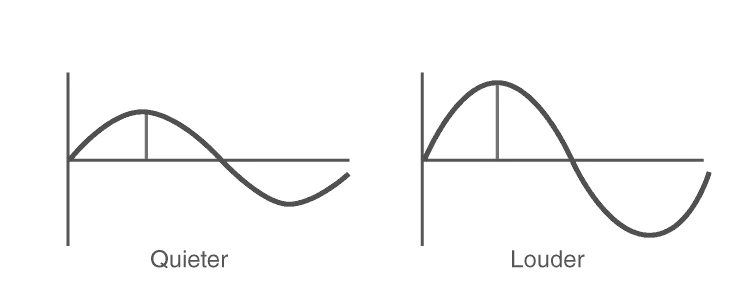
Solution: Loudness is proportional to the amplitude of the sound wave. Therefore, a wave with twice the amplitude will be perceived as louder, carrying more energy and producing a stronger sound sensation.
Wavelength and Its Significance
The wavelength of a sound wave is the physical distance between two successive compressions or rarefactions, often measured between two consecutive peaks in the waveform. It determines the spatial length of one complete cycle of the wave. Understanding wavelength helps in analyzing how sound waves propagate through different media.
Frequency and Pitch Relationship
Frequency indicates how many vibrations or cycles a sound wave completes in one second, measured in hertz (Hz). It determines the pitch of the sound: higher frequency results in a higher pitch, while lower frequency produces a lower pitch. The frequency \( f \) is related to the wavelength \( \lambda \) and the velocity \( v \) of sound by the formula:
\[ v = f \times \lambda \]
where \( v \) is the speed of sound in the medium.
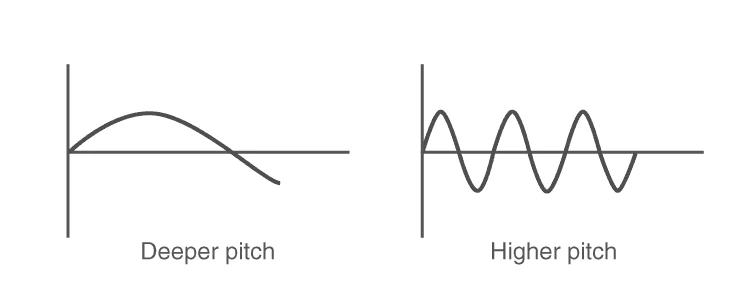
Solution: Using the formula \( v = f \times \lambda \), we find wavelength \( \lambda \) as:
\[ \lambda = \frac{v}{f} = \frac{340 \text{ m/s}}{680 \text{ Hz}} = 0.5 \text{ m} \]
So, the wavelength is \( 0.5 \text{ meters} \).Timbre: Distinguishing Sounds of Identical Pitch and Loudness
Timbre refers to the unique quality or tone color of a sound that allows us to differentiate between two sounds with the same pitch and loudness. For example, a piano and a bell playing the same note sound distinct because of their different timbres. This property arises from the complex mixture of frequencies and overtones present in the sound.
Behavior of Sound Waves: Reflection, Refraction, and Diffraction
Reflection and Echo Formation
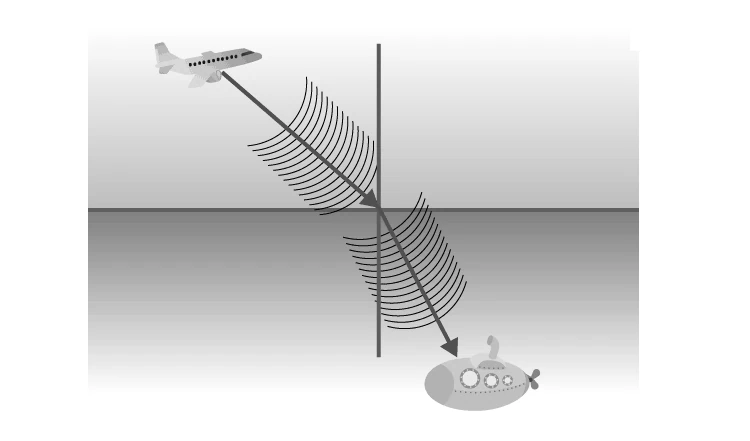
Sound waves reflect off surfaces much like light waves do. The angle at which the sound wave hits a surface (angle of incidence) equals the angle at which it bounces off (angle of reflection). This reflection causes echoes, which are repetitions of sound heard after the original sound. Large surfaces such as walls or clouds can reflect sound effectively. This principle is also utilized in SONAR technology to detect underwater objects by sending and receiving reflected sound waves.
Refraction of Sound Waves
Refraction occurs when sound waves pass through regions of varying density, causing a change in their speed and direction. For instance, temperature differences in the atmosphere affect air density, bending sound waves. This phenomenon is similar to light refraction and can even lead to total internal reflection under certain conditions.
Diffraction: Sound Bending Around Obstacles
Sound waves have the ability to bend around obstacles and spread through openings, a phenomenon known as diffraction. This explains why you can hear someone calling you from another room even if the door is closed or slightly open. Lower frequency sounds diffract more effectively than higher frequency sounds, which is why distant thunder sounds deep and rumbling rather than sharp and loud.
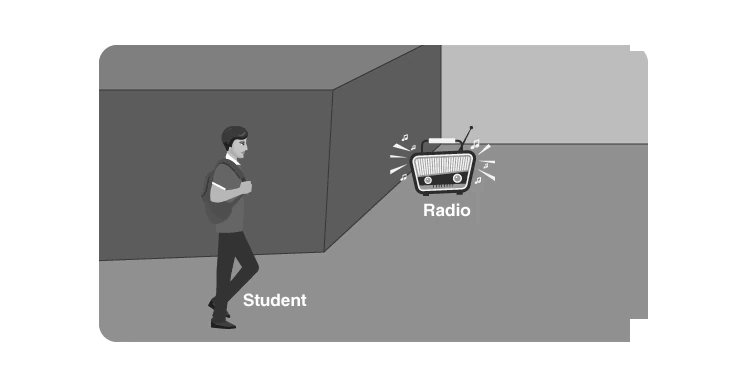
Solution: Low-pitched sounds have longer wavelengths, which allows them to bend around obstacles more effectively due to diffraction. High-pitched sounds have shorter wavelengths and do not diffract as much, making them harder to hear around corners.
Summary Table: Essential Properties of Sound Waves
| Property | Description | Effect on Sound |
|---|---|---|
| Vibration | Back-and-forth motion of particles producing sound | Source of sound generation |
| Amplitude | Maximum displacement of particles from rest | Determines loudness |
| Wavelength | Distance between two consecutive compressions or rarefactions | Relates to sound’s spatial length |
| Frequency | Number of vibrations per second (Hz) | Determines pitch |
| Timbre | Quality distinguishing sounds of same pitch and loudness | Identifies sound source |
| Reflection | Bouncing of sound waves from surfaces | Causes echoes and aids SONAR |
| Refraction | Bending of sound waves due to density changes | Alters sound direction and speed |
| Diffraction | Bending of sound waves around obstacles | Allows hearing around corners |
| Medium Requirement | Sound needs a material medium to travel | Cannot propagate in vacuum |
Glossary of Key Terms
| Term | Definition |
|---|---|
| Amplitude | Maximum displacement of particles in a wave from their rest position |
| Compression | Region of high pressure in a sound wave where particles are close together |
| Diffraction | Bending of waves around obstacles or through openings |
| Echo | Reflected sound wave heard after the original sound |
| Frequency | Number of wave cycles per second, measured in hertz (Hz) |
| Longitudinal Wave | Wave in which particle displacement is parallel to wave propagation |
| Pitch | Perceived frequency of a sound determining how high or low it sounds |
| Rarefaction | Region of low pressure in a sound wave where particles are spread apart |
| Reflection | Bouncing back of waves from a surface |
| Timbre | Characteristic quality of sound that distinguishes different sources |
Frequently Asked Questions
Why are sound waves classified as mechanical waves?
Sound waves require a medium to travel because they propagate through the vibration of particles, which is a characteristic of mechanical waves.
In which medium does sound travel fastest?
Sound travels fastest in solids because particles are closely packed, allowing quicker transmission of vibrations.
What type of wave are sound waves?
Sound waves are longitudinal waves where particle displacement is parallel to the direction of wave propagation.
What causes an echo?
An echo is produced when sound waves reflect off a large surface and return to the listener after a delay.
Why can't explosions on other planets be heard from Earth?
Sound cannot travel through the vacuum of space because there is no medium to carry the vibrations.