Fundamentals and Applications of Probability
Understanding Probability and Its Basic Principles
Concept and Measurement of Probability
Probability quantifies how likely an event is to occur, expressed as a value between 0 and 1. A probability of 0 indicates an impossible event, while 1 signifies certainty. This mathematical framework helps predict outcomes in uncertain situations by analyzing the ratio of favorable outcomes to all possible outcomes.
For instance, tossing a single coin yields two possible results: heads or tails. When two coins are tossed simultaneously, the total possible outcomes increase to four: (Heads, Heads), (Heads, Tails), (Tails, Heads), and (Tails, Tails).
Practical Example: Probability of Selecting a Yellow Pillow
Problem: A bed has 6 pillows: 3 red, 2 yellow, and 1 blue. What is the chance of randomly picking a yellow pillow?
Solution: The probability is the number of yellow pillows divided by the total pillows:
\[ P(\text{yellow}) = \frac{2}{6} = \frac{1}{3} \]
Visualizing Outcomes with a Probability Tree
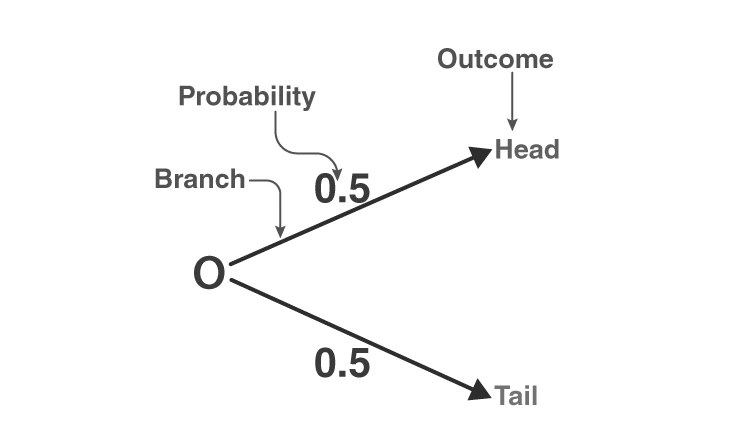
Tree diagrams are useful tools to map out all possible outcomes of an experiment, showing branches for each event and their associated probabilities. This helps determine when to multiply or add probabilities.
Different Approaches and Types of Probability
Theoretical Probability Explained
Theoretical probability is derived from logical reasoning about the possible outcomes of an event. For example, the chance of getting heads when tossing a fair coin is \( \frac{1}{2} \), based on the assumption of equally likely outcomes.
Experimental Probability Based on Observations
Experimental probability is calculated from actual trials or experiments. If a coin is flipped 10 times and lands on heads 6 times, the experimental probability of heads is:
\[ P(\text{heads}) = \frac{6}{10} = \frac{3}{5} \]
Understanding Axiomatic Probability
Axiomatic probability is founded on a set of formal rules or axioms, established by Kolmogorov, that apply universally to all probability scenarios. This approach defines probability as a measure on a sample space, ensuring values lie between 0 and 1 and adhere to specific properties.
Example: Calculating Experimental Probability of Picking a Green Bottle
Problem: Sumit picks bottles from a container 1000 times, recording 450 green bottles. What is the probability of selecting a green bottle?
Solution: The probability is the ratio of green bottles picked to total picks:
\[ P(\text{green}) = \frac{450}{1000} = 0.45 \]
If the container has 100 bottles, the expected number of green bottles is:
\[ 100 \times 0.45 = 45 \]
Key Probability Concepts and Their Applications
Calculating Probability of an Event
For an event \( E \) that can occur in \( r \) favorable ways out of \( n \) equally likely possible outcomes, the probability is:
\[ P(E) = \frac{r}{n} \]
The probability that event \( E \) does not occur, denoted \( E' \), is:
\[ P(E') = 1 - P(E) = \frac{n - r}{n} \]
These probabilities always satisfy:
\[ P(E) + P(E') = 1 \]
Equally Likely Events
Events are equally likely if each has the same chance of occurring. For example, when rolling a fair six-sided die, the probability of any face (1 through 6) is \( \frac{1}{6} \). Events such as getting a 3 or a 5, or getting an even or odd number, are equally likely.
Complementary Events in Probability
Complementary events are pairs where one event's occurrence means the other does not happen. Examples include:
- It will rain today or it will not rain.
- A student passes an exam or fails.
- Winning a lottery or not winning.
Example: Probability of Drawing a Face Card from a Deck
Problem: From a standard 52-card deck, what is the probability of drawing a face card (Jack, Queen, King)?
Solution: Number of face cards = \(4 \times 3 = 12\), total cards = 52.
\[ P(\text{face card}) = \frac{12}{52} = \frac{3}{13} \]
Example: Probability of Sequential Draws from a Vessel
Problem: A vessel contains 4 blue, 5 red, and 11 white balls. Three balls are drawn one after another without replacement. Find the probability that the first is red, the second blue, and the third white.
Solution:
Probability first ball is red:
\[ \frac{5}{20} \]
Probability second ball is blue (after one red removed):
\[ \frac{4}{19} \]
Probability third ball is white (after red and blue removed):
\[ \frac{11}{18} \]
Combined probability:
\[ P = \frac{5}{20} \times \frac{4}{19} \times \frac{11}{18} = \frac{220}{6840} = \frac{11}{342} \approx 0.032 \]
Summary Table for Quick Review
| Concept | Definition | Formula | Example |
|---|---|---|---|
| Probability of Event \(E\) | Chance of event occurring | \(P(E) = \frac{\text{favorable outcomes}}{\text{total outcomes}}\) | Picking yellow pillow: \( \frac{2}{6} \) |
| Complementary Event \(E'\) | Event not occurring | \(P(E') = 1 - P(E)\) | Not drawing a face card: \(1 - \frac{3}{13} = \frac{10}{13}\) |
| Theoretical Probability | Based on reasoning | Same as basic probability formula | Coin toss head: \( \frac{1}{2} \) |
| Experimental Probability | Based on trials | \(P(E) = \frac{\text{number of times event occurs}}{\text{total trials}}\) | Heads in 10 tosses: \( \frac{6}{10} \) |
| Equally Likely Events | Events with equal chance | Each event probability = \( \frac{1}{n} \) | Rolling a die: \( \frac{1}{6} \) for each face |
Glossary of Important Probability Terms
| Term | Meaning |
|---|---|
| Probability | Measure of how likely an event is to happen |
| Sample Space | Set of all possible outcomes of an experiment |
| Event | A specific outcome or set of outcomes |
| Favorable Outcome | Outcome(s) that satisfy the event condition |
| Complementary Event | Event that represents the non-occurrence of another event |
| Theoretical Probability | Probability based on reasoning rather than experiments |
| Experimental Probability | Probability calculated from actual trials |
| Equally Likely Events | Events with the same chance of occurring |
| Random Experiment | An experiment with uncertain outcomes |
| Probability Tree | Diagram representing all possible outcomes and their probabilities |
Frequently Asked Questions (FAQs)
What is the basic definition of probability?
Probability is the measure of how likely an event is to occur, expressed as a number between 0 and 1.
How is probability calculated?
It is calculated by dividing the number of favorable outcomes by the total number of possible outcomes.
What are the main types of probability?
Theoretical, experimental, and axiomatic probabilities are the primary types.
What does the complement rule state?
The sum of the probabilities of an event and its complement equals 1, i.e., \(P(E) + P(E') = 1\).
What are equally likely events?
Events that have the same chance of occurring, such as each face of a fair die.