Understanding Multiplication of Complex Numbers
Foundations of Complex Numbers and Their Multiplication
Basics of Complex Numbers and Their Algebraic Form
Complex numbers are expressed as \( z = x + iy \), where \( x \) and \( y \) are real numbers, and \( i \) is the imaginary unit defined by the property \( i^2 = -1 \). The term "imaginary" was coined by René Descartes since no real number satisfies this equation. In this expression, \( x \) is called the real part, and \( y \) is the imaginary part of the complex number. The set of all complex numbers is denoted by \( \mathbb{C} \) or simply \( C \).
Unlike ordinary numbers, complex numbers allow algebraic operations such as addition, subtraction, multiplication, and division. This article focuses on the multiplication operation and its geometric interpretation.
Stepwise Derivation of the Multiplication Formula
Consider two complex numbers \( z_1 = a + ib \) and \( z_2 = c + id \), where \( a, b, c, d \in \mathbb{R} \). To find their product, follow these steps:
- Write the product expression: \[ z_1 z_2 = (a + ib)(c + id) \]
- Apply the distributive property (FOIL method): \[ z_1 z_2 = ac + i(ad) + i(bc) + i^2 (bd) \]
- Substitute \( i^2 = -1 \) and simplify: \[ z_1 z_2 = ac + i(ad) + i(bc) - bd \]
- Group real and imaginary parts: \[ z_1 z_2 = (ac - bd) + i(ad + bc) \]
This formula is fundamental for multiplying complex numbers algebraically.
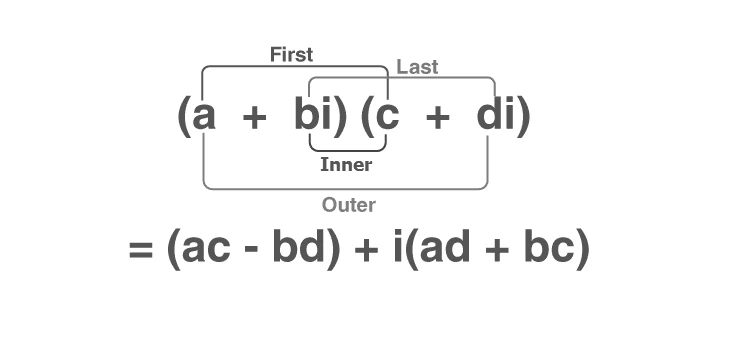
Example: Multiply (5 - 4i) and (2 + 6i)
Calculate the product of the complex numbers \( (5 - 4i) \) and \( (2 + 6i) \) using the formula.
Solution:
\[ (5 - 4i)(2 + 6i) = (5)(2) + (5)(6i) - (4i)(2) - (4i)(6i) \]
\[ = 10 + 30i - 8i - 24i^2 \]
\[ = 10 + 22i - 24(-1) \]
\[ = 10 + 22i + 24 = 34 + 22i \]
Geometric Interpretation and Polar Form Multiplication
Visualizing Multiplication on the Argand Plane
Multiplying complex numbers can also be understood geometrically on the Argand plane, where each complex number corresponds to a point or vector. The product of two complex numbers corresponds to multiplying their magnitudes and adding their arguments (angles).
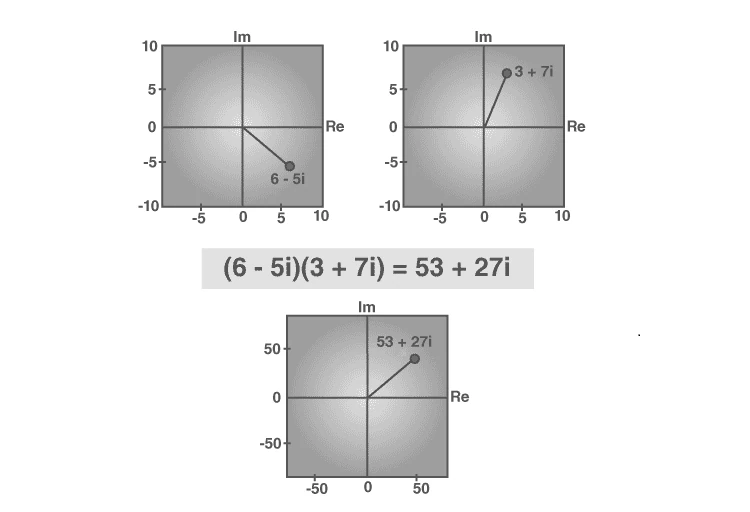
Multiplication Using Polar Coordinates
Expressing complex numbers in polar form as \( z_1 = r_1 (\cos \theta_1 + i \sin \theta_1) \) and \( z_2 = r_2 (\cos \theta_2 + i \sin \theta_2) \), their product is given by:
\[ z_1 z_2 = r_1 r_2 \left[ \cos(\theta_1 + \theta_2) + i \sin(\theta_1 + \theta_2) \right] \]
This shows that the magnitudes multiply while the angles add, providing a clear geometric interpretation.
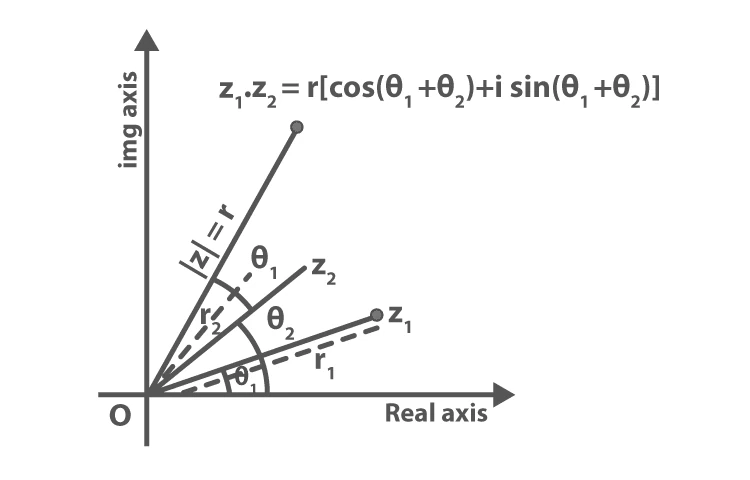
Example: Multiply \( z_1 = 3(\cos 30^\circ + i \sin 30^\circ) \) and \( z_2 = 4(\cos 45^\circ + i \sin 45^\circ) \)
Find the product \( z_1 z_2 \) in polar form.
Solution:
Multiply magnitudes: \[ r = 3 \times 4 = 12 \]
Add angles: \[ \theta = 30^\circ + 45^\circ = 75^\circ \]
Therefore, \[ z_1 z_2 = 12 \left( \cos 75^\circ + i \sin 75^\circ \right) \]
Key Properties and Practical Examples of Complex Multiplication
Fundamental Properties of Complex Number Multiplication
Multiplication of complex numbers follows several important algebraic properties:
- Closure: The product of any two complex numbers is also a complex number.
- Commutativity: \( z_1 z_2 = z_2 z_1 \).
- Associativity: \( (z_1 z_2) z_3 = z_1 (z_2 z_3) \).
- Multiplicative Identity: The complex number \( 1 + 0i \) acts as the identity element, satisfying \( z \times 1 = z \).
- Multiplicative Inverse: For any non-zero \( z = x + iy \), the inverse is \[ z^{-1} = \frac{x}{x^2 + y^2} - i \frac{y}{x^2 + y^2} \] such that \( z \times z^{-1} = 1 \).
- Distributive Law: Multiplication distributes over addition: \[ z_1 (z_2 + z_3) = z_1 z_2 + z_1 z_3 \] and \[ (z_1 + z_2) z_3 = z_1 z_3 + z_2 z_3 \]
Worked Examples Demonstrating Multiplication
Example 1: Calculate \( (8 + 3i)(5 - 7i) \)
Using the formula \( (a + ib)(c + id) = (ac - bd) + i(ad + bc) \), where \( a=8, b=3, c=5, d=-7 \):
\[ (8 + 3i)(5 - 7i) = (8)(5) - (3)(-7) + i[(8)(-7) + (3)(5)] \]
\[ = 40 + 21 + i(-56 + 15) = 61 - 41i \]
Example 2: Find the product of \( (4 + 5i), (1 - 2i), \) and \( (3 + i) \)
First multiply the first two:
\[ (4 + 5i)(1 - 2i) = (4)(1) - (5)(-2) + i[(4)(-2) + (5)(1)] = 4 + 10 + i(-8 + 5) = 14 - 3i \]
Now multiply the result by the third number:
\[ (14 - 3i)(3 + i) = (14)(3) - (-3)(1) + i[(14)(1) + (-3)(3)] = 42 + 3 + i(14 - 9) = 45 + 5i \]
Quick Reference: Multiplication of Complex Numbers
| Concept | Formula / Property | Explanation |
|---|---|---|
| Algebraic Multiplication | \( (a + ib)(c + id) = (ac - bd) + i(ad + bc) \) | Multiply and combine real and imaginary parts using FOIL and \( i^2 = -1 \) |
| Polar Form Multiplication | \( r_1 r_2 [\cos(\theta_1 + \theta_2) + i \sin(\theta_1 + \theta_2)] \) | Multiply magnitudes and add angles |
| Closure Property | Product is always in \( \mathbb{C} \) | Complex numbers are closed under multiplication |
| Commutative Law | \( z_1 z_2 = z_2 z_1 \) | Order of multiplication does not affect the product |
| Associative Law | \( (z_1 z_2) z_3 = z_1 (z_2 z_3) \) | Grouping of multiplication does not affect the product |
| Multiplicative Identity | \( 1 + 0i \) | Multiplying by 1 leaves the complex number unchanged |
| Multiplicative Inverse | \( z^{-1} = \frac{x}{x^2 + y^2} - i \frac{y}{x^2 + y^2} \) | Inverse exists for all non-zero complex numbers |
| Distributive Law | \( z_1 (z_2 + z_3) = z_1 z_2 + z_1 z_3 \) | Multiplication distributes over addition |
Glossary of Terms Related to Complex Number Multiplication
| Term | Definition |
|---|---|
| Complex Number | A number of the form \( x + iy \), where \( x, y \in \mathbb{R} \) and \( i^2 = -1 \) |
| Imaginary Unit | The symbol \( i \) satisfying \( i^2 = -1 \) |
| Real Part | The component \( x \) in \( x + iy \) |
| Imaginary Part | The component \( y \) in \( x + iy \) |
| FOIL Method | Technique to multiply two binomials: First, Outer, Inner, Last terms |
| Polar Form | Representation \( r(\cos \theta + i \sin \theta) \) of a complex number |
| Magnitude | Distance from origin to the point representing the complex number, \( r = \sqrt{x^2 + y^2} \) |
| Argument | Angle \( \theta \) made with the positive real axis in the Argand plane |
| Multiplicative Identity | The complex number \( 1 + 0i \) that leaves any number unchanged when multiplied |
| Multiplicative Inverse | The complex number which when multiplied with the original gives 1 |
Frequently Asked Questions on Multiplying Complex Numbers
What is the result when two complex numbers are multiplied?
The product of two complex numbers is another complex number, expressible in the form \( A + iB \) where \( A \) and \( B \) are real numbers.
How is multiplication of complex numbers performed algebraically?
Given \( z_1 = a + ib \) and \( z_2 = c + id \), their product is calculated as \( (ac - bd) + i(ad + bc) \) using the FOIL method and the property \( i^2 = -1 \).
What is the multiplicative identity in complex numbers?
The complex number \( 1 + 0i \) acts as the multiplicative identity, meaning multiplying any complex number by it leaves the number unchanged.
Which algebraic properties does multiplication of complex numbers satisfy?
Multiplication of complex numbers is closed, commutative, associative, distributive over addition, and has both an identity and inverses for non-zero elements.
How can the product of complex numbers be simplified?
By applying the FOIL technique and substituting \( i^2 = -1 \), the product can be simplified into standard form \( A + iB \).