Comprehensive Guide to Equations of Straight Lines
Fundamentals of Linear Equations in Two Variables
Understanding the General Form of a Straight Line
The equation representing a straight line in a two-dimensional plane is typically expressed as a first-degree equation in two variables:
\[ Ax + By + C = 0, \]
where \(A\), \(B\), and \(C\) are real constants, with \(A\) and \(B\) not both zero simultaneously. This equation always corresponds to a straight line when plotted on the Cartesian plane.
Here, \(x\) and \(y\) are the coordinates of any point lying on the line.
Example: Identify whether the equation \(4x - 5y + 10 = 0\) represents a straight line.
Solution: Since the equation is linear in \(x\) and \(y\) with constants \(A=4\), \(B=-5\), and \(C=10\), it represents a straight line in the plane.
Different Representations of Straight Line Equations
Slope-Intercept Representation
The slope-intercept form expresses the line equation as:
\[ y = mx + c, \]
where \(m\) denotes the slope of the line, indicating its steepness, and \(c\) is the point where the line crosses the y-axis (y-intercept).
Starting from the general form \(Ax + By + C = 0\), if \(B \neq 0\), it can be rearranged as:
\[ y = -\frac{A}{B}x - \frac{C}{B}, \]
which shows that the slope \(m = -\frac{A}{B}\) and the y-intercept \(c = -\frac{C}{B}\).
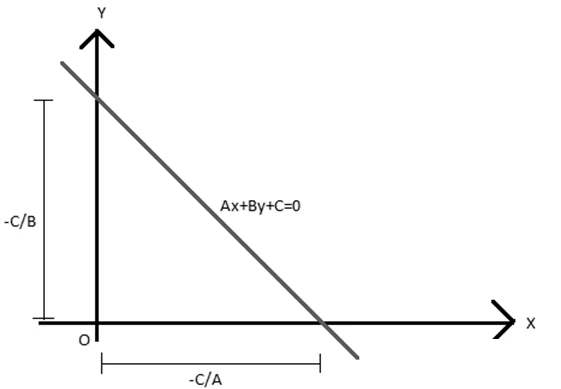
Graph plotted against equation of a line
Example: For the line \(3x - 9y + 6 = 0\), find the slope and y-intercept.
Solution: Rewrite the equation as:
\[ -9y = -3x - 6 \implies y = \frac{1}{3}x + \frac{2}{3} \]
Thus, slope \(m = \frac{1}{3}\) and y-intercept \(c = \frac{2}{3}\).
Intercept Form of a Line
The intercept form is useful when the line crosses the axes at known points. If a line intersects the x-axis at \((a, 0)\) and the y-axis at \((0, b)\), its equation is:
\[ \frac{x}{a} + \frac{y}{b} = 1, \]
where \(a\) and \(b\) are the x-intercept and y-intercept respectively.
From the general form \(Ax + By + C = 0\) with \(C \neq 0\), the intercepts can be found as:
\[ a = -\frac{C}{A}, \quad b = -\frac{C}{B}. \]
Example: Determine the intercepts of the line \(5x + 2y - 10 = 0\).
Solution: The x-intercept is:
\[ a = -\frac{-10}{5} = 2, \]
and the y-intercept is:
\[ b = -\frac{-10}{2} = 5. \]
Hence, the intercept form is:
\[ \frac{x}{2} + \frac{y}{5} = 1. \]
Normal Form of a Straight Line
The normal form expresses a line based on the perpendicular distance from the origin and the angle this perpendicular makes with the positive x-axis. If the perpendicular length is \(p\) and the angle is \(\alpha\), the equation is:
\[ x \cos \alpha + y \sin \alpha = p. \]
Converting the general form \(Ax + By + C = 0\) into normal form involves:
\[ p = -\frac{C}{\sqrt{A^2 + B^2}}, \]
and the direction cosines:
\[ \cos \alpha = \frac{A}{\sqrt{A^2 + B^2}}, \quad \sin \alpha = \frac{B}{\sqrt{A^2 + B^2}}. \]
This form is particularly useful in geometric interpretations involving distances and angles.
Example: Convert the line \(6x + 8y - 10 = 0\) into its normal form.
Solution: Calculate:
\[ \sqrt{6^2 + 8^2} = \sqrt{36 + 64} = \sqrt{100} = 10, \]
so
\[ p = -\frac{-10}{10} = 1, \quad \cos \alpha = \frac{6}{10} = 0.6, \quad \sin \alpha = \frac{8}{10} = 0.8. \]
Therefore, the normal form is:
\[ 0.6x + 0.8y = 1. \]
Key Properties and Applications of Line Equations
Determining Slope and Intercepts from the General Equation
From the general equation \(Ax + By + C = 0\), the slope and intercepts can be directly extracted as:
Slope: \(m = -\frac{A}{B}\) (provided \(B \neq 0\))
X-intercept: \(a = -\frac{C}{A}\) (if \(A \neq 0\))
Y-intercept: \(b = -\frac{C}{B}\) (if \(B \neq 0\))
These values help in quickly sketching the line and understanding its orientation.
Example: For the line \(7x - 2y + 4 = 0\), find the slope and intercepts.
Solution:
Slope:
\[ m = -\frac{7}{-2} = \frac{7}{2} = 3.5, \]
X-intercept:
\[ a = -\frac{4}{7} \approx -0.571, \]
Y-intercept:
\[ b = -\frac{4}{-2} = 2. \]
Relative Position of Points with Respect to a Line
Given two points \((x_1, y_1)\) and \((x_2, y_2)\), their positions relative to the line \(Ax + By + C = 0\) can be determined by evaluating the expressions:
\[ S_1 = A x_1 + B y_1 + C, \quad S_2 = A x_2 + B y_2 + C. \]
If \(S_1\) and \(S_2\) have the same sign (both positive or both negative), the points lie on the same side of the line. If the signs differ, the points are on opposite sides.
Example: Check if points \((1,2)\) and \((3,4)\) lie on the same side of the line \(2x - 3y + 1 = 0\).
Solution:
\[ S_1 = 2(1) - 3(2) + 1 = 2 - 6 + 1 = -3, \]
\[ S_2 = 2(3) - 3(4) + 1 = 6 - 12 + 1 = -5. \]
Both are negative, so the points lie on the same side of the line.
Practical Examples to Reinforce Concepts
Example 1: Finding Slope and Intercepts
Given the line equation \(4x - 8y + 12 = 0\), determine its slope and intercepts.
Solution:
Rewrite in slope-intercept form:
\[ -8y = -4x - 12 \implies y = \frac{1}{2}x + \frac{3}{2}. \]
Slope \(m = \frac{1}{2}\), y-intercept \(c = \frac{3}{2}\).
X-intercept:
\[ a = -\frac{12}{4} = -3, \]
Y-intercept:
\[ b = -\frac{12}{-8} = \frac{3}{2}. \]
Example 2: Slope and Intercepts from Another Equation
For the line \(9x + 3y - 18 = 0\), find the slope and intercepts.
Solution:
Express in slope-intercept form:
\[ 3y = -9x + 18 \implies y = -3x + 6, \]
so slope \(m = -3\), y-intercept \(c = 6\).
X-intercept:
\[ a = -\frac{-18}{9} = 2, \]
Y-intercept:
\[ b = -\frac{-18}{3} = 6. \]
Quick Reference: Essential Formulas for Straight Lines
Form | Equation | Key Parameters |
|---|---|---|
General Form | \(Ax + By + C = 0\) | Slope: \(-\frac{A}{B}\), Intercepts: \(a = -\frac{C}{A}\), \(b = -\frac{C}{B}\) |
Slope-Intercept Form | \(y = mx + c\) | Slope: \(m\), Y-intercept: \(c\) |
Intercept Form | \(\frac{x}{a} + \frac{y}{b} = 1\) | X-intercept: \(a\), Y-intercept: \(b\) |
Normal Form | \(x \cos \alpha + y \sin \alpha = p\) | Perpendicular distance: \(p\), Angle: \(\alpha\) |
Glossary of Key Terms
Term | Definition |
|---|---|
Slope | The ratio of vertical change to horizontal change between two points on a line. |
Y-intercept | The point where the line crosses the y-axis. |
X-intercept | The point where the line crosses the x-axis. |
General Form | Standard linear equation \(Ax + By + C = 0\). |
Slope-Intercept Form | Equation of the form \(y = mx + c\). |
Intercept Form | Equation expressing intercepts on axes: \(\frac{x}{a} + \frac{y}{b} = 1\). |
Normal Form | Equation based on perpendicular distance and angle: \(x \cos \alpha + y \sin \alpha = p\). |
Perpendicular Distance | Shortest distance from the origin to the line. |
Direction Cosines | Cosine values of angles a line makes with coordinate axes. |
Linear Equation | An equation of first degree in two variables representing a straight line. |
Frequently Asked Questions
How do I find the slope from the general form of a line?
The slope is calculated as \(m = -\frac{A}{B}\) from the equation \(Ax + By + C = 0\), assuming \(B \neq 0\).
What is the significance of the intercept form of a line?
It directly shows where the line crosses the x-axis and y-axis, making it easier to graph the line.
How can I convert the general form to the normal form?
Calculate the perpendicular distance \(p = -\frac{C}{\sqrt{A^2 + B^2}}\) and direction cosines \(\cos \alpha = \frac{A}{\sqrt{A^2 + B^2}}\), \(\sin \alpha = \frac{B}{\sqrt{A^2 + B^2}}\), then write the equation as \(x \cos \alpha + y \sin \alpha = p\).
What does it mean if two points have expressions with opposite signs when substituted into the line equation?
It means the points lie on opposite sides of the line.
Can the slope be zero or undefined?
Yes, slope is zero for horizontal lines and undefined for vertical lines.