Comprehensive Guide to the Equation of a Circle
Understanding the Equation of a Circle
Fundamentals of a Circle and Its Equation
A circle is defined as the collection of all points in a plane that are equidistant from a fixed point known as the center. The constant distance from the center to any point on the circle is called the radius.
The standard equation representing a circle with center at coordinates \( (h, k) \) and radius \( r \) is expressed as:
\[ (x - h)^2 + (y - k)^2 = r^2 \]
This formula allows us to determine the circle's equation when the center and radius are known.
Example:
Suppose a circle has its center at \( (2, -1) \) and a radius of 5 units. Find its equation.
Solution:
Using the standard form:
\[ (x - 2)^2 + (y + 1)^2 = 5^2 \]
Expanding,
\[ (x^2 - 4x + 4) + (y^2 + 2y + 1) = 25 \]
Combining terms,
\[ x^2 + y^2 - 4x + 2y + 5 = 25 \]
Rearranged as,
\[ x^2 + y^2 - 4x + 2y - 20 = 0 \]
This is the circle's equation in general form.
Clarifying the Function Status of a Circle
It is important to note that a circle does not represent a function because for some values of \( x \), there are two corresponding \( y \) values (one above and one below the center). This violates the definition of a function where each input must have exactly one output.
Deriving the Circle Equation with Center at the Origin
Formulating the Equation When Center is at (0,0)
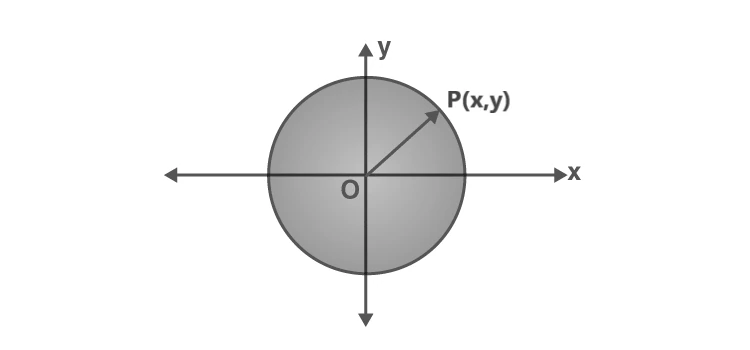
Consider a point \( P(x, y) \) lying on a circle centered at the origin \( O(0,0) \) with radius \( a \). The distance between \( P \) and \( O \) is the radius, which can be calculated using the distance formula:
\[ \sqrt{x^2 + y^2} = a \]
Squaring both sides yields the equation of the circle:
\[ x^2 + y^2 = a^2 \]
Alternative Derivation Using Right Triangle
By dropping a perpendicular from point \( (x, y) \) to the x-axis, a right triangle is formed with legs \( x \) and \( y \), and hypotenuse equal to the radius \( a \). Applying the Pythagorean theorem:
\[ x^2 + y^2 = a^2 \]
Example:
Find the equation of a circle centered at the origin with radius 7 units.
Solution:
Using the formula:
\[ x^2 + y^2 = 7^2 \]
\[ x^2 + y^2 = 49 \]
This is the required equation.
Equation of a Circle with Center Away from the Origin
Generalizing the Equation for Center \( (h, k) \)
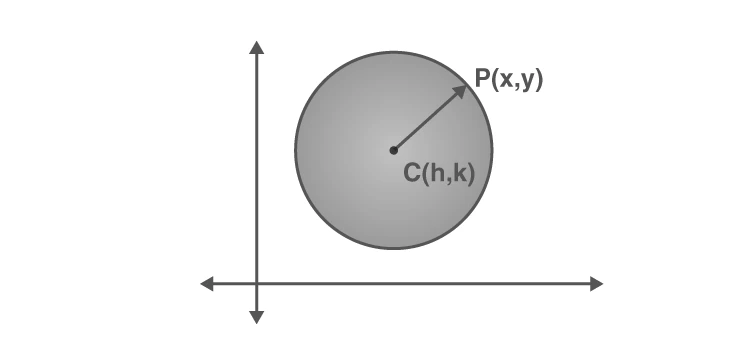
Let the center of the circle be \( C(h, k) \) and \( P(x, y) \) be any point on the circle. The radius \( a \) is the distance between \( C \) and \( P \), calculated by the distance formula:
\[ \sqrt{(x - h)^2 + (y - k)^2} = a \]
Squaring both sides gives the standard form:
\[ (x - h)^2 + (y - k)^2 = a^2 \]
Converting to General Form
The general equation of a circle can be written as:
\[ x^2 + y^2 + 2gx + 2fy + c = 0 \]
Completing the square, this can be rewritten as:
\[ (x + g)^2 + (y + f)^2 = g^2 + f^2 - c \]
Here, the center is \( (-g, -f) \) and the radius is:
\[ r = \sqrt{g^2 + f^2 - c} \]
Conditions for the radius:
- If \( g^2 + f^2 > c \), the radius is real and positive.
- If \( g^2 + f^2 = c \), the radius is zero, representing a point circle.
- If \( g^2 + f^2 < c \), the radius is imaginary, indicating no real circle.
Example:
Find the center and radius of the circle given by the equation:
\[ x^2 + y^2 - 8x + 6y + 9 = 0 \]
Solution:
Comparing with the general form:
\[ 2g = -8 \Rightarrow g = -4, \quad 2f = 6 \Rightarrow f = 3, \quad c = 9 \]
Center is at \( (-g, -f) = (4, -3) \).
Radius is:
\[ r = \sqrt{(-4)^2 + 3^2 - 9} = \sqrt{16 + 9 - 9} = \sqrt{16} = 4 \]
Thus, the circle has center \( (4, -3) \) and radius 4 units.
Polar Representation of a Circle
Deriving the Polar Equation
To express the circle's equation in polar coordinates, substitute \( x = r \cos \theta \) and \( y = r \sin \theta \) into the equation \( x^2 + y^2 = a^2 \):
\[ (r \cos \theta)^2 + (r \sin \theta)^2 = a^2 \]
Simplifying,
\[ r^2 \cos^2 \theta + r^2 \sin^2 \theta = a^2 \]
\[ r^2 (\cos^2 \theta + \sin^2 \theta) = a^2 \]
Using the identity \( \cos^2 \theta + \sin^2 \theta = 1 \), we get:
\[ r^2 = a^2 \implies r = a \]
This shows that the polar equation of a circle centered at the origin with radius \( a \) is simply \( r = a \).
Practical Methods to Determine Circle Equations
Steps to Formulate the Equation
To find the equation of a circle, follow these steps:
- Identify the center coordinates \( (h, k) \).
- Determine the radius \( r \).
- Substitute these values into the standard form:
\[ (x - h)^2 + (y - k)^2 = r^2 \]
Example 1:
Find the equation of a circle with center at the origin and radius 6 units.
Solution:
\[ x^2 + y^2 = 6^2 = 36 \]
Example 2:
Determine the equation of a circle with center \( (4, -2) \) and radius 3 units.
Solution:
\[ (x - 4)^2 + (y + 2)^2 = 3^2 = 9 \]
Expanding:
\[ x^2 - 8x + 16 + y^2 + 4y + 4 = 9 \]
Rearranged:
\[ x^2 + y^2 - 8x + 4y + 11 = 0 \]
Example 3:
Given the circle equation \( x^2 + y^2 - 10x + 6y + 9 = 0 \), find its center and radius.
Solution:
Rewrite the equation in general form:
\[ 2g = -10 \Rightarrow g = -5, \quad 2f = 6 \Rightarrow f = 3, \quad c = 9 \]
Center is \( (-g, -f) = (5, -3) \).
Radius is:
\[ r = \sqrt{(-5)^2 + 3^2 - 9} = \sqrt{25 + 9 - 9} = \sqrt{25} = 5 \]
Quick Reference: Key Formulas and Concepts
| Concept | Formula / Description |
|---|---|
| Standard Equation (Center at \( (h,k) \)) | \( (x - h)^2 + (y - k)^2 = r^2 \) |
| Equation with Center at Origin | \( x^2 + y^2 = r^2 \) |
| General Form | \( x^2 + y^2 + 2gx + 2fy + c = 0 \) |
| Center from General Form | \( (-g, -f) \) |
| Radius from General Form | \( r = \sqrt{g^2 + f^2 - c} \) |
| Polar Equation (Center at Origin) | \( r = a \) |
| Circumference | \( 2 \pi r \) |
| Area | \( \pi r^2 \) |
| Diameter | \( 2r \) |
| Distance Formula | \( \sqrt{(x_2 - x_1)^2 + (y_2 - y_1)^2} \) |
Glossary of Important Terms
| Term | Definition |
|---|---|
| Circle | A set of points equidistant from a fixed center point in a plane. |
| Center | The fixed point from which all points on the circle are equally distant. |
| Radius | The distance from the center to any point on the circle. |
| Diameter | A chord passing through the center; twice the radius. |
| Circumference | The perimeter or boundary length of the circle. |
| Standard Form | The equation \( (x - h)^2 + (y - k)^2 = r^2 \) representing a circle. |
| General Form | The expanded form \( x^2 + y^2 + 2gx + 2fy + c = 0 \) of a circle's equation. |
| Polar Coordinates | A coordinate system where points are defined by radius and angle. |
| Point Circle | A circle with zero radius, essentially a single point. |
| Function | A relation where each input has exactly one output; a circle is not a function. |
Frequently Asked Questions
What is the general equation of a circle?
The general equation is \( x^2 + y^2 + 2gx + 2fy + c = 0 \), where the center is \( (-g, -f) \) and radius is \( \sqrt{g^2 + f^2 - c} \).
How do you find the equation of a circle centered at the origin?
Use the formula \( x^2 + y^2 = r^2 \), where \( r \) is the radius.
Can a circle be represented as a function?
No, because for some \( x \) values, there are two corresponding \( y \) values, violating the definition of a function.
How to determine the center and radius from the general form?
Identify \( g, f, c \) from the equation and calculate center as \( (-g, -f) \) and radius as \( \sqrt{g^2 + f^2 - c} \).
What is the polar form of a circle centered at the origin?
The polar equation is \( r = a \), where \( a \) is the radius of the circle.