Understanding Domain, Range, and Codomain of Functions
Fundamentals of Functions and Their Relations
Conceptualizing Functions and Their Distinction from Relations
Functions form a cornerstone in mathematics, extensively applied in modelling real-world phenomena such as architecture and engineering. To grasp functions, one must first understand relations and Cartesian products. The Cartesian product of two sets, say \( A \) and \( B \), is the set of all ordered pairs \((a,b)\) where \(a \in A\) and \(b \in B\).
A relation is any subset of this Cartesian product, essentially linking elements from one set to another. A function is a specialized relation where each element in the first set corresponds to exactly one element in the second set.
For example, consider the sets:
\( A \): Countries that have won the Cricket World Cup
\( B \): Years in which the World Cup was held
An arrow diagram illustrating a relation where a country is linked to multiple years does not qualify as a function because one element in \( A \) maps to multiple elements in \( B \).
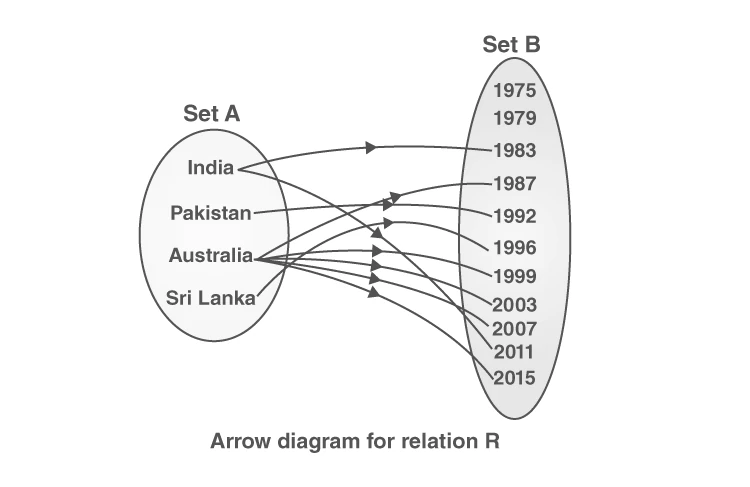
Relation example where countries map to multiple years
However, if the relation associates each country with the year it first won the World Cup, then each element in \( A \) maps to exactly one element in \( B \), making it a function.
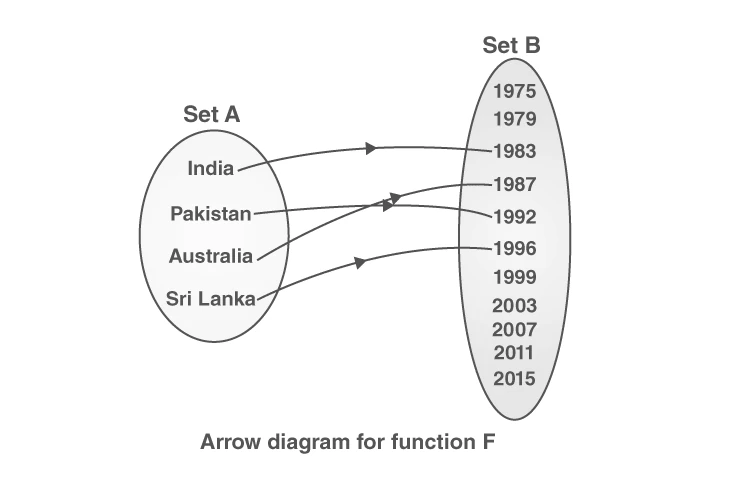
Function example associating countries to their first win year
Example: Consider the set \( A = \{\text{India, Australia, England}\} \) and \( B = \{1983, 1987, 2019\} \). If each country is linked to the year it first won the World Cup, this relation is a function because each country corresponds to exactly one year.
Exploring Domain and Range of Functions
Defining the Domain and Methods to Determine It
The domain of a function is the complete set of permissible input values, typically the independent variable values for which the function is defined. When dealing with functions involving fractions or roots, the domain excludes values that cause division by zero or negative values under even roots.
For instance, if a function is \( f(x) = 2x + 5 \), the domain is all real numbers since no restrictions apply. Conversely, for \( f(x) = \frac{1}{x-1} \), the domain excludes \( x=1 \) because it makes the denominator zero.
Sometimes, the domain is explicitly limited, such as \( f(x) = 3x + 4 \) with \( 2 < x < 12 \), meaning \( x \) can only take values within that interval.
Example: Determine the domain of \( f(x) = \frac{5}{x^2 - 9} \).
Solution: The denominator cannot be zero, so solve \( x^2 - 9 = 0 \) which gives \( x = \pm 3 \).
Therefore, the domain is all real numbers except \( x = 3 \) and \( x = -3 \), expressed as \( (-\infty, -3) \cup (-3, 3) \cup (3, \infty) \).
Determining the Range and Understanding the Codomain
How to Identify the Range of a Function
The range consists of all possible output values a function can produce after substituting the domain values. To find the range, one can express the input variable in terms of the output and analyze the resulting expression's domain.
For example, given \( y = f(x) \), solving for \( x \) in terms of \( y \) and determining the permissible \( y \) values helps identify the range.
The codomain is the set of all potential outputs defined for the function, which may be larger than the actual range. The range is always a subset of the codomain.
Adjusting the codomain can restrict the range accordingly. For instance, if the codomain is set to positive integers, the function's outputs and domain will be limited to satisfy this condition.
Example: Find the range of \( f(x) = 3x^2 - 5 \).
Solution: Let \( y = 3x^2 - 5 \).
Rearranging, \( 3x^2 = y + 5 \) so \( x^2 = \frac{y + 5}{3} \).
Since \( x^2 \geq 0 \), it follows that \( \frac{y + 5}{3} \geq 0 \) which implies \( y \geq -5 \).
Hence, the range is \( [-5, \infty) \).
Practical Examples on Domain and Range
Analyzing Domain and Range of Rational Functions
Understanding domain and range for rational functions requires identifying values that make denominators zero and solving for output restrictions.
Example: Determine the domain and range of \( f(x) = \frac{2x - 1}{x + 4} \).
Solution:
The function is undefined when the denominator is zero, so \( x + 4 = 0 \Rightarrow x = -4 \).
Domain: all real numbers except \( -4 \), i.e., \( (-\infty, -4) \cup (-4, \infty) \).
Let \( y = \frac{2x - 1}{x + 4} \). Multiply both sides:
\[ y(x + 4) = 2x - 1 \]
\[ xy + 4y = 2x - 1 \]
Rearranged:
\[ 2x - xy = 4y + 1 \]
\[ x(2 - y) = 4y + 1 \]
\[ x = \frac{4y + 1}{2 - y} \]
For \( x \) to be defined, denominator \( 2 - y \neq 0 \Rightarrow y \neq 2 \).
Range: all real numbers except \( 2 \), i.e., \( (-\infty, 2) \cup (2, \infty) \).
Summary Table for Quick Review
Term | Definition | Key Points |
|---|---|---|
Function | A relation where each input has exactly one output. | Maps each element of domain to one element in codomain. |
Domain | Set of all valid inputs for the function. | Exclude values causing division by zero or negative roots. |
Range | Set of all actual outputs from the function. | Subset of the codomain. |
Codomain | Set of all possible outputs defined for the function. | Range is always contained within codomain. |
Relation | Any subset of Cartesian product of two sets. | Not necessarily a function. |
Cartesian Product | Set of all ordered pairs from two sets. | Basis for defining relations and functions. |
Independent Variable | Input variable of a function. | Values belong to the domain. |
Dependent Variable | Output variable of a function. | Values belong to the range. |
Undefined Values | Inputs that make the function invalid. | Exclude from domain. |
Function Notation | Representation like \( f(x) \). | Maps input \( x \) to output \( f(x) \). |
Glossary of Key Terms
Term | Meaning |
|---|---|
Function | A special relation with unique output for each input. |
Domain | All possible input values for a function. |
Range | All possible output values from a function. |
Codomain | The set containing all potential outputs. |
Relation | A set of ordered pairs linking two sets. |
Cartesian Product | All ordered pairs from two sets. |
Independent Variable | Input variable in a function. |
Dependent Variable | Output variable in a function. |
Undefined Value | Input causing function to be invalid. |
Function Notation | Symbolic representation like \( f(x) \). |
Frequently Asked Questions
What distinguishes the domain from the codomain?
The domain is the set of all valid inputs for a function, while the codomain is the set of all possible outputs the function could produce.
How can one determine the domain of a function?
Identify all input values for which the function is defined, excluding those causing division by zero or negative values under even roots.
What is a straightforward method to find the range of a function?
Express the input variable in terms of the output and find the domain of this new expression; this domain corresponds to the original function's range.
Can the range ever be equal to the codomain?
The range can be equal to or a subset of the codomain but never larger than it.
Is the codomain a subset of the range?
No, the range is always a subset of the codomain, not the other way around.