Comprehensive Guide to Derivatives and Their Applications
Understanding the Concept of Derivatives
Fundamentals of Rate of Change
Derivatives represent how a function's output changes instantaneously with respect to changes in its input variable. They are essential when dealing with quantities that vary continuously and where the rate of change is not uniform. Essentially, a derivative quantifies the sensitivity of one variable relative to another, often described as the slope or gradient of the function at a specific point.
For example, consider a vehicle moving along a path. If the distance covered is a function of time, the derivative of this function with respect to time gives the velocity, indicating how fast the position changes at any instant.
Example: Calculating Instantaneous Velocity
A car travels from point A to point B in \( t \) seconds. To determine how fast the car is moving at any moment, we use velocity defined as the derivative of distance with respect to time:
\[ v = \frac{dx}{dt} \]
Here, \( x \) is the distance function and \( t \) is time. This derivative tells us the speed at any given instant, not just the average speed over an interval.

Mathematical Foundations of Derivatives
Definition and Differentiation Process
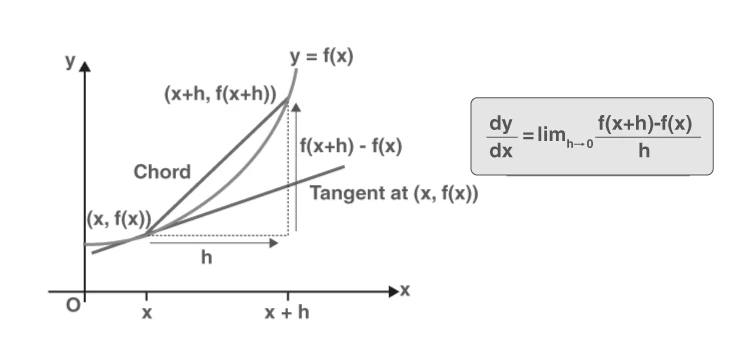
In calculus, the derivative of a function \( y = f(x) \) measures how \( y \) changes as \( x \) changes. The process of finding this derivative is called differentiation, while reversing it is known as anti-differentiation or integration.
When \( x \) changes by a very small amount \( dx \), the corresponding change in \( y \) is \( dy \). The derivative is the limit of the ratio of these changes as \( dx \) approaches zero:
\[ \frac{dy}{dx} = \lim_{h \to 0} \frac{f(x+h) - f(x)}{h} \]
This limit defines the instantaneous rate of change of the function at point \( x \).
Example: Derivative of a Quadratic Function
Consider the function \( f(x) = x^2 \). To find its derivative:
\[ \frac{d}{dx} x^2 = \lim_{h \to 0} \frac{(x+h)^2 - x^2}{h} = \lim_{h \to 0} \frac{x^2 + 2xh + h^2 - x^2}{h} = \lim_{h \to 0} \frac{2xh + h^2}{h} = \lim_{h \to 0} (2x + h) = 2x \]
This means the slope of the curve \( y = x^2 \) at any point \( x \) is \( 2x \).
Essential Derivative Formulas and Their Applications
Common Derivative Rules
Derivatives follow specific formulas depending on the function type. Some fundamental derivative formulas include:
| Function | Derivative |
|---|---|
| Constant \( k \) | \( 0 \) |
| Identity \( x \) | \( 1 \) |
| Power \( x^n \) | \( n x^{n-1} \) |
| Constant multiple \( kx \) | \( k \) |
| Square root \( \sqrt{x} \) | \( \frac{1}{2\sqrt{x}} \) |
| Reciprocal \( \frac{1}{x} \) | \( -\frac{1}{x^2} \) |
| Logarithm \( \log x \), \( x > 0 \) | \( \frac{1}{x} \) |
| Exponential \( e^x \) | \( e^x \) |
| Exponential \( a^x \) | \( a^x \ln a \) |
Example: Derivative of a Polynomial
Find the derivative of \( f(x) = 4x^3 - 5x + 7 \).
Solution:
\[ \frac{d}{dx} f(x) = \frac{d}{dx} (4x^3) - \frac{d}{dx} (5x) + \frac{d}{dx} (7) = 4 \times 3x^{2} - 5 \times 1 + 0 = 12x^{2} - 5 \]
Classification of Derivatives by Order
First and Second Order Derivatives Explained
Derivatives are categorized based on how many times differentiation is applied:
- First-Order Derivative: Indicates the slope or rate of change of the original function. It helps determine whether the function is increasing or decreasing at a point.
- Second-Order Derivative: Provides information about the curvature or concavity of the function's graph. It helps classify the graph as concave upward or concave downward.
For example, the function \( f(x) = x^2 \) has a first derivative \( f'(x) = 2x \) and a second derivative \( f''(x) = 2 \), which is positive, indicating the graph is concave up.
Example: Analyzing Function Behavior
Given \( f(x) = 3x^4 - 4x^2 \), find the first and second derivatives and interpret the concavity at \( x = 1 \).
Solution:
\[ f'(x) = 12x^3 - 8x \]
\[ f''(x) = 36x^2 - 8 \]
At \( x = 1 \), \( f''(1) = 36(1)^2 - 8 = 28 > 0 \), so the graph is concave upward at this point.
Limits and Their Role in Derivatives
Understanding the Limit Definition
Derivatives are fundamentally defined using limits. The derivative at a point is the limit of the average rate of change as the interval approaches zero. This means the change in the independent variable \( h \) becomes infinitesimally small but never exactly zero.
Formally, for a function \( f(x) \), the limit definition is:
\[ \lim_{h \to 0} \frac{f(x+h) - f(x)}{h} \]
This concept ensures the derivative captures the instantaneous rate of change rather than an average over a finite interval.
Example: Applying Limits to Derivative Calculation
Calculate the derivative of \( f(x) = \frac{1}{x} \) using the limit definition.
Solution:
\[ \frac{d}{dx} \frac{1}{x} = \lim_{h \to 0} \frac{\frac{1}{x+h} - \frac{1}{x}}{h} = \lim_{h \to 0} \frac{\frac{x - (x+h)}{x(x+h)}}{h} = \lim_{h \to 0} \frac{-h}{h x (x+h)} = \lim_{h \to 0} \frac{-1}{x (x+h)} = -\frac{1}{x^2} \]
Practical Application: Instantaneous Rate of Change Problem
Skydiver's Falling Speed Calculation
Consider a skydiver jumping from a height of 2200 meters. The height \( h(t) \) in meters after \( t \) seconds is modeled by:
\[ h(t) = 2200 - 4.9 t^2 \]
Assuming no air resistance, we want to find the speed at which the skydiver is descending after 4 seconds.
Solution:
The instantaneous velocity is the derivative of height with respect to time:
\[ h'(t) = \frac{d}{dt} (2200 - 4.9 t^2) = 0 - 4.9 \times 2t = -9.8 t \]
Substituting \( t = 4 \) seconds:
\[ h'(4) = -9.8 \times 4 = -39.2 \text{ m/s} \]
The negative sign indicates the skydiver is moving downward at 39.2 meters per second after 4 seconds.
Derivatives of Trigonometric Functions
Basic Trigonometric Derivative Formulas
Derivatives extend to trigonometric functions, which are fundamental in many fields such as physics and engineering. The key derivative formulas are:
| Function | Derivative |
|---|---|
| \( \sin x \) | \( \cos x \) |
| \( \cos x \) | \( -\sin x \) |
| \( \tan x \) | \( \sec^2 x \) |
| \( \csc x \) | \( -\csc x \cot x \) |
| \( \sec x \) | \( \sec x \tan x \) |
| \( \cot x \) | \( -\csc^2 x \) |
Deriving the Derivative of \( \tan x \)
The derivative of \( \tan x \) can be found using the quotient rule since \( \tan x = \frac{\sin x}{\cos x} \).
Let \( u = \sin x \) and \( v = \cos x \). The quotient rule states:
\[ \frac{d}{dx} \left( \frac{u}{v} \right) = \frac{v \frac{du}{dx} - u \frac{dv}{dx}}{v^2} \]
Applying this:
\[ \frac{d}{dx} \tan x = \frac{\cos x \cdot \cos x - \sin x \cdot (-\sin x)}{\cos^2 x} = \frac{\cos^2 x + \sin^2 x}{\cos^2 x} = \frac{1}{\cos^2 x} = \sec^2 x \]
Derivative of the Reciprocal Function \( \frac{1}{x} \)
Expressing \( \frac{1}{x} \) as \( x^{-1} \), its derivative is:
\[ \frac{d}{dx} x^{-1} = -1 \times x^{-2} = -\frac{1}{x^2} \]
Key Properties and Examples of Derivatives
Breaking Down Complex Functions
Derivatives can be computed term-by-term when functions are sums, differences, or quotients. This property simplifies differentiation by handling each part separately.
Example 1: Polynomial Derivative
Find the derivative of \( f(x) = 5x^2 - 3x + 4 \).
Solution:
\[ \frac{d}{dx} f(x) = \frac{d}{dx} (5x^2) - \frac{d}{dx} (3x) + \frac{d}{dx} (4) = 5 \times 2x - 3 \times 1 + 0 = 10x - 3 \]
Example 2: Derivative of a Trigonometric Expression
Calculate the derivative of \( g(x) = 3 \tan x + 2 \).
Solution:
\[ \frac{d}{dx} g(x) = 3 \frac{d}{dx} \tan x + \frac{d}{dx} 2 = 3 \sec^2 x + 0 = 3 \sec^2 x \]
Quick Reference: Derivative Formulas Summary
| Function | Derivative |
|---|---|
| Constant \( k \) | \( 0 \) |
| Identity \( x \) | \( 1 \) |
| Power \( x^n \) | \( n x^{n-1} \) |
| Constant multiple \( kx \) | \( k \) |
| Square root \( \sqrt{x} \) | \( \frac{1}{2\sqrt{x}} \) |
| Reciprocal \( \frac{1}{x} \) | \( -\frac{1}{x^2} \) |
| Logarithm \( \log x \) | \( \frac{1}{x} \) |
| Exponential \( e^x \) | \( e^x \) |
| Exponential \( a^x \) | \( a^x \ln a \) |
| \( \sin x \) | \( \cos x \) |
| \( \cos x \) | \( -\sin x \) |
| \( \tan x \) | \( \sec^2 x \) |
Glossary of Key Terms
| Term | Definition |
|---|---|
| Derivative | The instantaneous rate of change of a function with respect to a variable. |
| Differentiation | The process of finding the derivative of a function. |
| Limit | The value that a function approaches as the input approaches some point. |
| Instantaneous Rate of Change | The rate at which a quantity changes at a specific instant. |
| First-Order Derivative | The derivative representing the slope of the function. |
| Second-Order Derivative | The derivative of the first derivative, indicating concavity. |
| Concavity | The curvature direction of a graph, either upward or downward. |
| Quotient Rule | A formula to differentiate functions expressed as a quotient of two functions. |
| Chain Rule | A method to differentiate composite functions. |
| Anti-differentiation | The reverse process of differentiation, also called integration. |
Frequently Asked Questions
What is the meaning of a derivative in mathematics?
A derivative represents how a function's output changes instantaneously with respect to changes in its input variable.
How are derivatives used in finance?
In finance, derivatives are contracts whose value depends on underlying assets like securities or indices, used for hedging or speculation.
What is the general formula for a derivative?
The derivative of a function \( y = f(x) \) is denoted as \( \frac{dy}{dx} = \frac{d}{dx} f(x) \), representing the rate of change of \( y \) with respect to \( x \).
What symbols are commonly used to denote derivatives?
Derivatives are often represented by \( \frac{d}{dx} f(x) \), \( f'(x) \) for first order, and \( f''(x) \) for second order derivatives.
Why is the term "derivative" used?
The term "derivative" reflects that it is a function derived from another function, representing its rate of change.