Fundamentals of Event Algebra in Probability
Understanding Events and Their Complements
Defining Events and Their Opposites
In probability theory, an event is any subset of the sample space, which represents all possible outcomes of an experiment. For any event \( A \), there exists a complementary event \( A' \), which consists of all outcomes in the sample space that are not part of \( A \). This complementary event is often described as "not \( A \)". Formally, if \( S \) is the sample space, then:
\[ A' = \{ \omega : \omega \in S \text{ and } \omega \notin A \} = S - A \]
Here, \( \omega \) denotes an individual outcome.
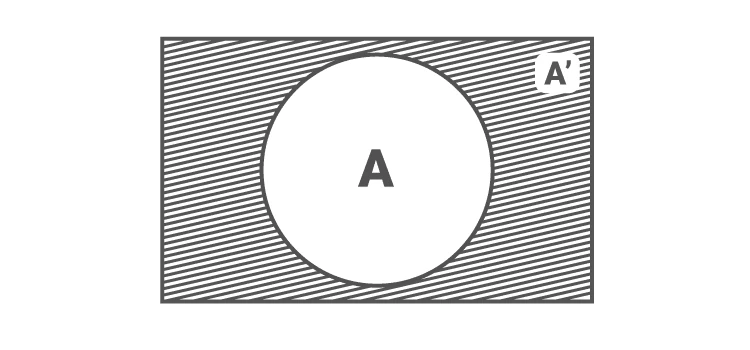
Venn diagram showing the complementary event \( A' \)
Consider tossing three coins simultaneously. The sample space is:
\[ S = \{ HHH, HHT, HTH, THH, HTT, THT, TTH, TTT \} \]
Let event \( A \) be "getting at least two heads". The outcomes in \( A \) are:
\[ A = \{ HHT, HTH, THH, HHH \} \]
The complementary event \( A' \) includes all outcomes where fewer than two heads appear:
\[ A' = \{ HTT, THT, TTH, TTT \} \]
Example: In the experiment of tossing three coins, identify the complementary event of getting at least two heads.
Solution: The event \( A \) is "at least two heads" with outcomes \( \{ HHT, HTH, THH, HHH \} \). The complement \( A' \) consists of outcomes with fewer than two heads: \( \{ HTT, THT, TTH, TTT \} \).
Union of Events: The "Either-Or" Scenario
Combining Events with "Or"
The union of two events \( A \) and \( B \), denoted by \( A \cup B \), represents the event that either \( A \) occurs, or \( B \) occurs, or both occur simultaneously. This is often referred to as "A or B". Formally:
\[ A \cup B = \{ \omega : \omega \in A \text{ or } \omega \in B \} \]
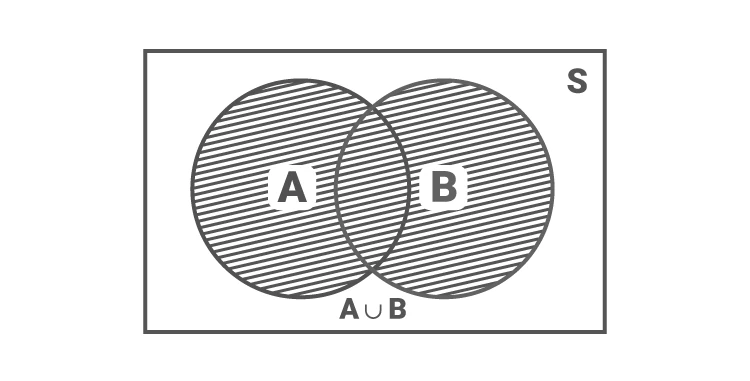
Venn diagram representing the union \( A \cup B \)
For instance, when rolling two dice, the sample space is:
\[ S = \{ (i,j) : i,j = 1,2,3,4,5,6 \} \]
Define event \( A \) as "sum of dice is a multiple of 3" and event \( B \) as "both dice show the same number". The outcomes are:
\[ A = \{ (1,2), (2,1), (1,5), (5,1), (2,4), (4,2), (3,3), (3,6), (6,3), (4,5), (5,4), (6,6) \} \]
\[ B = \{ (1,1), (2,2), (3,3), (4,4), (5,5), (6,6) \} \]
The union \( A \cup B \) includes all outcomes in either \( A \) or \( B \):
\[ A \cup B = \{ (1,1), (1,2), (1,5), (2,1), (2,2), (2,4), (3,3), (3,6), (4,2), (4,4), (4,5), (5,1), (5,4), (5,5), (6,3), (6,6) \} \]
Example: In a two-dice roll, let \( A \) be the event "sum is divisible by 3" and \( B \) be "both dice show the same number". List the outcomes in \( A \cup B \).
Solution: The union \( A \cup B \) contains all pairs where the sum is a multiple of 3 or both dice match, as listed above.
Intersection of Events: When Both Occur Together
Understanding the "And" Operation
The intersection of two events \( A \) and \( B \), denoted by \( A \cap B \), consists of all outcomes that belong to both \( A \) and \( B \) simultaneously. This event is described as "A and B". Formally:
\[ A \cap B = \{ \omega : \omega \in A \text{ and } \omega \in B \} \]
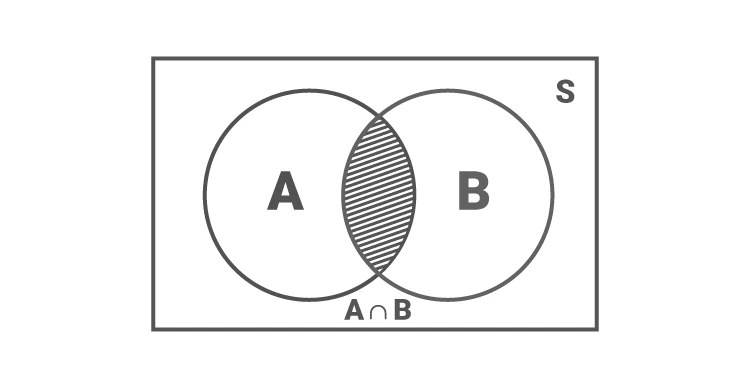
Venn diagram illustrating the intersection \( A \cap B \)
Consider again the experiment of rolling two dice. The sample space is:
\[ S = \{ (i,j) : i,j = 1,2,3,4,5,6 \} \]
Let event \( A \) be "the second die shows 5" and event \( B \) be "the sum of dice is 10 or more". The outcomes are:
\[ A = \{ (1,5), (2,5), (3,5), (4,5), (5,5), (6,5) \} \]
\[ B = \{ (3,6), (6,4), (5,5), (5,6), (6,5), (6,6) \} \]
The intersection \( A \cap B \) includes outcomes common to both events:
\[ A \cap B = \{ (5,5), (6,5) \} \]
Example: For two dice rolled, find the outcomes where the second die is 5 and the sum is at least 10.
Solution: The outcomes satisfying both conditions are \( (5,5) \) and \( (6,5) \).
Difference of Events: Elements in One but Not the Other
Exploring "A but Not B"
The difference between two events \( A \) and \( B \), denoted by \( A - B \), consists of all outcomes that are in \( A \) but not in \( B \). This can also be expressed as the intersection of \( A \) with the complement of \( B \):
\[ A - B = A \cap B' = \{ \omega : \omega \in A \text{ and } \omega \notin B \} \]
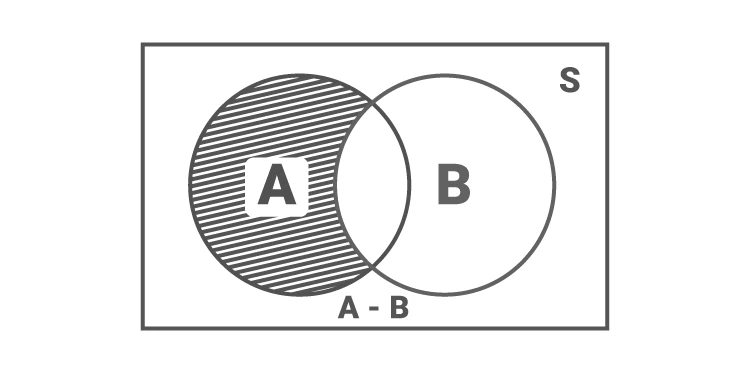
Venn diagram showing the difference \( A - B \)
For example, consider rolling a single die with sample space:
\[ S = \{1, 2, 3, 4, 5, 6\} \]
Let event \( A \) be "rolling a prime number" and event \( B \) be "rolling an even number". The outcomes are:
\[ A = \{2, 3, 5\}, \quad B = \{2, 4, 6\} \]
The difference \( A - B \) is:
\[ A - B = \{3, 5\} \]
Alternatively, since \( B' = \{1, 3, 5\} \), we have:
\[ A \cap B' = \{2, 3, 5\} \cap \{1, 3, 5\} = \{3, 5\} \]
Example: In a single die roll, find the outcomes that are prime numbers but not even.
Solution: The prime numbers are \( \{2,3,5\} \), even numbers are \( \{2,4,6\} \). The difference \( A - B = \{3,5\} \).
Comprehensive Problem on Event Operations
Applying Set Operations to Dice Rolls
Consider the experiment of rolling a single die. Define the following events:
\( A \): "the number rolled is less than 4"
\( B \): "the number rolled is greater than 2 but less than 5"
Determine the sets representing the following events:
\( A \cup B \) (A or B)
\( A \cap B \) (A and B)
\( A - B \) (A but not B)
\( A' \) (not A)
\( B' \) (not B)
Solution:
Sample space:
\[ S = \{1, 2, 3, 4, 5, 6\} \]
Events:
\[ A = \{1, 2, 3\}, \quad B = \{3, 4\} \]
Calculations:
\[ A \cup B = \{1, 2, 3, 4\} \]
\[ A \cap B = \{3\} \]
\[ A - B = \{1, 2\} \]
\[ A' = S - A = \{4, 5, 6\} \]
\[ B' = S - B = \{1, 2, 5, 6\} \]
Quick Reference: Summary of Event Algebra
Operation | Notation | Description | Set Representation |
|---|---|---|---|
Complement | \( A' \) | Outcomes not in event \( A \) | \( S - A \) |
Union | \( A \cup B \) | Outcomes in \( A \) or \( B \) or both | \( \{ \omega : \omega \in A \text{ or } \omega \in B \} \) |
Intersection | \( A \cap B \) | Outcomes in both \( A \) and \( B \) | \( \{ \omega : \omega \in A \text{ and } \omega \in B \} \) |
Difference | \( A - B \) | Outcomes in \( A \) but not in \( B \) | \( A \cap B' \) |
Glossary of Key Terms
Term | Definition |
|---|---|
Event | A subset of the sample space representing possible outcomes. |
Sample Space (S) | The set of all possible outcomes of an experiment. |
Complementary Event | The event consisting of all outcomes not in the original event. |
Union (\( \cup \)) | The event that either one or both events occur. |
Intersection (\( \cap \)) | The event that both events occur simultaneously. |
Difference (\( - \)) | The event containing outcomes in one event but not the other. |
Outcome (\( \omega \)) | A single possible result of an experiment. |
Prime Number | A natural number greater than 1 with no positive divisors other than 1 and itself. |
Venn Diagram | A graphical representation of sets and their relationships. |
Dice Roll | An experiment involving throwing dice to generate outcomes. |
Frequently Asked Questions
What is the complement of an event?
The complement of an event \( A \) includes all outcomes in the sample space that are not part of \( A \).
How is the union of two events defined?
The union \( A \cup B \) consists of all outcomes that belong to either event \( A \), event \( B \), or both.
What does the intersection of two events represent?
The intersection \( A \cap B \) contains all outcomes common to both events \( A \) and \( B \).
How do you find the difference between two events?
The difference \( A - B \) includes outcomes in \( A \) that are not in \( B \), equivalent to \( A \cap B' \).
Can an event and its complement occur simultaneously?
No, an event and its complement are mutually exclusive; they cannot happen at the same time.