Understanding Reactive Intermediates in Chemical Reactions
Nature and Characteristics of Reactive Intermediates
Defining Reactive Intermediates and Their Role
Reactive intermediates are transient, highly energetic species formed during the progression of chemical reactions. These molecules exist only briefly before transforming into more stable products. Although typically short-lived, under special conditions such as extremely low temperatures or isolation within inert environments, they can be stabilized and studied.
For instance, the technique of matrix isolation involves trapping reactive species within an unreactive solid matrix at low temperatures, allowing detailed examination without immediate reaction.
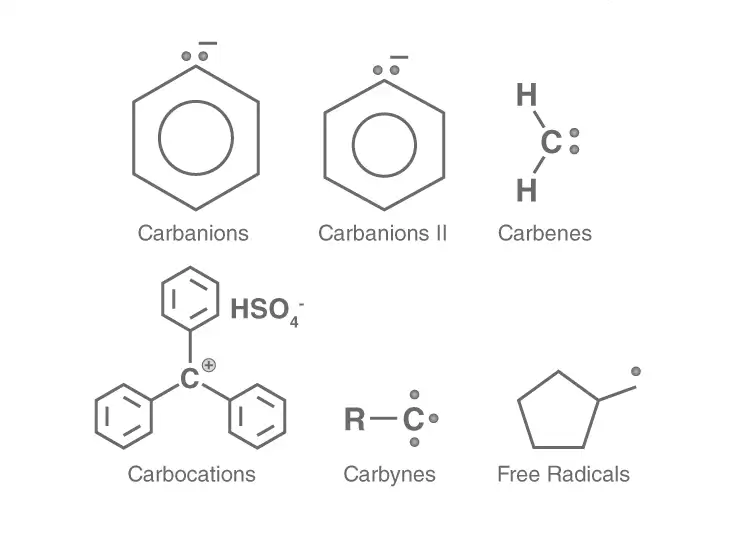
Illustration of matrix isolation used to trap reactive intermediates
Example Problem
In a reaction, a reactive intermediate is trapped using matrix isolation at 15 K. If the intermediate normally reacts within 10-6 seconds at room temperature, estimate the factor by which the reaction rate decreases at 15 K assuming Arrhenius behavior with an activation energy of 50 kJ/mol. Use \( R = 8.314 \text{ J/mol·K} \).
Solution:
The Arrhenius equation relates rate constants \( k \) at two temperatures \( T_1 \) and \( T_2 \) as:
\[ \frac{k_2}{k_1} = e^{-\frac{E_a}{R} \left(\frac{1}{T_2} - \frac{1}{T_1}\right)} \]
Given:
\( E_a = 50,000 \text{ J/mol} \)
\( T_1 = 298 \text{ K} \) (room temperature)
\( T_2 = 15 \text{ K} \)
Calculate exponent:
\[ -\frac{50,000}{8.314} \left(\frac{1}{15} - \frac{1}{298}\right) = -6014 \times (0.0667 - 0.00336) = -6014 \times 0.06334 = -381.1 \]
Therefore,
\[ \frac{k_2}{k_1} = e^{-381.1} \approx 0 \]
This shows the reaction rate at 15 K is effectively zero compared to room temperature, explaining the stability of the intermediate under matrix isolation.
Experimental Techniques for Detecting Reactive Intermediates
Using Spectroscopy and Chemical Trapping
Reactive intermediates are often elusive due to their fleeting existence and low concentrations. Spectroscopic methods, which analyze interactions between electromagnetic radiation and matter, are commonly employed to detect these species. Different types of spectroscopy (UV-Vis, IR, NMR, ESR) are selected based on the energy transitions involved.
When direct spectroscopic detection is challenging, chemical trapping is used. This involves introducing a compound that reacts selectively with the intermediate to form a stable product, allowing indirect identification.
Spectroscopic methods applied to identify transient species
Example Problem
A reactive intermediate is present at a concentration below the detection limit of a spectroscopic method. A chemical trap is added that reacts with the intermediate to form a stable compound. Explain why this approach is effective and list two conditions where chemical trapping is preferred over spectroscopy.
Answer:
Chemical trapping converts the short-lived intermediate into a stable product that can be easily detected and quantified.
This method is preferred when the intermediate concentration is too low for spectroscopic detection.
It is also useful when the intermediate's signals overlap or interfere with other species in the mixture, making direct detection difficult.
Distinguishing Reactive Intermediates from Transition States and Environmental Effects
Clarifying Differences and Understanding Molecular Environments
Reactive intermediates differ from transition states, although both represent high-energy points along a reaction pathway. Transition states are fleeting configurations at the peak of the potential energy barrier and cannot be isolated, whereas intermediates are local minima with finite lifetimes.
Additionally, the 'cage effect' describes how a molecule's immediate surroundings influence its reactivity. Molecules trapped within a solvent cage must diffuse out before reacting with others, affecting reaction rates and pathways.
Example Problem
Explain why a transition state cannot be isolated like a reactive intermediate, and describe how the cage effect might influence the fate of a reactive intermediate in solution.
Answer:
A transition state corresponds to the highest energy point along the reaction coordinate and exists only momentarily; it cannot be isolated because it is not a stable species.
Reactive intermediates are local energy minima and have a finite lifetime, allowing possible detection or trapping.
The cage effect restricts the movement of reactive intermediates by surrounding solvent molecules, which can delay or prevent their reaction with other species until they escape the cage.
Quick Reference: Key Points on Reactive Intermediates
Aspect | Details |
|---|---|
Definition | Short-lived, high-energy species formed during reaction steps |
Detection Methods | Spectroscopy, chemical trapping, matrix isolation |
Difference from Transition State | Intermediates are local minima; transition states are energy maxima |
Stabilization Techniques | Low temperatures, inert matrices |
Cage Effect | Solvent environment restricts molecular diffusion and reaction |
Glossary of Important Terms
Term | Meaning |
|---|---|
Reactive Intermediate | A transient species formed during a reaction with high reactivity |
Matrix Isolation | Technique to trap reactive species in an inert solid at low temperature |
Spectroscopy | Study of interaction between electromagnetic radiation and matter |
Chemical Trapping | Method to detect intermediates by converting them into stable compounds |
Transition State | Highest energy point along a reaction coordinate, not isolable |
Cage Effect | Influence of solvent molecules restricting molecular movement |
Activation Energy | Minimum energy required to initiate a chemical reaction |
Elementary Step | Single reaction event in a multi-step mechanism |
Guest Particle | Molecule, atom, or ion trapped within a host matrix |
Host Matrix | Inert material used to isolate reactive species |
Frequently Asked Questions
What makes reactive intermediates difficult to detect?
They are highly unstable and exist only briefly at low concentrations, often below the detection limits of standard instruments.
How does matrix isolation help in studying reactive intermediates?
It traps intermediates in an inert, solid environment at very low temperatures, preventing them from reacting further and allowing detailed analysis.
Can reactive intermediates be isolated like stable compounds?
Generally no, but under special conditions such as matrix isolation or chemical trapping, they can be stabilized long enough for study.
What is the difference between a reactive intermediate and a transition state?
Reactive intermediates are local energy minima with finite lifetimes, while transition states are energy maxima and cannot be isolated.
Why is chemical trapping used instead of spectroscopy sometimes?
When intermediates are too reactive, present in low amounts, or their signals overlap with other species, chemical trapping provides an indirect detection method.