Fundamentals and Applications of Paper Chromatography
Core Concepts Behind Paper Chromatography
Understanding the Separation Mechanism
Paper chromatography is a separation technique that employs paper as the stationary phase through which a solvent, called the mobile phase, moves. This method relies on the differential migration of components in a mixture due to their varying affinities for the stationary and mobile phases. The stationary phase consists of water molecules trapped within the fibers of the paper, while the mobile phase is a solvent that travels through the paper by capillary action.
The separation occurs because each compound partitions itself between the stationary water phase and the mobile solvent phase differently. This can be explained by two main principles: partition chromatography, where substances distribute between two liquid phases, and adsorption chromatography, where compounds adhere to the solid surface of the paper. The interplay of these principles allows for effective separation of mixture components.
Example: A mixture containing two dyes is subjected to paper chromatography using a solvent mixture of ethanol and water. If dye A has a higher affinity for the solvent and dye B prefers the water in the paper, which dye will travel farther up the paper? Explain your reasoning.
Solution: Dye A, having greater solubility in the mobile phase (ethanol-water mixture), will move faster and travel farther up the paper. Dye B, which has a stronger attraction to the stationary water phase, will move slower and remain closer to the origin. This difference in migration distances enables their separation.
Stepwise Methodology for Conducting Paper Chromatography
Preparation and Execution of the Experiment
To perform paper chromatography effectively, several preparatory steps are essential. First, select the type of chromatography based on the sample complexity; ascending and radial chromatography are commonly preferred for their simplicity and speed. Next, choose filter paper with appropriate pore size to ensure optimal solvent flow and sample retention.
Prepare the sample by dissolving it in a solvent that does not react with the analyte or interfere with the mobile phase. Using a capillary tube, carefully spot the sample near the edge of the paper. Then, immerse the paper in the mobile phase solvent, allowing it to ascend by capillary action and carry the sample components along.
After the solvent front has traveled a sufficient distance, remove the paper and dry it. To visualize the separated spots, apply a detecting reagent if necessary, and allow the paper to dry again.
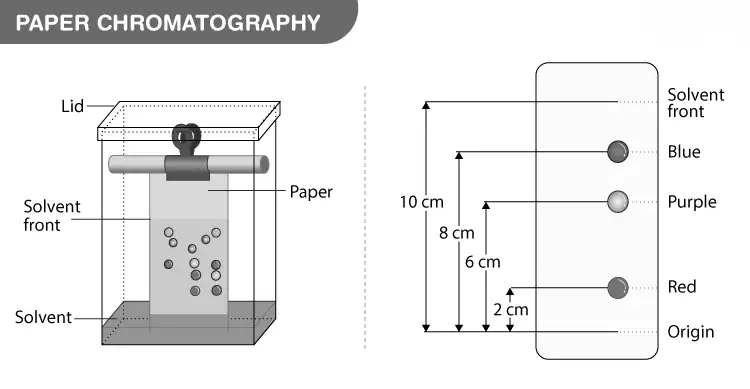
Illustration showing the setup and process of paper chromatography
Example: In an experiment, a student spots a mixture of three pigments on filter paper and uses a solvent system of 70% ethanol. After 30 minutes, the solvent front has moved 12 cm, and the pigments have traveled 3 cm, 6 cm, and 9 cm respectively. Calculate the \( R_f \) values for each pigment.
Solution: The retention factor \( R_f \) is calculated as:
\[ R_f = \frac{\text{Distance travelled by substance}}{\text{Distance travelled by solvent front}} \]
For pigment 1:
\[ R_f = \frac{3}{12} = 0.25 \]
For pigment 2:
\[ R_f = \frac{6}{12} = 0.50 \]
For pigment 3:
\[ R_f = \frac{9}{12} = 0.75 \]
These values help identify the pigments based on known standards.
Varieties and Practical Uses of Paper Chromatography
Different Modes and Their Applications
Paper chromatography can be performed in several formats depending on the direction and pattern of solvent movement:
Ascending Chromatography: The solvent moves upward against gravity, carrying the sample components along the paper.
Descending Chromatography: The solvent flows downward due to gravity and capillary action, useful for longer separation paths.
Ascending-Descending Chromatography: The solvent initially moves upward and then downward after passing over a support rod, combining both directions for enhanced separation.
Radial (Circular) Chromatography: The sample is placed at the center of a circular paper, and solvent moves outward radially, allowing multi-directional separation.
Two-Dimensional Chromatography: This technique separates substances with similar \( R_f \) values by running the chromatogram in two perpendicular directions using different solvents.
Paper chromatography finds extensive use in various fields such as analyzing food colorants, detecting adulterants in beverages, studying biochemical reaction mixtures, and verifying pharmaceutical purity.
Example: A forensic scientist uses two-dimensional paper chromatography to separate components of a complex ink mixture. Explain why this method is preferred over one-dimensional chromatography in this case.
Solution: Two-dimensional chromatography allows separation of compounds that have similar \( R_f \) values in one solvent system by running the chromatogram in a second solvent system perpendicular to the first. This enhances resolution and helps distinguish components that would otherwise overlap in one-dimensional chromatography.
Quick Reference: Key Points on Paper Chromatography
Aspect | Details |
|---|---|
Stationary Phase | Water trapped in cellulose fibers of filter paper |
Mobile Phase | Solvent or solvent mixture moving through paper |
Separation Principle | Partition and adsorption chromatography |
Common Types | Ascending, Descending, Radial, Two-Dimensional |
Applications | Food analysis, drug testing, biochemical studies, purity checks |
Advantages | Simple, cost-effective, requires small sample amounts |
Limitations | Not suitable for large samples or complex mixtures, less quantitative |
Visualization | Detecting reagents or UV light for spot identification |
Retention Factor (\( R_f \)) | Ratio of distance travelled by substance to solvent front |
Discovery | Developed by Synge and Martin in 1943 |
Glossary of Essential Terms
Term | Definition |
|---|---|
Adsorption | Process where molecules adhere to a surface |
Capillary Action | Movement of liquid through narrow spaces without external forces |
Chromatogram | Visual output showing separated components on paper |
Mobile Phase | Solvent that moves through the stationary phase carrying substances |
Partition Chromatography | Separation based on distribution between two liquid phases |
Retention Factor (\( R_f \)) | Ratio of distance travelled by a substance to solvent front distance |
Stationary Phase | Phase that remains fixed, here water in paper fibers |
Solvent Front | Leading edge of the solvent as it moves through the paper |
Two-Dimensional Chromatography | Technique involving two solvent systems applied perpendicularly |
Filter Paper | Special paper used as stationary phase in chromatography |
Frequently Asked Questions
What benefits does paper chromatography offer compared to other methods?
Paper chromatography is simple, quick, and requires only small sample quantities. It is cost-effective and can separate both organic and inorganic compounds with good resolution, making it accessible for many laboratories.
Why is water generally avoided as a mobile phase solvent in paper chromatography?
Water is highly polar and tends to retain polar compounds on the paper, limiting their movement. Using less polar solvents like ethanol allows non-polar substances to travel farther, improving separation efficiency.
What are the main drawbacks of paper chromatography?
This technique is not suitable for analyzing large sample volumes or complex mixtures. It is less precise for quantitative analysis and offers lower accuracy compared to advanced methods like HPLC or HPTLC.
How is paper chromatography important in food industry analysis?
It helps identify and quantify food colorants and additives, ensuring only permitted substances are present. This safeguards consumer health by detecting unauthorized or harmful compounds.
Is paper chromatography classified as partition or adsorption chromatography?
Paper chromatography primarily functions as a type of partition chromatography, where substances distribute between the stationary water phase and the mobile solvent phase.