Fundamentals and Techniques of Metallurgical Processes
Overview of Metal Extraction and Refinement
Understanding Metallurgy and Its Core Concepts
Metallurgy is the science and technology concerned with extracting metals from their natural mineral forms and refining them into pure metals. Minerals, which are compounds containing metals combined with earth materials like sand, limestone, and rocks, serve as the primary source. When these minerals contain sufficient metal content to be economically extracted, they are called ores. To facilitate the removal of unwanted impurities, substances known as fluxes are added during processing. Metallurgy encompasses both the purification of metals and the creation of alloys to enhance their properties.
Example: Consider an ore containing iron mixed with sand and limestone. The flux added during smelting helps bind the impurities, forming slag, which can be separated easily, leaving behind purified iron.
Stepwise Procedures in Metal Extraction
Initial Ore Preparation: Crushing and Grinding
The first stage in metal extraction involves breaking down the ore into fine particles through crushing and grinding. This pulverization increases the surface area, making subsequent processes more efficient. Crushers or ball mills are typically used to achieve this fine powder form.
Example: If 500 kg of ore is crushed to particles averaging 0.5 mm diameter, the increased surface area significantly improves the efficiency of the next concentration step.
Enhancing Ore Quality: Concentration Techniques
Concentration, or ore dressing, is the process of separating valuable metal-bearing particles from the surrounding impurities. Several methods are employed depending on the ore's nature:
Hydraulic Washing: Ore is passed over a sloped, vibrating table with grooves while water flows over it. Denser metal particles settle in grooves, while lighter impurities are washed away.
Magnetic Separation: Crushed ore is transported on a conveyor belt passing over a magnetic wheel. Magnetic particles adhere to the wheel and separate from non-magnetic waste.
Froth Flotation: Crushed ore is mixed with oil and water in a tank, and compressed air is bubbled through. Metal particles attach to oil droplets and rise as froth, separating from impurities.
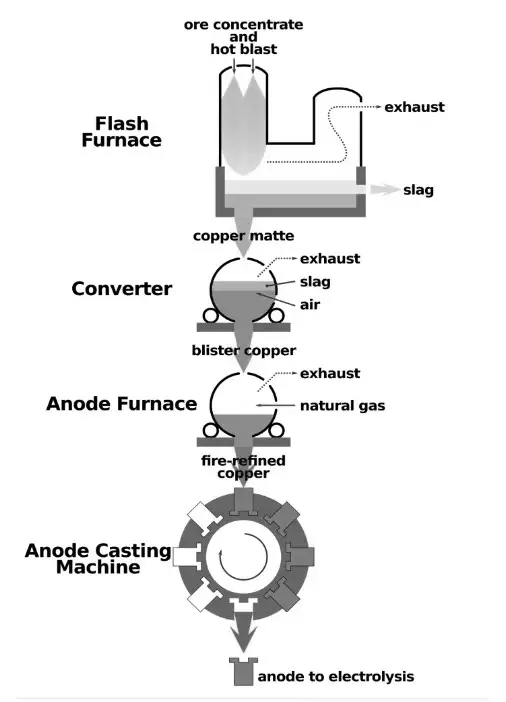
Illustration of Copper Flash Smelting Process
Example: A sample of ore containing 60% metal is subjected to froth flotation, resulting in a concentrate with 85% metal content. Calculate the percentage increase in metal concentration.
Solution:
Initial metal content = 60%
Final metal content = 85%
Increase = 85% - 60% = 25%
Percentage increase = \( \frac{25}{60} \times 100 = 41.67\% \)
Thermal Treatment: Roasting and Calcination
Heating concentrated ores is essential to prepare them for metal extraction. Two main heating processes are:
Roasting: Heating sulfide ores in the presence of oxygen to convert them into oxides and release sulfur dioxide.
Calcination: Heating carbonate or hydrated oxide ores in the absence of air to remove volatile components and convert them into oxides.
Example: When zinc carbonate ore is heated in the absence of air, it undergoes calcination. Write the chemical equation for this process.
Solution:
\[ \text{ZnCO}_3 \xrightarrow{\text{heat}} \text{ZnO} + \text{CO}_2 \]
Fundamental Principles Guiding Metallurgical Operations
Purification and Refining of Metals
After extraction, metals often contain impurities such as carbon, phosphorus, and silicon. Refining processes are employed to remove these contaminants and obtain metals of high purity. The choice of refining method depends on the metal and the nature of impurities. Electrolytic refining is widely used for its efficiency and ability to produce very pure metals.
Example: Copper obtained from smelting contains impurities. Electrolytic refining uses an impure copper anode and a pure copper cathode in an electrolyte solution. Over time, pure copper deposits on the cathode, leaving impurities behind.
Reduction Methods in Metal Extraction
Reduction is the chemical process of extracting metal from its ore by removing oxygen or other elements. Common reduction techniques include:
Using coke as a reducing agent in blast furnaces.
Thermal decomposition of molten salts to liberate metals.
Example: Iron oxide is reduced to iron using coke in a blast furnace. Write the simplified chemical reaction.
Solution:
\[ \text{Fe}_2\text{O}_3 + 3\text{C} \rightarrow 2\text{Fe} + 3\text{CO} \]
Smelting: Extracting Metals by Heat
Smelting involves heating ores to high temperatures to separate the base metal from impurities. It is a key step in extractive metallurgy for metals like silver, copper, and iron. The process often involves the addition of flux to bind impurities and form slag.
Example: In copper smelting, copper sulfide ore is heated with oxygen, producing copper and sulfur dioxide gas.
Reaction:
\[ 2\text{Cu}_2\text{S} + 3\text{O}_2 \rightarrow 2\text{Cu}_2\text{O} + 2\text{SO}_2 \]
Quick Reference: Summary of Metallurgical Processes
Process | Description | Purpose |
|---|---|---|
Crushing & Grinding | Breaking ore into fine particles | Increase surface area for processing |
Concentration | Separating metal-rich particles from impurities | Enhance ore quality |
Roasting | Heating sulfide ores in air | Convert sulfides to oxides |
Calcination | Heating carbonate ores without air | Remove volatile components |
Reduction | Removing oxygen from metal oxides | Extract pure metal |
Refining | Purifying extracted metals | Obtain high purity metal |
Smelting | Heating ore with flux | Separate metal from impurities |
Glossary of Key Metallurgical Terms
Term | Definition |
|---|---|
Alloy | A mixture of two or more metals to improve properties |
Concentration | Process of increasing metal content by removing impurities |
Flux | Substance added to bind impurities during smelting |
Gangue | Non-metallic impurities present in ore |
Ore | Mineral containing metal in sufficient quantity for extraction |
Pulverization | Crushing and grinding ore into fine powder |
Roasting | Heating sulfide ores in presence of oxygen |
Calcination | Heating carbonate ores in absence of air |
Reduction | Removal of oxygen from metal oxides to obtain metal |
Smelting | Heating ore with flux to extract metal |
Frequently Asked Questions on Metallurgical Processes
What are the main methods used for concentrating ores?
The primary ore concentration techniques include hydraulic washing, magnetic separation, and froth flotation, each suited to different ore types and impurity characteristics.
How do roasting and calcination differ?
Roasting involves heating sulfide ores in the presence of air to convert them into oxides, while calcination heats carbonate or hydrated oxide ores in the absence of air to remove volatile substances.
Why is refining necessary after metal extraction?
Extracted metals often contain impurities that affect their properties. Refining removes these contaminants to produce metals suitable for industrial and commercial use.
What role does reduction play in metallurgy?
Reduction chemically removes oxygen or other elements from metal compounds, enabling the extraction of pure metals from their ores.
Can you explain what smelting entails?
Smelting is the process of heating ores with flux to separate the base metal from impurities, often producing slag and releasing gases like sulfur dioxide.