Fundamentals of Nuclear Chemistry and Radiation
Introduction to Nuclear Chemistry
Understanding the Scope of Nuclear Chemistry
Nuclear chemistry explores the chemical and physical characteristics of elements influenced by alterations in the atomic nucleus. This branch also investigates the energy released during nuclear transformations and its practical applications. Often referred to as radiochemistry, it encompasses the study of element formation in the cosmos, the development of radioactive pharmaceuticals for medical diagnostics, and various other technological uses.
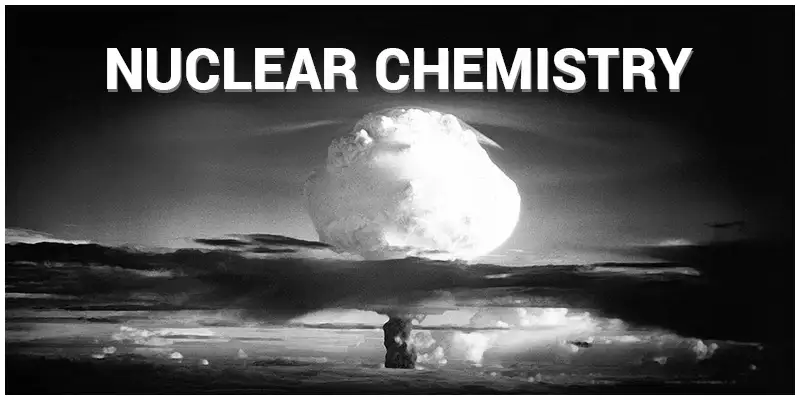
Visual representation of Nuclear Chemistry concepts
Example Problem
Explain why nuclear chemistry is essential in the development of diagnostic medicines.
Solution:
Nuclear chemistry enables the design of radioactive tracers that can target specific organs or tissues.
These tracers emit radiation detectable by imaging devices, allowing non-invasive diagnosis.
The understanding of nuclear decay and radiation types ensures safe and effective use in medicine.
Radioactive Emissions and Their Characteristics
Classification of Nuclear Radiations
In 1902, Ernest Rutherford distinguished three types of radioactive emissions by observing their deflection in an electric field. The particles that curved towards the negatively charged plate carried a positive charge and were named alpha particles. Those deflected towards the positively charged plate were negatively charged beta particles. The third type, which passed straight without deflection, was identified as gamma rays, which are electrically neutral.
Deflection patterns of alpha, beta, and gamma radiations in an electric field
Example Problem
Describe how alpha, beta, and gamma radiations differ in terms of charge and deflection in an electric field.
Solution:
Alpha particles have a positive charge and bend towards the negative plate.
Beta particles carry a negative charge and curve towards the positive plate.
Gamma rays are neutral and travel straight without deflection.
Types of Nuclear Radiations and Their Effects
Alpha Radiation and Its Impact
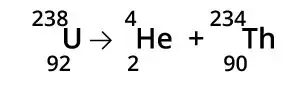
Alpha radiation involves the emission of alpha particles, each consisting of two protons and two neutrons, resembling a helium nucleus (\(^{4}_{2}\text{He}\)). When an atom emits an alpha particle, its atomic mass decreases by 4 units, and the atomic number reduces by 2, leading to the formation of a new element.
Emission of alpha particles from an atomic nucleus
Example Problem
An isotope of uranium-238 undergoes alpha decay. Write the nuclear equation for this process and identify the resulting element.
Solution:
The alpha decay of uranium-238 can be represented as:
\[ {}^{238}_{92}\text{U} \rightarrow {}^{234}_{90}\text{Th} + {}^{4}_{2}\text{He} \]
The atomic mass decreases by 4 units (238 to 234).
The atomic number decreases by 2 (92 to 90), changing uranium to thorium.
Beta Radiation and Its Characteristics
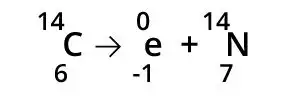
Beta radiation occurs when an atom emits a beta particle, which is an electron or positron. Unlike alpha decay, beta emission does not change the atomic mass but increases the atomic number by one, transforming the element into its next higher atomic number counterpart.
Beta particle emission from an atomic nucleus
Example Problem
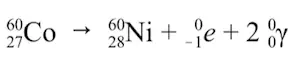
Cobalt-60 undergoes beta decay. Write the nuclear equation and state the new element formed.
Solution:
\[ {}^{60}_{27}\text{Co} \rightarrow {}^{60}_{28}\text{Ni} + \beta^{-} \]
The atomic mass remains 60.
The atomic number increases from 27 to 28, changing cobalt to nickel.
Gamma Radiation and Its Nature
Gamma radiation is the emission of high-energy electromagnetic waves from the nucleus. Unlike alpha and beta emissions, gamma rays do not involve particle emission and therefore do not alter the atomic number or mass of the atom. They often accompany other types of decay to release excess energy.
Example Problem
Explain why gamma radiation does not cause transmutation of elements.
Solution:
Gamma rays are pure energy waves without mass or charge.
They do not change the number of protons or neutrons in the nucleus.
Hence, the element's identity remains unchanged after gamma emission.
Artificially Induced Nuclear Reactions
Nuclear Fission: Splitting the Atom
Nuclear fission is a process where a heavy atomic nucleus divides into smaller nuclei, releasing a significant amount of energy. This reaction is harnessed in nuclear reactors and atomic bombs. The energy released is due to the mass difference converted into energy according to Einstein’s equation.
Example Problem
In a fission reaction, uranium-235 absorbs a neutron and splits into barium-141, krypton-92, and additional neutrons. Write the balanced nuclear equation for this reaction.
Solution:
\[ {}^{1}_{0}\text{n} + {}^{235}_{92}\text{U} \rightarrow {}^{141}_{56}\text{Ba} + {}^{92}_{36}\text{Kr} + 3\,{}^{1}_{0}\text{n} \]
The sum of atomic numbers on both sides: \(0 + 92 = 56 + 36 + 0\)
The sum of mass numbers: \(1 + 235 = 141 + 92 + 3 \times 1\)
Nuclear Fusion: Combining Nuclei
Nuclear fusion involves the merging of two light atomic nuclei to form a heavier nucleus, releasing enormous energy. This process powers stars, including the sun, and is being researched for clean energy production on Earth.
Example Problem
Deuterium (\(^{2}_{1}\text{H}\)) and tritium (\(^{3}_{1}\text{H}\)) nuclei fuse to form helium-4 and a neutron. Write the nuclear equation for this fusion reaction.
Solution:
\[ {}^{2}_{1}\text{H} + {}^{3}_{1}\text{H} \rightarrow {}^{4}_{2}\text{He} + {}^{1}_{0}\text{n} + \text{energy} \]
Atomic numbers: \(1 + 1 = 2 + 0\)
Mass numbers: \(2 + 3 = 4 + 1\)
Quick Reference Summary
Concept | Description | Effect on Atom |
|---|---|---|
Alpha Radiation | Emission of \(^{4}_{2}\text{He}\) nucleus | Atomic mass decreases by 4, atomic number decreases by 2 |
Beta Radiation | Emission of electron or positron | Atomic mass unchanged, atomic number increases by 1 |
Gamma Radiation | Emission of electromagnetic waves | No change in atomic mass or number |
Nuclear Fission | Splitting of heavy nucleus into smaller nuclei | Releases large energy, changes elements |
Nuclear Fusion | Combination of light nuclei to form heavier nucleus | Releases large energy, forms new element |
Glossary of Key Terms
Term | Definition |
|---|---|
Alpha Particle | A helium nucleus emitted during alpha decay, consisting of 2 protons and 2 neutrons. |
Beta Particle | An electron or positron emitted during beta decay. |
Gamma Rays | High-energy electromagnetic radiation emitted from a nucleus. |
Nuclear Fission | Process of splitting a heavy nucleus into smaller nuclei with energy release. |
Nuclear Fusion | Process of combining light nuclei to form a heavier nucleus with energy release. |
Atomic Number | Number of protons in the nucleus of an atom. |
Atomic Mass | Total number of protons and neutrons in an atomic nucleus. |
Radiochemistry | Branch of chemistry dealing with radioactive substances and nuclear processes. |
Transmutation | Conversion of one chemical element into another through nuclear reactions. |
Radioactive Decay | Spontaneous transformation of an unstable nucleus into a more stable one. |
Frequently Asked Questions
What distinguishes nuclear chemistry from regular chemistry?
Nuclear chemistry focuses on changes in the atomic nucleus and the energy released, unlike regular chemistry which deals with electron interactions and chemical bonds.
Why does alpha decay reduce the atomic mass and number?
Because an alpha particle contains 2 protons and 2 neutrons, its emission decreases the atomic mass by 4 and atomic number by 2.
Can gamma radiation change one element into another?
No, gamma rays are energy emissions without particles, so they do not alter the atomic number or mass.
How is nuclear fission utilized in power generation?
Fission reactions release large amounts of energy used to produce steam that drives turbines for electricity generation.
What makes nuclear fusion a potential clean energy source?
Fusion produces vast energy with minimal radioactive waste, making it a promising clean energy option.