Understanding Colloids: Types, Properties, and Examples
Fundamentals of Colloidal Systems
Defining Colloids and Their Characteristics
A colloid is a type of heterogeneous mixture where extremely small particles of one substance are evenly distributed throughout another substance, known as the dispersion medium. These particles typically range in size from 1 to 1000 nanometers in diameter. Despite their small size, these particles remain suspended and do not settle out over time, distinguishing colloids from true solutions and suspensions.
These dispersed particles can be observed using optical microscopes or, for even smaller particles, electron microscopes. The stability of colloids arises from the continuous dispersion of these particles within the medium, preventing sedimentation.
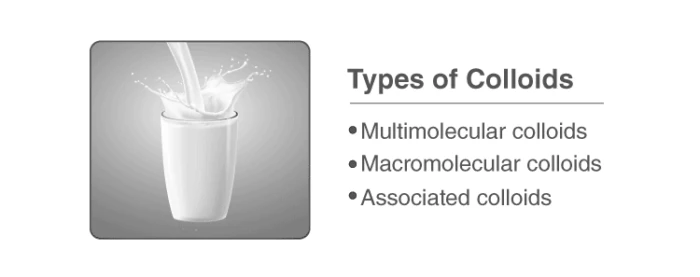
Illustration of Colloidal Dispersion
Example Problem
A mixture contains particles of diameter 500 nm dispersed in water. Explain why these particles do not settle down and how they differ from particles in a suspension.
Solution:
- The particle size of 500 nm lies within the colloidal range (1–1000 nm), which is small enough to remain suspended due to Brownian motion.
- Unlike larger particles in suspensions, these colloidal particles do not settle because the random motion counteracts gravitational forces.
- Thus, the mixture remains stable and homogeneous at the microscopic level, characteristic of colloids.
Components and Classification of Colloids
Dispersed Phase and Dispersion Medium Explained
In any colloidal system, the substance present as tiny particles is called the dispersed phase, while the substance in which these particles are distributed is termed the dispersion medium. The interaction between these two components determines the nature and stability of the colloid.
The size of the dispersed particles ranges from 1 to 1000 nanometers, which is crucial for the colloidal properties such as light scattering and stability.
Example Problem
Identify the dispersed phase and dispersion medium in a fog and explain their roles.
Solution:
- Fog consists of tiny water droplets dispersed in air.
- Here, water droplets form the dispersed phase, and air acts as the dispersion medium.
- The water droplets remain suspended due to their small size, creating the colloidal fog.
Classification Based on Particle Types
Colloids are categorized into three main types depending on the nature of the dispersed particles:
- Multimolecular Colloids: Formed by the aggregation of many small molecules or atoms into clusters within the colloidal size range.
- Macromolecular Colloids: Consist of large molecules such as polymers or proteins dissolved in a suitable solvent.
- Associated Colloids: Substances that behave as electrolytes at low concentrations but form micelles and exhibit colloidal properties at higher concentrations.
Example Problem
Classify the following colloids: a starch solution, a sulfur sol, and soap solution.
Solution:
- Starch solution is a macromolecular colloid because it contains large polymer molecules dispersed in water.
- Sulfur sol is a multimolecular colloid formed by clusters of sulfur atoms.
- Soap solution is an associated colloid as it forms micelles above a certain concentration.
Varieties of Colloids and Their Interactions
Physical State-Based Classification
Colloids can also be classified according to the physical states of the dispersed phase and the dispersion medium. Some common types include:
- Foams: Gas dispersed in a liquid or solid.
- Aerosols: Solid or liquid particles dispersed in a gas.
- Emulsions: Liquid dispersed in another liquid.
- Gels: Liquids dispersed in solids.
- Sols: Solid particles dispersed in liquids.
Example Problem
Identify the type of colloid formed when air bubbles are trapped in a solid substance like whipped cream.
Solution:
- Air (gas) is dispersed in a solid (cream), forming a foam.
- This is an example of a solid foam colloid.
Affinity-Based Classification: Lyophilic and Lyophobic Colloids
Colloids are further divided based on the affinity between the dispersed phase and the dispersion medium:
- Lyophilic Colloids: These have a strong attraction between dispersed particles and the medium, making them stable and easy to prepare. Examples include starch and proteins.
- Lyophobic Colloids: These have little or no affinity for the medium, making them unstable and difficult to prepare without stabilizers. Examples include sols of metals like gold and silver.
Example Problem
Explain why lyophobic colloids require stabilizing agents while lyophilic colloids do not.
Solution:
- Lyophobic colloids have weak interaction with the dispersion medium, causing particles to aggregate and settle.
- Stabilizing agents prevent aggregation by providing a protective layer around particles.
- Lyophilic colloids have strong affinity with the medium, naturally preventing coagulation and maintaining stability.
Summary Table for Quick Review
| Aspect | Description | Example |
|---|---|---|
| Dispersed Phase | Particles distributed in the medium, size 1–1000 nm | Water droplets in fog |
| Dispersion Medium | Substance in which particles are dispersed | Air in fog |
| Multimolecular Colloids | Clusters of atoms or molecules forming colloidal particles | Sulfur sol |
| Macromolecular Colloids | Large molecules dispersed in solvent | Starch solution |
| Associated Colloids | Form micelles at higher concentrations | Soap solution |
| Lyophilic Colloids | Strong affinity between dispersed phase and medium | Protein sol |
| Lyophobic Colloids | Weak affinity, unstable without stabilizers | Gold sol |
| Foam | Gas dispersed in liquid or solid | Whipped cream |
| Aerosol | Solid or liquid dispersed in gas | Smoke |
| Emulsion | Liquid dispersed in liquid | Milk |
Key Terms and Definitions
| Term | Meaning |
|---|---|
| Colloid | A heterogeneous mixture with particles dispersed in a medium, size 1–1000 nm |
| Dispersed Phase | The particles distributed throughout the dispersion medium |
| Dispersion Medium | The substance in which the dispersed phase is distributed |
| Multimolecular Colloid | Colloid formed by aggregation of many molecules or atoms |
| Macromolecular Colloid | Colloid consisting of large molecules like polymers |
| Associated Colloid | Colloid formed by micelle aggregation at higher concentrations |
| Lyophilic Colloid | Colloid with strong affinity between dispersed phase and medium |
| Lyophobic Colloid | Colloid with little or no affinity between dispersed phase and medium |
| Micelle | Aggregated particles formed in associated colloids |
| Kraft Temperature | The temperature above which micelles form in associated colloids |
Frequently Asked Questions
What distinguishes a colloid from a true solution?
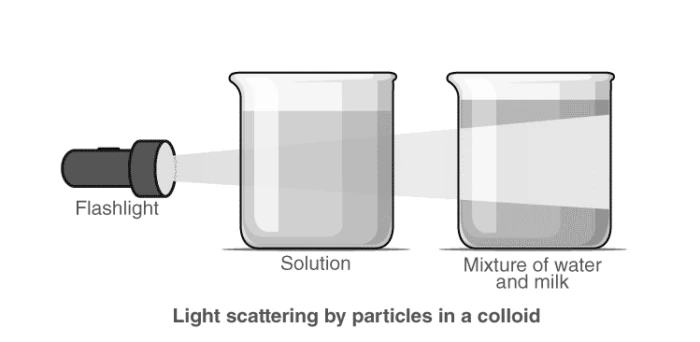
Colloids have larger particles (1–1000 nm) that remain suspended and scatter light, whereas true solutions have smaller particles that dissolve completely and do not scatter light.
Why do colloidal particles not settle down over time?
Because of their small size and continuous random motion (Brownian motion), colloidal particles remain suspended and do not settle under gravity.
What is the role of stabilizing agents in lyophobic colloids?
Stabilizing agents prevent aggregation of particles by forming protective layers, thus maintaining the stability of lyophobic colloids.
How are associated colloids different from other colloids?
Associated colloids form micelles at concentrations above the critical micelle concentration and behave like electrolytes at lower concentrations.
Can colloids be separated by filtration?
No, colloidal particles are too small to be separated by ordinary filtration but can be separated by ultrafiltration or centrifugation.