Comprehensive Overview of Carbohydrates: Structure, Types, and Functions
Fundamentals and Chemical Nature of Carbohydrates
Understanding the Basic Composition and Definition
Carbohydrates are organic molecules widely found in living organisms and foods, primarily existing as starch, cellulose, and various sugars. Their elemental composition features carbon, hydrogen, and oxygen atoms, with hydrogen and oxygen typically in a 2:1 ratio, mirroring that of water. This characteristic ratio is reflected in their general formula, often expressed as \( \mathrm{C_x(H_2O)_y} \), especially for simple sugars.
Originally, carbohydrates were thought to be simple "hydrates of carbon" due to this formula. However, modern chemistry classifies them based on their structural features rather than just empirical formulas. They are now recognized as polyhydroxy aldehydes or ketones, or compounds that yield such units upon hydrolysis. This group includes important biomolecules like cellulose, starch, and glycogen.
Example: Calculating the Molecular Formula of a Simple Sugar
Problem: A carbohydrate molecule contains 6 carbon atoms and follows the general formula \( \mathrm{C_x(H_2O)_y} \). Determine the molecular formula of this carbohydrate.
Solution: Given \( x = 6 \), the formula becomes \( \mathrm{C_6(H_2O)_y} \). Since each water unit contributes one oxygen and two hydrogens, the number of water units \( y \) equals the number of carbon atoms for simple sugars, so \( y = 6 \).
Therefore, the molecular formula is:
\[ \mathrm{C_6(H_2O)_6 = C_6H_{12}O_6} \]
This corresponds to common monosaccharides like glucose and fructose.
Classification and Structural Variations of Carbohydrates
Distinguishing Simple and Complex Carbohydrates
Carbohydrates are broadly categorized into simple and complex types based on their molecular structure and digestibility. Simple carbohydrates, also known as sugars, consist of one or two sugar units and are typically sweet and water-soluble. Examples include monosaccharides like glucose and fructose, and disaccharides such as sucrose and lactose.
Complex carbohydrates are polymers made up of many monosaccharide units linked together. These include oligosaccharides and polysaccharides like starch, glycogen, and cellulose. Complex carbs provide sustained energy as they take longer to break down during digestion.
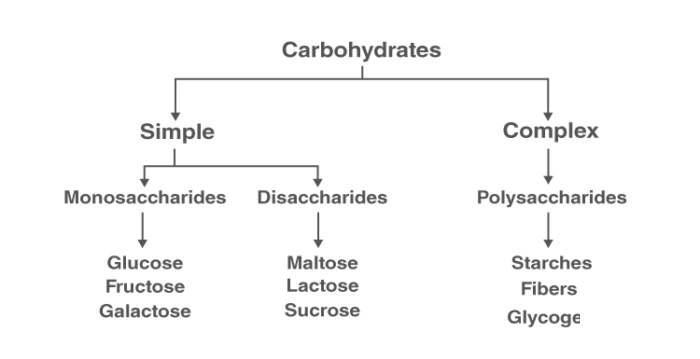
Diagram illustrating the classification of carbohydrates
Example: Identifying Carbohydrate Types in Foods
Problem: Classify the following foods as sources of simple or complex carbohydrates: honey, whole wheat bread, candy, and potatoes.
Solution:
Honey: Contains natural simple sugars (monosaccharides and disaccharides).
Whole wheat bread: Rich in complex carbohydrates (polysaccharides).
Candy: Primarily simple carbohydrates (processed sugars).
Potatoes: Mainly complex carbohydrates (starch).
This classification helps understand their digestion rates and energy release profiles.
Detailed Structures and Examples of Key Carbohydrates
Monosaccharides: Glucose and Fructose Structures
Monosaccharides are the simplest carbohydrates, consisting of a single sugar unit. They can be classified as aldoses if they contain an aldehyde group or ketoses if they have a ketone group. Glucose, an aldohexose, is a vital energy source and exists predominantly in a cyclic pyranose form in solution. The cyclic structure explains many of its chemical properties, including the existence of α and β anomers, which differ in the orientation of the hydroxyl group at the anomeric carbon.
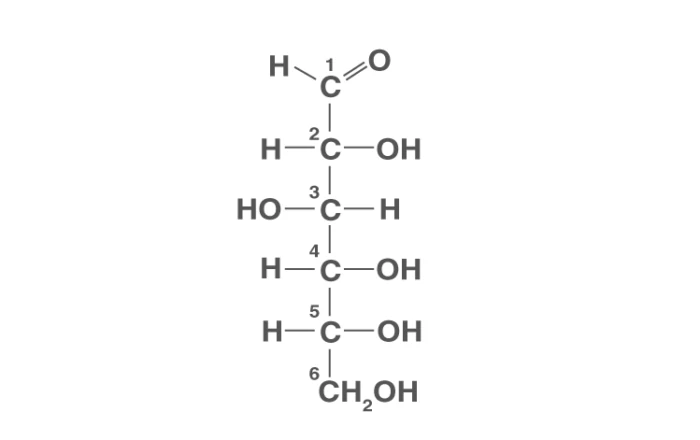
Molecular structure of glucose, a simple carbohydrate
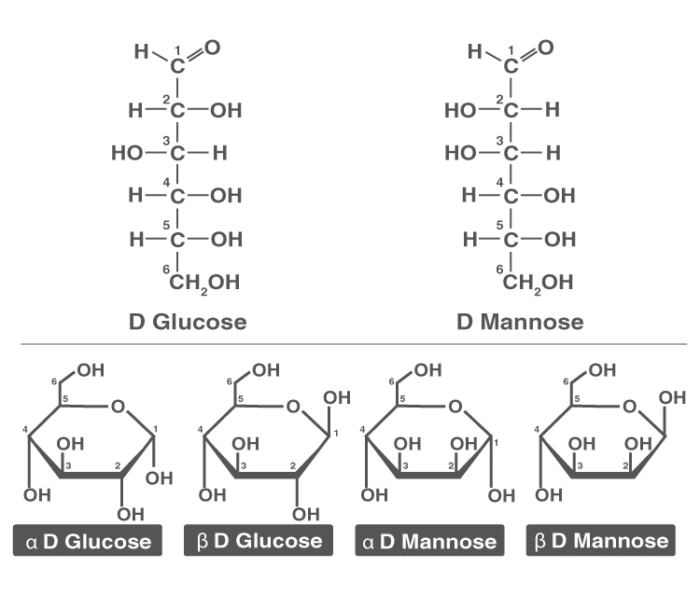
Cyclic pyranose form of glucose showing α and β anomers
Fructose, a ketohexose, contains a ketone group at the second carbon and typically forms a five-membered furanose ring in solution. It shares the molecular formula \( \mathrm{C_6H_{12}O_6} \) with glucose but differs structurally and functionally.
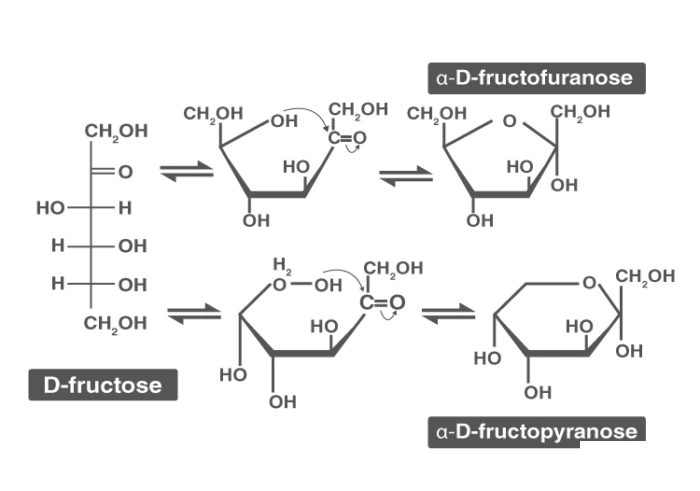
Furanose ring structure of fructose
Example: Hydrolysis of Sucrose into Monosaccharides
Problem: Sucrose is a disaccharide composed of glucose and fructose. Write the hydrolysis reaction of sucrose and identify the products.
Solution: Sucrose undergoes hydrolysis in the presence of dilute acid or the enzyme sucrase, breaking the glycosidic bond and yielding one molecule each of glucose and fructose.
Chemical equation:
\[ \mathrm{C_{12}H_{22}O_{11} + H_2O \xrightarrow{acid/enzyme} C_6H_{12}O_6 (glucose) + C_6H_{12}O_6 (fructose)} \]
This reaction is essential in digestion, allowing the body to absorb monosaccharides.
Polysaccharides: Structure and Biological Roles
Polysaccharides are large carbohydrate polymers formed by linking many monosaccharide units via glycosidic bonds. Starch, glycogen, and cellulose are prominent examples. Starch, the primary energy reserve in plants, consists of amylose and amylopectin, both polymers of α-glucose. Glycogen serves as the main carbohydrate storage in animals, found in liver and muscles. Cellulose, composed of β-glucose units, provides structural support in plant cell walls.
Illustration of polysaccharide structures such as starch and cellulose
Example: Comparing Energy Storage in Starch and Glycogen
Problem: Explain why glycogen is more suitable for rapid energy release in animals compared to starch in plants.
Solution:
Glycogen has a highly branched structure, increasing the number of terminal ends where enzymes can act simultaneously.
This branching allows faster mobilization of glucose units during energy demand.
Starch has fewer branches, resulting in slower glucose release.
Therefore, glycogen efficiently meets the quick energy needs of animals.
Quick Reference: Summary of Carbohydrate Essentials
Aspect | Details |
|---|---|
General Formula | \( \mathrm{C_x(H_2O)_y} \) for simple sugars |
Basic Units | Monosaccharides (single sugar units) |
Types | Simple (monosaccharides, disaccharides), Complex (polysaccharides) |
Examples of Monosaccharides | Glucose, Fructose |
Common Disaccharides | Sucrose, Lactose, Maltose |
Polysaccharides | Starch, Glycogen, Cellulose |
Primary Functions | Energy source, energy storage, structural components |
Sources in Diet | Fruits, grains, vegetables, dairy products |
Hydrolysis Products | Monosaccharides |
Glycosidic Bond | Linkage between sugar units in disaccharides and polysaccharides |
Glossary of Key Terms Related to Carbohydrates
Term | Definition |
|---|---|
Monosaccharide | The simplest form of carbohydrate consisting of a single sugar unit. |
Disaccharide | A carbohydrate composed of two monosaccharide units linked by a glycosidic bond. |
Polysaccharide | Large carbohydrate polymers made of many monosaccharide units. |
Glycosidic Bond | Covalent bond that connects sugar units in carbohydrates. |
Aldose | Monosaccharide containing an aldehyde functional group. |
Ketose | Monosaccharide containing a ketone functional group. |
Anomers | Isomers of cyclic sugars differing in the configuration at the anomeric carbon. |
Hydrolysis | Chemical process of breaking down compounds by reaction with water. |
Starch | Plant storage polysaccharide composed of amylose and amylopectin. |
Glycogen | Animal storage polysaccharide, highly branched glucose polymer. |
Frequently Asked Questions About Carbohydrates
What are carbohydrates and why are they important?
Carbohydrates are organic compounds made of carbon, hydrogen, and oxygen. They serve as the primary energy source for the body and are essential for various biological functions.
Which foods are rich sources of carbohydrates?
Common carbohydrate-rich foods include fruits, vegetables, grains, dairy products, and legumes. Processed foods like candies and soft drinks also contain carbohydrates, mostly simple sugars.
How do simple and complex carbohydrates differ?
Simple carbohydrates consist of one or two sugar units and are quickly digested, providing rapid energy. Complex carbohydrates are long chains of sugars that digest slowly, offering sustained energy.
What is the role of glycogen in the body?
Glycogen is the storage form of glucose in animals, primarily found in liver and muscles. It provides a readily available energy reserve during physical activity or fasting.
How are carbohydrates digested and absorbed?
Carbohydrates are broken down by enzymes into monosaccharides during digestion, which are then absorbed into the bloodstream for use as energy or storage.