Understanding Transpiration in Plants: Mechanisms and Importance
Fundamentals of Water Loss in Plants
What is Transpiration and Its Biological Role?
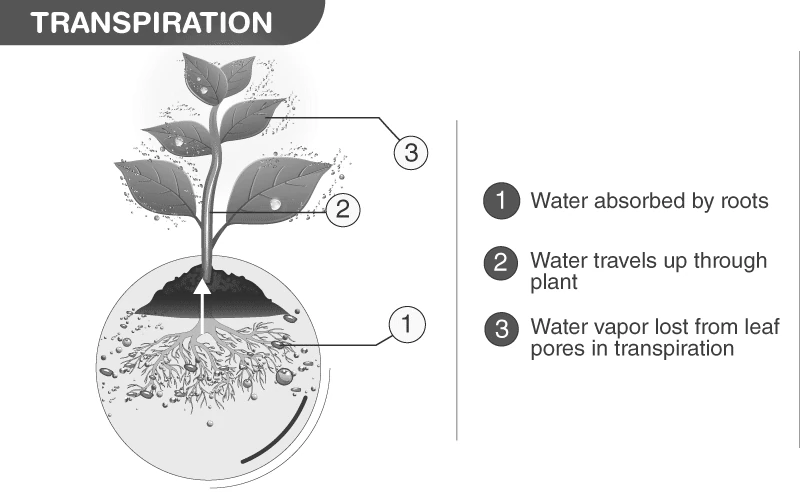
Transpiration is a vital physiological process in plants where water is released as vapor from the above-ground parts, primarily leaves. This mechanism helps plants eliminate surplus water absorbed from the soil, maintaining internal water balance and supporting various metabolic activities.
Although plants absorb large quantities of water, only a small fraction is used for growth and cellular functions; the majority is lost through transpiration.
Diagram illustrating the transpiration process in plants
Varieties of Transpiration in Plants
Different Modes of Water Vapor Loss
Plants lose water vapor through three primary pathways, each contributing differently to the overall transpiration rate.
Stomatal Transpiration
This is the predominant form of transpiration, occurring through tiny pores called stomata located mainly on the leaf surfaces. When stomata are open, water evaporates from the moist internal leaf tissues into the atmosphere.
Influences on the Rate of Transpiration
Internal and External Factors Affecting Water Loss
The speed at which transpiration occurs depends on several cellular and environmental variables that regulate water movement and evaporation.
Cellular Determinants
Key internal factors include leaf orientation, water content within the plant, leaf structural features, and the number and distribution of stomata. These characteristics influence how readily water vapor escapes from the plant.
Environmental Conditions
External elements such as light intensity, humidity, temperature, air movement, atmospheric pressure, and soil water availability significantly impact transpiration rates.
Effect of Relative Humidity
Relative humidity measures the water vapor concentration in the air relative to saturation at a given temperature. Transpiration decreases as humidity rises because the air holds more moisture, reducing the vapor pressure gradient.
Temperature Influence
Higher temperatures lower relative humidity and stimulate stomatal opening, thereby increasing transpiration. Even in darkness, elevated temperatures can cause stomata to open.
Role of Light
Light triggers stomatal opening, enhancing transpiration during the day. At night, stomata generally close, reducing water loss.
Impact of Air Movement
Still air causes water vapor to accumulate near leaf surfaces, lowering transpiration. Conversely, wind removes saturated air, increasing the rate of water loss.
Water Availability in Soil
When soil moisture is abundant, roots absorb more water, supporting higher transpiration. Scarcity of water leads to stomatal closure and wilting, decreasing transpiration.
Leaf Surface Area
Leaves with larger surface areas transpire more due to greater exposure to air and sunlight.
Mechanisms Supporting Water Movement and Stomatal Function
How Transpiration Drives Water Ascent
Water evaporation from leaves creates a negative pressure known as transpiration pull, which draws water upward through the xylem vessels from roots to leaves. This movement relies on water's cohesive and adhesive properties, as well as surface tension.
Cohesion: Attraction between water molecules helps maintain a continuous water column.
Adhesion: Water molecules adhere to xylem walls, aiding upward movement.
Surface Tension: Water molecules at the liquid-gas interface resist separation, supporting the water column.
Regulation of Stomatal Aperture
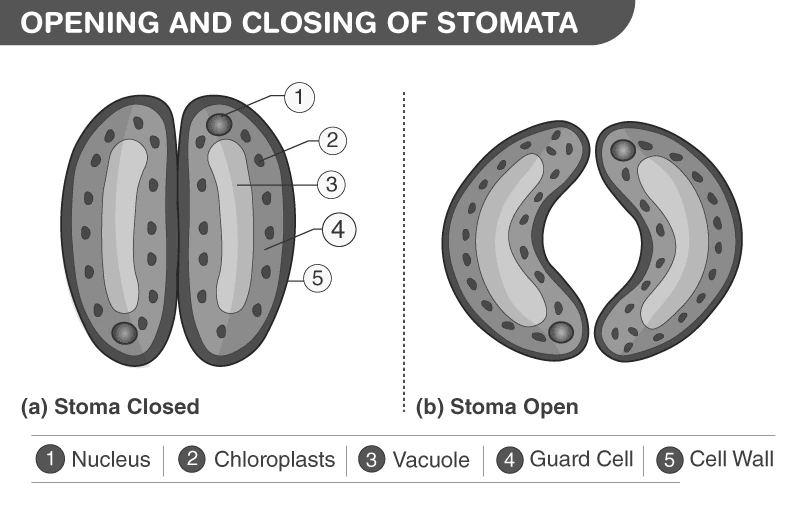
Stomata consist of two guard cells surrounding a pore. Their opening and closing depend on the turgidity of these cells, which changes with water content.
When guard cells absorb water, they swell, causing the stomatal pore to open. The inner walls of guard cells are thicker and less flexible, so swelling causes the cells to curve outward, enlarging the aperture. Conversely, water loss causes guard cells to become flaccid, closing the pore.
The orientation of cellulose microfibrils in guard cells facilitates this movement, allowing efficient stomatal function.
Illustration of stomatal opening and closing controlled by guard cells
Example Problem
Explain how a decrease in water availability affects stomatal behavior and transpiration rate.
Solution:
Reduced water availability causes guard cells to lose turgor pressure.
Loss of turgidity leads to stomatal closure, minimizing water loss.
Consequently, transpiration rate decreases to conserve water.
Importance and Limitations of Transpiration
Benefits of Transpiration for Plant Health
Transpiration plays several critical roles in plant physiology:
Facilitates upward transport of water and dissolved minerals from roots to aerial parts.
Maintains water balance and cell turgidity, essential for structural support.
Generates transpiration pull, aiding in the ascent of sap through xylem vessels.
Helps regulate leaf temperature through evaporative cooling.
Supports metabolic processes by maintaining osmotic balance.
Drawbacks Associated with Transpiration
Despite its advantages, transpiration has some disadvantages:
Excessive water loss can lead to dehydration and wilting if not compensated by root absorption.
Energy is expended in absorbing and transporting large volumes of water.
Plants may absorb more water than necessary, leading to inefficiencies.
Example Problem
Describe two ways in which transpiration benefits plants and one potential disadvantage.
Solution:
Benefits: Transpiration helps in mineral transport and cooling of leaves.
Disadvantage: It can cause water loss leading to wilting during drought.
Quick Reference: Key Points on Transpiration
Aspect | Details |
|---|---|
Definition | Loss of water vapor from aerial parts of plants |
Major Types | Stomatal, Lenticular, Cuticular |
Primary Pathway | Stomatal transpiration (majority of water loss) |
Factors Affecting Rate | Leaf structure, humidity, temperature, light, air movement, water availability |
Stomatal Control | Guard cell turgidity regulates opening and closing |
Significance | Water transport, temperature regulation, maintaining cell turgor |
Disadvantages | Water loss leading to wilting, energy expenditure |
Glossary of Important Terms
Term | Meaning |
|---|---|
Transpiration | Evaporation of water vapor from plant surfaces |
Stomata | Microscopic pores on leaves for gas exchange |
Lenticels | Small openings in bark for gas exchange |
Cuticle | Waxy protective layer on leaf surface |
Guard Cells | Paired cells controlling stomatal aperture |
Transpiration Pull | Negative pressure driving water ascent in xylem |
Cohesion | Attraction between water molecules |
Adhesion | Attraction of water molecules to surfaces |
Relative Humidity | Percentage of moisture in air relative to saturation |
Turgidity | State of being swollen with water in cells |
Frequently Asked Questions
What is the process of transpiration in plants?
Transpiration is the process by which plants lose excess water as vapor from their aerial parts, mainly leaves, helping maintain water balance.
Which types of transpiration occur in plants?
Plants exhibit stomatal, lenticular, and cuticular transpiration, with stomatal being the most significant.
How do stomata regulate water loss?
Stomata open when guard cells are turgid, increasing transpiration, and close when guard cells lose water, reducing water loss.
Why is transpiration essential for plants?
It aids in water and mineral transport, maintains cell rigidity, and cools the plant through evaporation.
What are the negative effects of transpiration?
Excessive transpiration can cause water deficiency, leading to wilting and reduced growth.